Photo: oopnm.ru
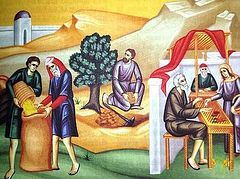
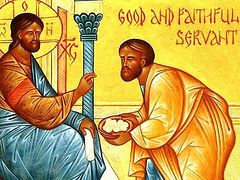
I believe the general meaning of the Parable of the Talents is clear to everyone. The Lord shows us that a person who desires to use his life for good must cultivate what has been given him by God—to multiply his talents in every sense of the word. This life’s labor returns to him a hundredfold, as a reward in eternal life above all, and for many, even in this life as well—in the form of inner spiritual wealth and steadfastness, which no one can take away.
At the same time, this parable also speaks of the person who, for some reason, refuses to accept God’s gift. Such a person acts wrongly and leads himself toward destruction. This kind of behavior—speaking in modern terms, “downshifting,”—the avoidance of possible realization of what God has given you, is not only a poor use of one’s life here and now, but a threat to one’s very life in eternity.
Beyond these obvious points, we can draw other conclusions as well.
The first is this: We must pay attention to the fact that God gives talents unequally—to one He gives five, to another three, to another two, and to the last, one. The inequality that we see here on earth is not only in material wealth, but also in gifts, in the paths of human lives, and in the opportunities that are available to people from the outset. And this inequality is not the result of some worldly injustice, but a divine arrangement.
Therefore, it would be wrong to strive to make everyone equal—not only in a crude material or socio-political sense, as the organizers of the French or Russian revolutions attempted to do—but even to attempt equality in the realm of spiritual life, in the inner being of man.
One should not imagine the Kingdom of Heaven as some place where everyone marches in formation and dwells in the same rank among the saved righteous. The Apostle Paul teaches that in the Kingdom of Heaven, one star differeth from another star in glory (1 Cor. 15:41). The righteous will dwell there not because they have reached some standard level—like +30 or +50 degrees—but because they have revealed within themselves the fullness and greatness of the image and likeness of God.
In this sense, they do not become like soldiers or policemen in uniform, but, on the contrary, they become maximally dissimilar from one another, having attained the highest degree of individuality possible for a person who has discovered and cultivated the talent given to him by God. Perhaps they resemble one another in ascetic struggle—but at the same time, they attain absolute personal individuality.
You cannot line up the righteous in military ranks.
This becomes clear even if we consider it from the opposite side: In sin, a person loses individuality and becomes like a herd animal, reduced to common base instincts shared by all, ready to chant slogans with the crowd—forgetting that, as an individual, he bears his own talent before God.
If we believe in God, who is Love and perfect Wisdom, then we must accept that He knows to whom He gives five talents, to whom three, and to whom one. Each person may use them for good or for evil. For receiving five talents does not guarantee their fulfillment. And if the one who received only one talent puts it to use, he may develop it and gain even more than the one who was initially given many, but buried all of them in the ground.
The New Testament tells us that it is hard for a rich man to enter into the Kingdom of Heaven (Lk. 18:25). Continuing that Gospel thought, we can also say: It is not easy for those who are very gifted, successful, beautiful, or prosperous to enter the Kingdom of Heaven. The Gospel indeed warns us about this.
But today’s parable warns us of something else as well: You can lose your soul even if you possess very little. One may be an ordinary person, unremarkable, not wealthy, not talented, possessing nothing much of value—and still perish. This can happen if one decides that what little one has, received from God, is too risky to touch, that it’s better to put it away in a box and do nothing with one’s life, and simply coast along by inertia up to the Kingdom of Heaven. But even if you have very little, you must labor over it. This is the clear command of today’s Gospel.
Why, ultimately, did the man who received one talent perish?
Because he formed within himself a false image of his Master—an idea unsupported by the word of God—about the One who had given him the talent in the first place.
The Gospel says that the master who distributed the talents was good, that he gave the gifts out of his own love. We see nothing to indicate that he was harsh or cruel, that he gave them with ulterior motives or out of indifference. But the one who received one talent did not reflect on the fact that his portion had been given according to the law of goodness and love. Instead, he believed it was dangerous, and that the one who gave it to him was severe, and above all intent on punishing him.
One profound twentieth-century theologian noted with great accuracy that a person can go for decades thinking he is praying to God, while in reality, he is merely turning toward the holy corner of his house—and not remembering Christ at all, the Christ of the Gospel.
Another twentieth century writer, Maxim Gorky—who was by no means a theologian—in the book Childhood, (which most Russians read in school) writes that his grandfather and grandmother—remember?—had two different Gods. The grandfather’s God was stern and cruel, who punished even the slightest misstep. But the grandmother’s God was loving and gracious, who forgave everything, no matter what one had done.
But in fact, both the grandfather and the grandmother had created for themselves a kind of phantom, a god not based on the Gospel. Neither the teaching of a God who permits any sin, nor the image of a God as a harsh overlord who ruthlessly punishes, is founded in the Gospel—they are fabrications of people, who force their own preconceptions onto something that cannot be contained within human assumptions or limitations.
And so, we must, especially in light of today’s Gospel reading, reflect on whether our faith in God, our personal relationship with the Creator, is based not on what we imagine God to be (“I’d like God to be like this”), but on the objective witness of Divine Revelation, which, for the Christian, is always Holy Scripture.