“Much has been written and will continue to be written about him—and the more Siberia is populated, brought to life, and humanized, the higher and clearer will stand this apostolic figure.”
—I.A. Goncharov, Frigate “Pallada”
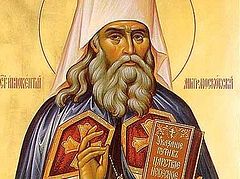
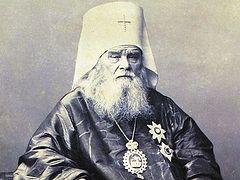
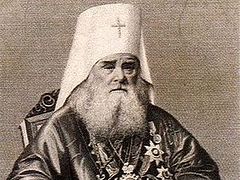
 Holy Hierarch Innocent (Veniaminov)
On September 23 / October 6, the Russian Orthodox Church commemorates the glorification of Saint Innocent (Veniaminov), Metropolitan of Moscow and Kolomna, Apostle to America and Siberia.
The saint’s life path was one of ceaseless and arduous labor—of his nearly eighty-two years of life, forty-five were spent on the road, preaching the Word of God to the peoples of the Far North of Russia, Alaska, and the Aleutian Islands. He revealed to those northern peoples the true spiritual image of the Russian soul—bringing with him culture, education, and enlightenment. There, he became a true expression of the great and expansive Russian heart, capable of embracing all and serving all with its generous compassion.
Saint Innocent (in the world: Ivan Evseyevich Popov) was born on August 26, 1797, in the village of Anga, in the Verkhne-Lena District of the Irkutsk Province, into the family of a church reader (psalomshchik) at the Church of the Holy Prophet Elias. When Ivan was five years old, his father began to teach him to read and write. In August of 1803, the Popov family suffered a great loss—the father died. The record in the parish register states, “Having confessed his sins, having communed of the Holy Mysteries, and been anointed with oil, he reposed at the age of forty.” His wife and four children were left in dire poverty. Orphaned at an early age, Ivan came to know want and hardship, and throughout his life he would carry with him a deep compassion for the suffering of others.
The young Ivan was taken in by his uncle, who continued his education. By age eight Ivan was already reading the Epistle in church—and his clear and thoughtful reading brought comfort to the faithful. At age nine, he was admitted to the Irkutsk Theological Seminary, where he studied for twelve long years. Recalling his childhood, he later wrote:
“I studied well, but until I left the seminary, I never tasted pure bread without husks.”
Ivan’s uncle, having been widowed, took monastic vows with the name David and was assigned to Irkutsk. In his spare time, Father David enjoyed working with mechanical devices, and young Ivan often helped him. This interest in applied sciences would prove very useful to Ivan in the years to come.
In 1814, the seminary rector began changing the surnames of some students. During his studies, Ivan’s surname was changed twice. At first, the name of his native village was added to his surname, making him Popov-Anginsky. But on June 8, 1814, Bishop Benjamin (Bagryansky) of Irkutsk and Nerchinsk reposed. In his memory, the rector gave Ivan the surname Veniaminov, in honor of the beloved and revered bishop.
In 1817, Ivan Veniaminov married for love and was soon ordained a deacon at the Church of the Annunciation in Irkutsk. After completing seminary, Fr. Ioann1 was appointed a teacher in the parish school. In 1821, he was ordained priest of that same Church of the Annunciation in Irkutsk. During his brief priestly ministry (just over two years), Fr. Ioann earned the love and respect of his parishioners.
In 1823, Bishop Michael (Burdukov) of Irkutsk and Nerchinsk (†1830) received a directive from the Holy Synod suggesting he appoint a priest to Unalaska Island, where a spiritual mission was being established to enlighten the native peoples with the light of Christ’s faith. No one volunteered to go—no one wanted to travel to such a distant land. Fr. Ioann also initially listed himself among those unwilling to go. But after hearing a report from a local Aleut native, Ivan Kryukov, about the Aleuts’ zeal for prayer and hearing the Word of God, Fr. Ioann changed his mind. His family had no idea how dramatically their life would change in the near future.
On May 7, 1823, Fr. Ioann departed from Irkutsk with his family, which at that time included his elderly mother, his wife, their one-year-old son Innokenty, and his nineteen-year-old brother Stefan. First, he traveled to his native village, and from there—after serving a moleben (a prayer service)—he set off on a pavozka (a type of barge) down the Lena River to Yakutsk. From Yakutsk, the journey continued to Okhotsk, located on the Sea of Okhotsk. The distance of a thousand versts (~1000 km) was covered on horseback, and on July 8, 1824, the family set sail from Okhotsk on the ship Rurik, bound for Unalaska Island.
On July 29, 1824, Fr. Ioann arrived safely at his appointed destination. At first, he and his family lived in a dugout shelter, and later in a modest wooden house built with his own hands. He crafted all their household items himself, including the wall clock. Fr. Ioann was a man of many trades: carpenter, clockmaker, mechanic, and even net-weaver for fishing. In the evenings, he and his children would cast wax candles for their church.
In his spare time, he loved to go on mountain walks with his children, and as an amateur naturalist, he would pass on his knowledge of nature to them.
Fr. Ioann’s parish consisted of sixty small islands on the border between the Bering Sea and the Pacific Ocean, the largest of which was Unalaska Island. That island alone had ten villages with no more than 400 people total. There was no church—only a dilapidated chapel. The new church, built by Fr. Ioann practically with his own hands, was dedicated to the Ascension of the Lord, and its consecration took place on June 29, 1826.
“It would be impossible to wish for a man of better morals, knowledge, noble character, and such diligence in his duties for this region than Fr. Ioann.” These were the words of praise by Matvey Ivanovich Muravyev, chief administrator of Russian America.2
The climate on Unalaska and across the Aleutian Islands was damp and unpredictable. Overcast skies, fog, and strong winds prevailed for most of the year, and there were no more than fifty clear days annually. Summers were not particularly warm, and in winter, the cold was so intense that birds would freeze in mid-flight.
“I can be very content with my present situation,” wrote Fr. Ioann upon his arrival to K.T. Khlebnikov, “for as long as I am healthy, I can be cheerful, peaceful, untroubled, and happy.”3
 Portrait of St. Innocent (1841) Fr. Ioann frequently undertook dangerous journeys from island to island, from village to village, in order to fulfill the spiritual needs of his scattered flock. He dedicated a significant portion of the year to these travels. His patience and fearlessness in these journeys are truly admirable. He would often cross the sea in a tiny kayak, so narrow that his legs had to be kept straight and tightly pressed together.
He was often caught en route in blizzards and storms, and had to spend the night in ravines or out in the tundra, digging himself a hole in the snow in which he would shelter for a day or two—or more—before continuing. He endured hunger, cold, pouring rain, and after being soaked to the bone, would sometimes take rest in a cold Aleut yurt.
After ten years on the islands, Fr. Ioann developed a chronic illness in his legs, which caused him constant pain for the rest of his life. His missionary labors were recognized by his diocesan authorities; he was awarded a gold pectoral cross.
As a true missionary deeply devoted to his calling, Fr. Ioann understood the importance of preaching the Word of God in the native language of the people. He immediately set about studying the Aleut language and developing a written form for it, since none yet existed. Using the Cyrillic script, he created an alphabet for the Aleut-Fox dialect and compiled a dictionary of 1,200 words. He then began teaching Aleut children reading and writing in a small school.
In his spare time, Fr. Ioann began translating sacred texts into the Aleut-Fox language. He translated the Catechism and the Gospel of Matthew, and later the Divine Liturgy. By 1830, he was able to preach fluently in the local language without an interpreter.
Fr. Ioann loved the Aleuts for their sincerity and eagerness to hear the Word of God. In a letter to Metropolitan Philaret (Drozdov; †1867) dated August 1, 1843, he wrote:
“The more I get to know the so-called “savages,” the more I love them, and the more I become convinced that we, with all our so-called enlightenment, have strayed far—very far—from the path of perfection, almost without noticing it; for many of the so-called savages are morally better than many of the so-called enlightened.”
In the winter of 1831–1833, Fr. Ioann wrote a small book in the Aleut language titled, A Guide to the Kingdom of Heaven. This book, which he wrote for the newly converted Aleuts to introduce them to the fundamentals of Christian salvation, became very popular. It was later translated into Church Slavonic and Russian, and went through forty-seven editions.
An indefatigable, perceptive, and intelligent observer, Fr. Ioann compiled various anthropological, ethnographic, geographic, and meteorological descriptions. These would later be collected into a three-volume work titled, Notes on the Islands of the Unalaska District, which has not lost its relevance even today. Several of his articles were translated into French and German. In recognition of his scholarly contributions, Fr. Ioann was elected a member by correspondence of the Russian Academy of Sciences.
In 1834, Fr. Ioann was assigned to Sitka Island—one of the largest islands of the Vancouver Archipelago, located off the southwestern coast of mainland Alaska. On Sitka, his primary mission was to bring the light of Christ’s Gospel to the proud and warlike native Tlingit people (referred to then as Kolosh).
The Tlingits were very different in both appearance and character from the Aleuts. By nature, they were proud, self-willed, and extremely vengeful. If a Tlingit was unable to avenge an offense during his lifetime, he would bequeath the obligation of vengeance to his descendants. Their conversion to Christianity proceeded very slowly.
Fr. Ioann began by studying their language and customs, and later began writing sermons in their native tongue. He sought to persuade rather than compel, and patiently awaited their voluntary desire to be baptized.
His research resulted in a treatise titled “Some Remarks on the Kolosh and Kodiak Languages,” to which he appended a dictionary of over one thousand words.
In addition to his missionary work, Fr. Ioann taught the natives carpentry and blacksmithing, and even instructed them in how to vaccinate against smallpox.
In his free time, he enjoyed craftsmanship. He built a clock for the bell tower above St. Michael’s Cathedral in New Archangel (now Sitka). For many years, this clock was considered a local landmark.
In 1836, Fr. Ioann traveled to California to visit Fort Ross—a Russian settlement founded in 1811 on the Pacific coast, approximately seventy miles north of San Francisco. It had been arranged that the fort’s chapel would be served by a visiting priest from Sitka.
Fr. Ioann spent a month at Fort Ross waiting for a ship to return to Sitka from San Francisco. During this time, he visited four Spanish missions. This was his first encounter with the Roman Catholic Church. Fr. Ioann appreciated the hospitality of the Spanish missionaries, with whom he conversed in Latin. At their request, Fr. Ioann personally crafted small organs for them.4
In the autumn of 1837, the English ship “Sulphur” visited Sitka. The ship’s captain, Sir Edward Belcher, visited the local church and became acquainted with Fr. Ioann, who made a great impression on him. In Belcher’s own words:
“He [Fr. Ioann] was a huge man of athletic build, about six feet three inches tall, wearing boots, a true Hercules, and very intelligent.”5
Fr. Ioann showed him his workshop, where there was a rather large organ, a barometer, and many other items personally crafted by him. At the captain’s request, Fr. Ioann repaired two barometers for the ship, which functioned without need of repair for many years thereafter.
At the time, missionary activity in Russian America was in desperate need of reform. The territory spanned thousands of kilometers, but only four priests served across four churches in Sitka, Kodiak, Unalaska, and Atka, for 10,000 native Christian converts and around 1,000 Russians. Thousands of natives had never even seen a missionary. Financial support for missionary work was woefully insufficient. The mission had no independent structure—each priest reported directly to the bishop of Irkutsk, located over 10,000 versts (approx. 10,600 km) away. Materially, they were entirely dependent on the Russian-American Company.
Fr. Ioann hoped to petition the Holy Synod for an increase in the number of churches, better material support, and the establishment of a proper missionary deanery. He also wished to publish his works in the Aleut language and personally oversee their printing at the Synodal Printing House in St. Petersburg.
Receiving permission to travel to St. Petersburg, Fr. Ioann sent his wife and their four children to Irkutsk, where their two eldest sons, Innocent and Gavriil, were students of the seminary. Then, in November 1838, he set off on a round-the-world journey with his seven-year-old daughter Thekla. The voyage lasted eight months, and on July 25, 1839, they arrived in the capital of the Russian Empire.
Fr. Ioann met with Count N.A. Protasov, the Chief Procurator of the Holy Synod, and presented his detailed report, titled, “Overview of the Orthodox Church in Russian America,” which included his recommendations for improvement. As the Synod was on summer recess, Fr. Ioann traveled to Moscow, where he met with the Metropolitan Philaret of Moscow and Kolomna.
Metropolitan Philaret took a great interest in Fr. Ioann’s work in distant America and became both his patron and lifelong friend. From the first meeting, St. Philaret deeply loved this industrious preacher, saying:
“There is something apostolic in this man.”
As a sign of his special regard, the Metropolitan granted Fr. Ioann the blessing to stay in the guesthouses of the Holy Trinity-St. Sergius Lavra, both in Moscow and St. Petersburg, during his visits.
In the autumn of 1839, Fr. Ioann returned to St. Petersburg and was invited to take part in a session of the Holy Synod. His report was received favorably, and for his many years of tireless labor, he was elevated to the rank of archpriest for the Feast of the Nativity of Christ. He also received a blessing to publish his works in the Aleut language at the Moscow Synodal Printing House. His articles on the people, languages, and nature of Russian America began to appear in various newspapers and journals, and he gave lectures in multiple venues.
In the early spring of 1840, Fr. Ioann received tragic news: On November 25, 1839, his beloved wife, Ekaterina Ivanovna, had passed away in Irkutsk. He grieved deeply, as though “frozen by a blow of fate.” His closest companion and helper in his difficult apostolic labor had been taken from him by Divine Providence—in order to lead him to a higher path of Church service. Metropolitan Philaret tried to comfort the mourning priest and suggested that he consider monastic tonsure.
Fr. Ioann initially declined, concerned primarily for the well-being of his now-orphaned children. In order to gather spiritual strength and arrive at the right decision, he visited first the Holy Trinity-Sergius Lavra, then the Kiev Caves Lavra.
The Holy Synod, having accepted Fr. Ioann’s recommendations on missionary work in North America, reached an agreement with the Russian-American Company to significantly increase funding for the mission. It was decided to establish a deanery on Sitka Island and send several more priests to Russian America.
Meanwhile, thanks to Metropolitan Philaret’s intercession and the favor of Emperor Nicholas I, the children of Fr. Ioann were provided for—his sons were transferred from the Irkutsk Seminary to the St. Petersburg Seminary, and his daughters were admitted to a girls’ school in the capital.
Fr. Ioann no longer resisted the call to monasticism. On November 29, 1840, he was tonsured a monk with the name Innocent, in honor of St. Innocent of Irkutsk († 1731), and was elevated to the rank of archimandrite.
At the same time, the Holy Synod issued a decree establishing a new diocese on the Aleutian Islands. A list of three candidates was presented to Emperor Nicholas I, and the Emperor personally chose Archimandrite Innocent. After their conversation, the Tsar said to him:
“Tell the Metropolitan that I wish for you to be appointed bishop of the new diocese.”
On December 14, 1840, in the Kazan Cathedral in St. Petersburg, Fr. Innocent was consecrated as Bishop of Kamchatka, the Kuril Islands, and the Aleutians.
On his way to assume his new episcopal post, Bishop Innocent traveled to Irkutsk. There, he visited the grave of his departed wife, who had been buried next to the cemetery church of the Entry of the Lord into Jerusalem, and served a memorial service (panikhida). He visited the Annunciation Church, where he had begun his priestly service, and celebrated the Divine Liturgy and a moleben of thanksgiving there.
Before leaving Irkutsk, he also visited his native village of Anga, and entered the little wooden hut where he had been born and raised.
The bishop now faced the most painful separation of all—parting with his children. Andrei Nikolaevich Muravyev recalled:
“Great indeed was the paternal sacrifice he offered to God. The next morning, I visited him at the house of the Russian-American Company where he was staying. Innocent was pacing the room in great agitation, trying to master himself. When he saw me, he could not hold back his tears. ‘Ah, my children, my dear children!’ he said in a choked voice, ‘how I pity you! I just said goodbye to them a moment ago—oh, how they cried! Especially the youngest—I had never been apart from her before. She grew up with me, sailed around the world with me, and was always my comfort. I still have one more day to remain here, but I don’t know whether I should go back to see them. I long to kiss them and bless them one last time—but they’ll cry again and upset me. No, it’s better if I don’t go. I have already entrusted them to God and to good people.’ And once more tears poured from the eyes of that tender father.”
Bishop Innocent returned to Sitka (New Archangel). The Church of St. Michael became the cathedral of the newly established diocese, whose vast territory stretched across two continents and included Alaska, the Aleutian and Kuril Islands, Kamchatka, and the shores of the Sea of Okhotsk.
His arrival in Sitka coincided with the issuance by Emperor Nicholas I of a new charter for the Russian-American Company. The new charter was notably favorable to the native population, explicitly prohibiting the use of force or coercion and encouraging the spread of education among them. These provisions reflected the deep convictions of Bishop Innocent himself.
When appointing priests to new missionary assignments, he gave them detailed instructions, urging them to preach often, to teach the people, and to lead by personal example.
From his earliest days as a priest, Fr. Ioann had placed great importance on religious education for children and youth—even back in Irkutsk, he had led Sunday school classes. As the head of the missionary diocese, he proposed that all priests regularly hold lessons with young people in their parishes. He himself taught the Law of God in the newly built episcopal residence: girls on Tuesdays, boys on Wednesdays.
Bishop Innocent was a remarkable preacher and never missed an opportunity to preach or simply engage in meaningful conversation with the people. In his instructions to Fr. Jacob Netsvetov (who later became a noted missionary and was canonized by the Orthodox Church in America), he wrote:
“Woe to him who is called and appointed to preach the Word of God and fails to do so! When explaining the doctrine of faith, we must speak thoughtfully, clearly, concisely, and as briefly as possible. Otherwise, our preaching will leave little impression. We must explain that all the teachings of Jesus Christ call us to repent, to believe in Him, and to love Him and all people with a selfless and pure love. In order to touch the heart, one must also speak from the heart—for out of the abundance of the heart, the mouth speaketh (Matt. 12:34). Only he who is filled with faith and love can possess the eloquence and wisdom that pierce the hearts of listeners.”
The bishop suffered deeply over the fate of his eldest son, Innokenty, who, left without parental supervision, had strayed from the right path. This pain never left the bishop for the rest of his life. In a letter to N.E. Lazhechnikov dated July 29, 1846, he wrote:
“I sincerely thank you for your care for my unfortunate son. For God’s sake, do not abandon him in the future either. And if possible, send him to the Caucasus. But if he does not go there, do not let him die of hunger—give him money on my account… Here is proof that one must always remain devoted to God and not insistently demand anything from Him. This unfortunate son of mine was the fourth to be born to me (all before him died young), and he was already ready to die, and in fact, he was dying, but I, one might say, forcibly tore him from the hands of death—or rather, from the hands of God—and He, the Merciful One, gave him to me, but also punished me through him (I accept this punishment with humility). Had he died then, he would now be in the heavenly school with the other infants, and I would have long forgotten him. But now—God knows what will become of him! Nevertheless, may God’s will be done.”6
Bishop Innocent visited every corner of his vast diocese. On every island, in every village, the people received him with great joy. Recalling his perilous journey to Kodiak Island, the bishop wrote:
“For us, this journey was very beneficial, because if everything goes well all the time, you can quickly forget God and begin to imagine that you are some kind of indispensable person.”7
The bishop used every form of transportation available to him—mostly kayaks, but also horses and dog sleds. Once, while crossing the Kamchatka mountain range, he had to descend into a deep ravine measuring fifty fathoms (about 100 meters). He was wrapped in reindeer skins, tied with reindeer straps, and lowered into the abyss, while his companions slid down the snowy slope after him. First, they sent the dogs down, bundled together, and then they followed. Bishop Innocent vividly embodied the apostolic life described by St. Paul:
They wandered about in sheepskins and goatskins; being destitute, afflicted, tormented… they wandered in deserts, and in mountains, and in dens and caves of the earth (Heb. 11:37–38).8
In 1842, at the beginning of a trip to Spruce Island, where St. Herman of Alaska (†1837, commemorated July 27 / December 13) was buried, the ship carrying Bishop Innocent was caught in a fierce storm, caused by an earthquake. He later wrote:
“During the violent storm, we tacked about near Spruce Island for twenty-eighty days. Everyone was in danger, and our drinking water ran out. I said in my heart: ‘If you, Father Herman, have found favor with God, then let the wind change.’ And sure enough, within about a quarter of an hour, the wind turned in our favor. Soon I was serving a memorial litia at the elder’s burial site.”
In his instructions to missionaries, the bishop wrote:
“One should not resort to unverified proofs from Holy Scripture or invent false miracles or revelations, under pain of the strictest punishment. However, if it pleases the Lord to reveal His power in some visible way, then a most objective investigation must be conducted and submitted to me with all supporting testimony.”9
Bishop Innocent favored simplicity in church furnishings, preferred modest, neat vestments, and insisted on a clear, orderly, and intelligible manner of celebrating services, especially the reading of Psalms and Holy Scripture. Once, he said to a reader who had come from Moscow, “You read well, but I see that the strange custom of shouting at the end of the reading hasn’t died out in Moscow yet.”10
On another occasion, he said approvingly, “The protodeacon has a good voice—he read the Gospel evenly and finished without yelling.”11
He worked hard to enable his priests to serve the Divine Liturgy wherever possible. In the summer of 1845, he issued guidelines for the use of portable antimens, which were distributed to priests for missionary journeys, “so that every Orthodox resident would have the opportunity to receive the Holy Mysteries without delay when possible.”
In 1850, after a full decade as bishop of the diocese, he submitted a comprehensive report to the Holy Synod. According to this report, the Kamchatka, Kuril, and Aleutian Diocese encompassed 23,130 people. About 15,000 of these lived in the North American part of the diocese. Of the twenty-four churches, nine were in Alaska, five of which had been built after Bishop Innocent’s appointment. In Russian America, there were also thirty-seven chapels and prayer houses, while nineteen were under construction in Kamchatka.
In Alaska, churches were located in New Archangelsk (Sitka)—which had three: the St. Michael’s Cathedral, the Chapel of the Cross in the bishop’s residence, and a new church for the Tlingits. In addition to the churches already existing in Kodiak, Unalaska, and Atka, new churches were under construction in Kenai, Nushagak, and Kvikhpak.
Across the whole diocese, there were twenty-nine priests, five deacons, and fifty-five readers. In the American part, there were nine priests, two deacons, and a sufficient number of readers.
To be continued…