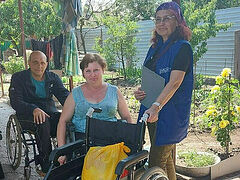
Valeria and her fellow volunteer Nadezhda on assignment It happened in the beginning of March. Viewing a film about the destruction of Mariupol made my heart ache. I felt the urge to help those who had tasted sorrow and to do something to ease their pain. That’s when I began to look for opportunities to travel to Donbass, and found out about the volunteer work of the Patriarchal Humanitarian Mission. I joined in a heartbeat by filling out the questionnaire and sending my application.
It just so happened that I had some money set aside for a future vacation abroad. This was what I used to pay for my airfare to Moscow. My family took my decision in stride—everyone showed support and no one tried to dissuade or put fear in my heart. This was how I ended up in Donetsk, at the Institute of the V.K. Gusak Emergency and Reconstructive Surgery. I didn’t have any expectations, plans or illusions about my future ministry. I couldn't even fathom then how strongly this trip would change my attitude toward life, God and people.
On my first day there, I just locked myself in a room
 Valeria changes bandage on a wounded soldier I was well-familiarized with first aid. I had gone through an emergency response course, and I also provided first-aid briefings to my coworkers. So, I had a pretty good understanding of what I could do myself (like washing, changing bandages, or applying treatment) and in what situation a doctor’s intervention was necessary.
This affected how confidently I first walked into the ward full of wounded soldiers. But immediately my confidence was replaced with the fear of seeing so many people suffering and in pain. Pity towards the wounded so gripped my heart that I had to rush outside, lock myself in a room and get busy sorting through boxes with humanitarian aid, just to avoid seeing anyone. I can’t recall how long I was there, or what I was thinking about, or how I felt. I suffered a complete shock. Of course, I never knew what it was like to see so much blood, or what wounds actually looked like. Because all I had seen before was theoretical first aid taught in a classroom setting, while here, I saw it all for real…
I was asked to feed someone. He had suffered awful burns. It really helped that I immediately struck up a conversation with him. The wounded man laughed in an attempt to calm down and encourage me, as if it was I who needed care, not him. That was when I realized how powerful are these men around me. I definitely needed to take a lesson or two from them.
Never thought my English would be put to good use
 Valeria with her fellow volunteer Nadezhda from Omsk and actress Anna Artamonova who visited the burn ward
A wounded soldier from Cameroon was assigned to the ward where I assisted. He knew English and French, but didn’t speak a word of Russian. Well, he barely spoke English, as well. When I had just met him, he was literally afraid of everyone there, so he just was lying there in silence, staring fixedly in front of himself. I assisted him when he began to walk, learned to hold a spoon again, and to speak. We literally had to do lip-reading with him–shell-shocked, my new friend constantly heard noise in his ears, and he was unable to speak loudly. I would explain to him what doctors wanted of him and assisted during his surgery. We were even able to call his family. After that, the young man finally perked up, became cheerful, and took to assisting other guys in his ward, propping them up as they walked, turning the electric kettle on for them or opening the window. He also anxiously waited for me to come to their ward when I was on duty. That’s how I was unexpectedly able to put my English to good use.
 On a walk around the ward with the fighter from Cameroon One day, Anna Artamonova, the actress from the Moscow theater "Et Cetera,” came to give a charity concert in the hospital. There were many bedridden patients at the event. They listened with great attention and gratitude. My Cameroonian friend also attended the concert. And it was so nice that Anna sang one song in English, just for him. He sat there staring at the floor until he heard the familiar words. And when he recognized them, he lifted his head, and I saw tears in his eyes and a smile on his lips.
I saw how much one can love one’s native city
Before, I really wanted to leave Omsk for good. At first, I thought about going to Moscow, and then I started to consider options to move and live abroad. Finally, my trip to Donetsk brought me down to earth. I saw how much the locals love their city. Despite the hardships of living there—Donetsk has ongoing shortages of even drinking water, not to mention other things—but people choose to stay where they were born and continue working at their jobs.
I saw how much people love their native city. Despite the hardships of living there, they choose to stay where they were born
The people’s love for their native city is felt practically everywhere. In the beauty and neatness of its streets, parks and houses. In the story of a taxi driver who moved away from his hometown, but then realized he couldn’t live away from home and returned. In the never-ending work of women at the catering unit who cook food for the entire hospital. They practically live there even now; they peel potatoes, cook soups, and bake delicious pies for the wounded.
When I came back to Omsk, I suddenly felt a surge of love for my native city. I felt the desire to continue living there, just like those people back in Donetsk, to study at my university, and work responsibly at my workplace.
 Valeria at the entrance of the church of the Iversky monastery Before my trip to Donetsk, I rarely if ever attended church. Except when, in my early childhood, I was living at my grandmother’s and we went to services together. My parents were baptized, but they were brought up at a time when our country was ruled by communist ideology. Moreover we resided in the village of Zvonarev Kut in the Azov German National District of the Omsk Region. The majority of its residents are Germans, in other words, the Catholics and the Lutherans. Even our Christmas celebrations at school were held according to Catholic traditions. In such an environment, I had almost no opportunity to understand what Orthodoxy was about.
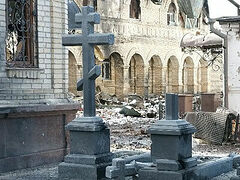
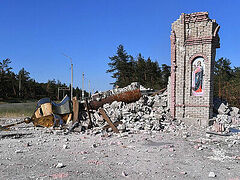
However, I have long sensed that God exists, so I was as if living in anticipation of the right moment to come to Him. In Donetsk, we read the morning and evening prayer rule, prayed before every meal, and took a trip to the destroyed Iveron monastery. I saw icons near the wounded soldiers and listened to their stories.
One man, a Muslim, had a friend who placed an icon in his pocket. He was burned all over, except on that particular pocket. He survived and decided to baptize his entire family. Another man, dying in the flames of fire, cried out to God, pleading to accept him. In another second, he realized that the fire was gone, like had never been there …
A few months have passed since my trip. I felt an urge to go to church and I attend one now
Several months have passed since my trip. I felt an urge to go to church and have now started attending regularly. I was a changed person after my encounter with the volunteers and the wounded. I realized that we ourselves choose the people who surround us, what we do and how we feel. The wounded we care for did not suffer from depression, but, on the contrary, they continued to joke and to support one another, and to make plans for the future. My conversations with them helped me—and I began to worry less about trifles. Certain things and situations I had considered as problems before I no longer perceived this way. I have a newly-found meaningfulness and happiness in my life.
You can become a volunteer of the Patriarchal Humanitarian Mission in the Donbas by filling out a questionnaire or calling 8-800-70-70-222.
The Russian Orthodox Church is one of the largest organizers of charity in Russia. The Church assists the homeless, people with disabilities, addicts, and women in crisis. You can also support the work of the Synodal Charity Department.