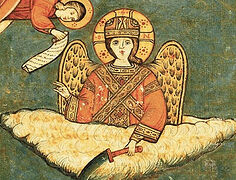
Seven Angels Pour Out the Vials of God’s Wrath Upon the Earth, unknown artist, 19th C.
We continue our reading of Revelation with chapter 17. In chapters 15 and 16 we saw seven angels who had seven plagues. These angels held seven vials. Every vial was poured out upon the earth, bringing plagues to the world. We saw the glassy sea described by John the Evangelist and various vials. The first vial became a plague against apostates, the second—against sea creatures, the third turned the river into blood, the fourth burned people with fire, the firth darkened the kingdom of the beast, the sixth opened the way for the kings of the east along the dried-up Euphrates River, and from the seventh came lightning, thunder, and earthquakes.
Today we’re reading chapter 17. And there came one of the seven angels which had the seven vials, and talked with me, saying unto me, Come hither; I will shew unto thee the judgment of the great whore that sitteth upon many waters: With whom the kings of the earth have committed fornication, and the inhabitants of the earth have been made drunk with the wine of her fornication (17:1–2). The Evangelist John sees a picture before him like the others: One of the seven angels who held the seven vials described earlier comes and calls the Apostle to show him the punishment of the great whore. Some have interpreted her image as a city, as an empire, some as the Roman Empire, others as various ideologies and religions that have appeared at various times. No one can know for sure who it is. It’s probably not just a woman, a specific person, but something else that we can’t know. The kings of the earth have committed fornication with her, and those who dwell on the earth reveled in the wine of her fornication and sin.
So he carried me away in the spirit into the wilderness: and I saw a woman sit upon a scarlet coloured beast, full of names of blasphemy, having seven heads and ten horns. And the woman was arrayed in purple and scarlet colour, and decked with gold and precious stones and pearls, having a golden cup in her hand full of abominations and filthiness of her fornication (17:3–4). After the word that the angel gave to the Apostle John, he led him in the spirit (that is, by the grace of God, in the rapture of the Holy Spirit) to the wilderness. There in the wilderness there was a woman sitting on a red beast who was full of blasphemous names. Picture this: a red beast full of blasphemous names who had seven heads and ten horns. And this woman was dressed in purple and scarlet, adorned with gold, precious stones, and pearls. In her hand was a golden cup full of the vileness and impurity of her fornication. All of her uncleanness, all her sins, her whole condition was inside the golden cup she was holding.
And upon her forehead was a name written, MYSTERY, BABYLON THE GREAT, THE MOTHER OF HARLOTS AND ABOMINATIONS OF THE EARTH (Rev. 17:5). Imagine the impurity, depravity, and malice of this woman. Further, the angel will explain to the Apostle John what exactly he’s seeing. We’ll see this next.
And I saw the woman drunken with the blood of the saints, and with the blood of the martyrs of Jesus: and when I saw her, I wondered with great admiration (Rev. 17:6). You see, he begins to explain and reveal the mystery. The path of the saints in this world is clearly seen here. The saints, the people of God, are imitators of Christ. It can’t be otherwise. You can’t be a disciple of Christ if you don’t follow the same path He followed. And since He shed His blood and suffered, those who follow Him will also suffer. Perhaps we won’t have to shed our blood, perhaps they won’t kill us, won’t slaughter us, won’t do those terrible things to us that the saints endured. But martyrdom is not only this. The Holy Fathers say that our daily asceticism is the shedding of blood. “Give blood, get Spirit,” the Fathers say. In order to labor spiritually and receive the grace of the Holy Spirit, you have to “give blood.” It doesn’t just happen, as if through deep thought, intellectually, with ease. You have to fight to the point of blood; fight very hard in order to follow Christ. It’s not that God’s way is burdensome and depressing. You might say: “Why should I follow this way of God, only to be killed, only to have all my blood poured out?”
The other day, a philosophically inclined man said to me: “Listen, my father, why should I pray for the Kingdom of God, when I have daily problems to deal with? If I can’t handle them, what do I have to say about the Kingdom of God?” On the one hand, he’s right in the sense that it’s not so easy to tell someone else: “Don’t worry, they’ll kill you and drink your blood for the sake of the Kingdom of God.” He’d respond: “Okay, and why should I agree to this? Who can guarantee that I’ll remain firm, endure so much suffering, and enter the Kingdom of Heaven?”
 40 Martyrs of Sebaste
And why did the saints suffer torments? Was there a need for it? Does God really want us to be tormented, to suffer? Does God really want His beloved people who followed and loved Him to endure so much suffering? Wasn’t it enough that they loved him? Of course, God doesn’t want this. He doesn’t want anyone to be tormented, to suffer and die. But such is the path if you want to be like Christ, to put off the old man, to cast off sins and passions, to preserve what you believe in. Sometimes you’ll have to stand even to the point of blood, because this battle will be waged, first and foremost, by you. When you want to sin, when you feel inclined towards it, you have to abstain and not allow yourself.
I’m not talking only about carnal passions, although this is a very strong battle. But there are also very many simple things. For example, revenge. I want to open my mouth and make sure that the man standing before me—who speaks ill of me, who insults me, who slanders me and causes me so much pain—doesn’t even know where to run to get away from me. And I can do it. We all have a tongue, thank God. But if I don’t want to act that way, understanding that the Gospel doesn’t allow it, then I grit my teeth and bite my tongue, sometimes even literally, so as not to say a word. This is bloodshed. When I see someone mocking me, making a fool of me, deceiving me, laying a trap for me, I have to shed blood to endure it all, to not take revenge, to not start behaving the same way.
Or I have the opportunity to receive material benefits, but my conscience tells me that it’s wrong, that the path I see before me isn’t good. We start to find a thousand justifications why it’s okay to do it, like the thief who says:
“Father, I stole a gold watch. Should I give it to you?”
“I don’t want it. Why would you give it to me?”
“So what should I do with it?” the thief asks.
“Return it to the owner.”
“Father, he won’t accept it.”
“If he doesn’t want it, then keep it.”
The priest doesn’t realize that the thief stole the watch from him. Do you see what’s going on? A clever thief. That’s how we behave. If we see something advantageous for us, we come up with such fabrications, such clever reasonings, a thousand justifications, a thousand of everything.
You think on a fasting day: “It’s been a while, I should eat so I don’t disturb anyone, so they don’t think I’m trying to make myself out to be a saint. What if I’m offending someone with this? It’s no big deal—eat, no need to put on airs.” And you start eating everything you can and can’t.
And how do we handle possessions? “If my mother gave this to me, what can I do about it?” You take it for yourself while the rest of the family suffers. We always find justifications for ourselves. If we want to do something, we find many excuses for ourselves; our ego is very skilled at convincing us. As soon as we do, the flip side starts to show itself, then things go worse. Resisting yourself requires effort—it’s not simple at all. You have to resist “skin for skin,” as Elder Joseph the Hesychast said, to fight directly with your opponent. There’s also the devil, who fights with spiritual weapons, with cunning. There’s our environment. You arrive somewhere, and they start: “Ah, you're a Church person!” And you have to answer for priests, for bishops, to explain and defend yourself when they back you into a corner over every little thing. A thousand occasions a day, and you have to resist, withstand the burden.

Even our children. I’ve already told you in previous talks that I’m amazed by young children who aren’t even in elementary school yet and they already bear witness for Christ. They go to school and they don’t want to say any swear words. Or the other kids start provoking them but they don’t want to respond in kind. Or a child is fasting, they invite him to a birthday party with various treats, but he chooses not to eat everything because he wants to fast, to receive Communion the next day, or because it’s a fasting period. It’s a struggle. It’s good when children labor from an early age, because then they’ll become good warriors. But it’s an ascetic labor. Perhaps you won’t have to shed blood: God doesn’t want man to suffer. But the reality is such that, unfortunately, in order to crush the old man, to change the situation and pass through the sea—the world, the devil, our passions, our ego, our environment, a thousand different things—you have to sacrifice yourself and wage a serious struggle.
This woman was intoxicated with the blood of the saints and of Jesus’ witnesses, therefore some interpreters saw her as Rome, because at the time when Revelation was written, in the 90s AD, hundreds of people were suffering for Christ every day. There were thousands of martyrs in Rome. The Roman Empire was the center of Christian persecution. Therefore, to some it seemed that the image of the harlot spoke of Rome: It reveled in the blood of the saints and martyrs. The Apostle John saw her and was amazed.
Names in the Book of Life
In verse 7, the angel tells him: And the angel said unto me, Wherefore didst thou marvel? I will tell thee the mystery of the woman, and of the beast that carrieth her, which hath the seven heads and ten horns (Rev. 17:7). Some interpreters believed that the seven heads are the seven hills upon which Rome was built and the ten horns are the ten emperors who persecuted Christians. This is one interpretation. We don’t know.
The angel told him that he would explain the mystery of the woman and the mystery of the beast that bore her (she sat on a red beast full of blasphemous names, with seven heads and ten horns).
The beast that thou sawest was, and is not; and shall ascend out of the bottomless pit, and go into perdition: and they that dwell on the earth shall wonder, whose names were not written in the Book of Life from the foundation of the world, when they behold the beast that was, and is not, and yet is (Rev. 17:8). The beast that he saw was, and now is gone, in contrast to what he said about God in the beginning: Which is, and Which was, and Which is to come (Rev. 1:8). But the beast existed, and now doesn’t exist. And all the works of satan, all the works of men exist, but then they will be no more. Then the beast will come out of the abyss and go into perdition, into punishment, into destruction. All who dwell on earth will marvel, those whose names aren’t written in the Book of Life from the foundation of the world.
Do you remember the book that we saw earlier, with the names of those who believed in Christ, in the Lamb, in God? Their names were recorded in the Book of Life. They were the people who freely and intentionally followed Christ—they had a different path. But here are mentioned those whose names weren’t written in the Book of Life. I’ll explain a bit. It’s not that God decided not to write someone’s name in the Book of Life, but that these people chose not to have a relationship with God, neither in this life nor in eternity. This is a question of human freedom, not predestination—some are recorded, some aren’t recorded in the Book of Life. You can’t say: “How’s it my fault if my name isn’t written down?” And it would be even more cunning to say: “Let’s go see if our name is written there. And if not, then let’s at least have some fun, commit a couple of sins instead of laboring, and then end up outside the Bridal chamber anyway.”

St. Paisios often gave us such an example. He would say:
There are some people who don’t have piety. Let’s say they say the Second Coming has begun. Those who want to be saved gather together, go to Paradise, and at some point the Lord says: “Sorry, Paradise is full. There’s no more room to receive anyone. We didn’t provide for so many places, didn’t account for everyone. I’m sorry, only those who have already entered will remain, but you won’t enter; there’s no room for you.” Those who don’t have piety will say: “Maybe we’ll have time to return then, to do something else that we haven’t done before?” But the pious will say: “Don’t worry, Lord, it’s enough for us that Paradise is filled with people. This is a great joy and blessing for us; we’re content and grateful. It doesn’t matter that we didn’t get in. It’s enough that there are worthy people there, and You, Lord, are glad and pleased that Paradise is full.”
He said this to show the difference between people who have piety, magnanimity, and zeal, and those who don’t. It’s not God’s work to determine who’s recorded and who’s not—this is up to each man for himself. Man records his own name in the Book of Life, but he can also erase it or not write it at all if he doesn’t want to have a connection with God—it’s a question of his own freedom.
Those whose names aren’t written in the Book of Life, who aren’t God’s people, will be surprised and perplexed when they see this beast, which everyone thought was strong and robust, but it was a false picture. Now this beast is heading for perdition and will be no more.
And here is the mind which hath wisdom. The seven heads are seven mountains, on which the woman sitteth (Rev. 17:9). Another element is given here, suggesting that this woman symbolizes Rome. The Apostle John says here that you have to understand, have to have wisdom. Seven heads are seven mountains and the woman is sitting on these mountains. You all know that Rome was called the city on seven hills. The woman sitting on these hills is the Roman Empire.
And there are seven kings: five are fallen, and one is, and the other is not yet come; and when he cometh, he must continue a short space (Rev. 17:10). Do you see that this speaks of events that have already taken place? The Apostle John is speaking prophetically, by the Holy Spirit. Revelation also talks about things that have already happened, as we see here. It talks about the seven kings of this city, five of whom have fallen, one is, and the last will come and stay for a short time. It seems it’s talking about the Roman Empire here, which slaughtered the martyrs. Let me remind you that this may be so, but these words could also mean something else. Perhaps this refers to Rome in the time of St. John the Theologian, but at the same time it may indicate events that will be revealed in the last times. We don’t know for sure, but the possibility exists.
And the beast that was, and is not, even he is the eighth, and is of the seven, and goeth into perdition. And the ten horns which thou sawest are ten kings, which have received no kingdom as yet; but receive power as kings one hour with the beast (Rev. 17:11–12). These are the kings who reigned in these circumstances.
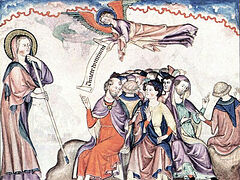
 The Lamb Defeating the Ten Kings, 13th C. These have one mind, and shall give their power and strength unto the beast (Rev. 17:13). All these kings will have the same thoughts, the same opinion, and they’ll agree on something—against Christ, against Christians. They’ll give power to the beast, to satan, to the devil and his instruments.
These shall make war with the Lamb, and the Lamb shall overcome them: for He is Lord of lords, and King of kings: and they that are with Him are called, and chosen, and faithful (Rev. 17:14). They will all battle with the Lamb. The Lamb is Christ, as we’ve said and seen on other occasions, sometimes slain, sometimes as He is. On the one side we have this meek Lamb Who takes away the sins of the world, our Lord Jesus Christ, meek as a lamb, as we say; and on the other side we have a beast. Despite this, the Lamb defeats the beast. But He defeats it not in a worldly way, but otherwise. The saints were victorious not through worldly methods, but even when it seemed they were being defeated by the world.
To be continued…