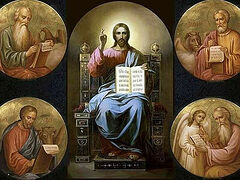
The Ship of Faith, 17th–18th C.
And there were voices, and thunders, and lightnings; and there was a great earthquake, such as was not since men were upon the earth, so mighty an earthquake, and so great (Rev. 16:18). After a voice was heard saying everything was done, lightning, thunder, voices, and a huge earthquake occurred, such as never had been before.
And the great city was divided into three parts, and the cities of the nations fell: and great Babylon came in remembrance before God, to give unto her the cup of the wine of the fierceness of His wrath (Rev. 16:19). Here it speaks of a great city. Some believe this is Rome, the capital of the Roman Empire, which fell and collapsed (like the empire itself). Others believe this is Jerusalem or various other cities. But it seems this is a symbolic city that will be destroyed by a huge earthquake.
And every island fled away, and the mountains were not found. And there fell upon men a great hail out of Heaven, every stone about the weight of a talent: and men blasphemed God because of the plague of the hail; for the plague thereof was exceeding great (Rev. 16:20–21). Men blasphemed God for the plague from the hail that was the size of a talent (a large coin). They didn’t repent, but blasphemed God. It’s not the timing of when this will happen that we should be concerned about (it will happen, though). No one can know the time, because God allows various things to happen depending on people’s repentance or lack thereof.
Do you remember what happened to Nineveh, the ancient city mentioned in the Old Testament? God told the Prophet Jonah: “Go tell the Ninevites that their city will be destroyed in three days because of the sins committed there.” Jonah, being a prophet of God, knew God and didn’t want to go, knowing that they would repent and God wouldn’t destroy their city, and then Jonah would seem to be a deceiver. They would continue to live for many years and they’d say to him: “Why did you deceive us? God didn’t destroy our city!”
Do you remember the story of Jonah when he was swallowed by the whale and then released three days later? He went to Nineveh and told the people: “In three days, Nineveh will be destroyed!” The people wept, fasted, mourned, prayed, and the city remained intact. It wasn’t destroyed until a hundred years later. It turned out that poor Jonah told a lie, which gave rise to many thoughts against God: “You see how I’ve become a liar! How will I be received in this city?” This wonderful story happened with Nineveh.
Seeing people’s repentance, God allows various things to happen in this world. Therefore, no one knows the last hour. save the Omniscient God. But God doesn’t plan: “The Second Coming will occur at this exact hour!” Men themselves determine it according to their repentance. If there’s no repentance in the world, then men won’t be saved, then the very existence of this world and the entire cosmos loses its meaning. As long as the Church exists, as long as the Divine Liturgy is celebrated, as long as men are being saved, there is meaning to the existence of the world, there is purpose to life. But if there is no meaning, there will be no world itself. What we should be concerned about is how we can get through all the difficulties that will either happen over the years or will happen suddenly, as Scripture says, or gradually. What saves us and what we must be careful about is that we remain united with Christ and the Church.
Many ask what we’ll do in these terrible times—what will be the criteria by which we’ll be saved? They have the thought: “We’ll be seduced, lost, and deceived!” and they start to resist. However, when a man begins a struggle, having such thoughts, a bad struggle that gives rise to anxiety, unbelief, and trepidation, it’s not from God. Spiritual things don’t create anxiety, fear, and disorder in the human soul. For us, the answer to this is simple and obvious: Remain with the Church. Whoever remains with the Church remains in the ark of salvation. The Church will never disappear and never be deceived. Many cite the words of the Gospel that even the elect will be deceived. The elect may be deceived, but the Church—never.
I remember when we were on the Holy Mountain, there were already products with bar codes. There was a lot of noise and concern, which is quite natural and justified both for laymen and even for Athonite monks, who are far from the world and don’t know what’s going on. And for some time, we were all preoccupied with the topic of barcodes, with 666, the antichrist, about one thing and the other. There was a man, a little strange, who came to see Elder Paisios. I was with him then. The Elder treated him to some loukoumi with nuts—very tasty. He said: “Have some!” “No, I don’t eat that kind.” “Why not?” “It’s deluded.” “The loukoumi is deluded?” “Yes! It has nuts. They’re from India—they’re in delusion!” Elder Paisios began tearing at his hair. People would say all sorts of things...
I went to see St. Ephraim of Katounakia. I asked him: “Geronda, what are we doing to do with everything that’s happening?” “Father, why are you worried? After all, we have the Church—the ark of salvation. We’re within the Church and we walk together with it. We don’t have to worry about anything, or question anything, or say what we’ll choose. Will you choose? The Church will tell you whether something is from God or from the antichrist. It’s the Church that will decide what happens. What should concern us is how to remain united with the Church. That’s what we seek. Whoever separates from the Church is lost, but whoever remains united with the Church is saved.”
I’ll give you one simple example. This year, in 2024, it’s been 100 years since the problem with the calendar arose. In 1924, they switched to the new calendar. Not in all Churches, but the Greek, Cypriot, Alexandrian, and Antiochian Churches. Then a movement began among ordinary pious people who believed the calendar issue was a question of faith and that in no case should they switch to another calendar; they believed it was a mistake to switch calendars. They separated from the Church and fought to live according to the old calendar in order to preserve true Orthodoxy. What happened in the end? They went into schism, several groups were formed, different branches (right now there are ten or twelve different groups, separate from each other), and they’re all completely separated from the Church. The Church remains and continues on its path, but unfortunately, they’ve fallen away. Perhaps they were right in some ways, logically, and outwardly it might seem so. But the aftermath showed that those who remained with the Church remained on the path of salvation.
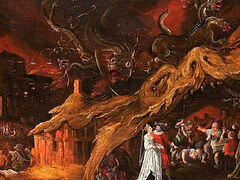
 Last Judgment, Stefan Lochner
Dogmatically, ideologically, theoretically, we have everything necessary for salvation in the Church. If a man lives carefully, labors ascetically, and experiences Christ, he’ll certainly be saved. If he’s negligent, he won’t be saved by the mere fact that he’s a member of the Church. He must labor to keep himself pure by repentance. Delusion comes in when we leave the Church. We have no reason to worry, no reason to say: “What will we do, how will we understand, how will we be able to distinguish?” If we have simplicity of heart and seek Christ, then for us the visible sign of salvation is the Church. There’s no salvation without the Church. You can be super Orthodox in your thinking, but if you’re outside the Church, salvation doesn’t exist for you. Therefore, we can continue our lives without any worries. We read prophecies, we read everything the Fathers said (and they didn’t say all this to scare us—they weren’t terrorists), and we see that they say: “Christ will defeat satan and his weapons. He’ll overcome and be the Bridegroom of the Church, the Bridegroom of our souls.”
—Geronda, you said at the end of your talk today that it’s important to remain faithful to the Church. But the topic of the last times and difficult trials torment many people. You yourself know this, because you’re very often asked such questions from Greece and from everywhere; they call in when you’re on the radio. Let me ask you one specific question that it would be important to hear your opinion about. There’s a hostile mood right now towards some bishops, and Patriarch Bartholomew. They’re spoken of very negatively in certain circles; they call them heretics and basically urge the people to separate from them. They write online, in certain groups, citing the words of the Holy Fathers, of worthy hierarchs, such as Metropolitan Augustinos (Kandiotis), Sts. Kosmas of Aetolia and Mark of Ephesus. They talk about the concept of walling off, which I don’t really understand. Perhaps you can explain it. Generally, it means that people don’t commemorate certain bishops but they don’t go into schism. Personally, I rely on your words and constantly tell people that we have to stick to the Church. Perhaps you can explain some of the things that are happening—globalization, communication with Roman Catholics, and so on?
—Okay, I’ll say something. It’s a phenomenon of our era—unhealthy and destructive. They talk about Patriarch Bartholomew. But the Church isn’t Bartholomew, or Athanasius, or Georgios, or any of the patriarchs. A patriarch can fall into heresy. The Church is a whole. Let’s say you separate from some heretic bishop. I’ve gotten letters here in Limassol that people want to separate from me, a heretic bishop. I answered one of them (he was also a psalmist, a church singer): “Okay, separate from me. But who do you belong to? No one. You’ve separated from the Church.” He hadn’t confessed or communed for two and a half years. What are these people doing? They’re separated from the Church by a wall and are just on their own. Separating means I say that such and such a bishop is a heretic. Indeed, there’s a canon of the First-Second Council: “If a bishop speaks heresy, separate yourself.” Okay, this is separating from one bishop, but not the Church. Leave Athanasius of Limassol, but go to Kirill of Moscow or Porfirije of Serbia. Go to some bishop in order to belong to the Church. But if you don’t commune, don’t confess, if you separate yourself from the Sacraments, such separation puts you in the hands of demons. You renounce your Baptism. It can happen that a certain bishop speaks heresy, and you can leave him. But don’t depart from the Church. But these people leave the entire Church and go naked, losing grace. They leave, but where do they go?
We had a young priest in the Metropolis here. Some former Athonite told him that he should separate himself. He went to the Synod and said: “I’m separating from you, heretic bishops.” I asked him: “Father, when were you ordained?” “Five years ago.” “Who ordained you?” “Georgios of Paphos.” “When he ordained you, he was a good bishop, he had grace, and you became a priest. And now, five years later, you, a priest, are renouncing the bishop who ordained you? If he’s a heretic, the Church will condemn him.” This poor man was so unlearned that he didn’t even know “O Heavenly King.”
What can you say here? Of course, he has the right to separate, to leave a bishop. Leave a heretic bishop, but go to another bishop. God established the hierarchy in the Church. The Church isn’t something indefinite; it’s not a cloud floating in the sky with no body or hypostasis. The Church has a structure. There are bishops, priests, deacons, and the people of God who make up the Church. It isn’t something cloudy and undefined. They don’t understand that by leaving they’re doing the same thing as Protestants—they divide into a thousand pieces.
They’re very divided now; each belongs to his own sect, and as a result they move from one blasphemy to another, from one delusion to another, and now they’ve reached the point where they say there’s no priesthood. Now they have no bishops, no priests. I remember one elder monk on the Holy Mountain who was a zealot—he was deceived. He hung a chalice on the Royal Doors and said: “That’s it! There are no more priests in the world!” But this is a great delusion. Until a man realizes his delusion, it will lead him very far—it knows no bounds. And it’s very hard for a deceived man to go back.
Our ever-memorable Elder used to say: “His spirit is deaf and dumb.” He doesn’t hear or understand anything. They could see miracles, the resurrection of the dead, and they’ll say: “The devil did this.” They don’t listen to anyone or anything. Those who have humility and simplicity will be saved if they humble themselves and repent. But unfortunately, there’s this huge delusion. Many young guys fall into such nets out of zeal and inexperience.
There was a guy who came to see me recently. He brought me a Pedalion[1]—he wanted to teach me. I told him: “Listen, a year ago you were running here and there. I remember your life since you confessed to me. And now, a year later, you’ve come to teach me the canons? You should at least be embarrassed. You haven’t even finished high school yet. You should be ashamed—we at least completed our education, we were acquainted with holy men. And you, a twenty-three-year-old guy, have come to teach me while still immersed in your passions and sins? You’ve read some of the canons and you’re starting to teach? Do you think our souls are only fit to be thrown away? We have no hope of salvation, while you—who just started going to church—are being saved?” It shows that such delusions are born of egotism—people don’t hear or understand anything.