On October 11/24, the Russian Church commemorates the Synaxis of All the Saints of the Optina Monastery. The elders of Optina were skilled spiritual physicians who penetrated into the very depths of the human soul. We have talked about their experience, letters, and gifts with Bishop Joseph (Korolev), the current Abbot of the Optina Monastery.
 Bishop Joseph (Korolev) —Vladyka, the Optina Elders were successors of the spiritual legacy of St. Paisius Velichkovsky. Thanks to his feats and labors, and through his disciples, hesychasm was revived at the monastery. Please tell us about this teaching and how it influenced the revival of Russian monasticism at the Optina Monastery?
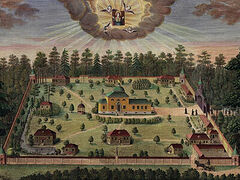
—Yes, indeed, disciples of the disciples (spiritual grandchildren) of the famous elder, St. Paisius Velichkovsky, set up a skete, introduced the practice of eldership at the Optina Monastery, and brought Athonite traditions there. Thanks to this, the monks attained great heights in their spiritual life, and the Optina Monastery became a place that sanctified many people. The future Metropolitan Philaret (Amfiteatrov; 1779–1857) of Kiev gave his blessing for founding a skete not far from the monastery—in the forest next to an apiary. He saw that this place was very suitable for secluded life, for monastic feats, and invited there the most experienced hermits of that time—ascetics from the Roslavl forests (now in the Smolensk region). Thus, ascetic life began there.
In 1829, the then famous Elder Leonid (in the schema Leo/Lev; 1768–1841) made the skete his home. Elder Leonid had many spiritual children. When the saint arrived at the Optina Skete, people started flocking to him from all over the country, and he pastored all of them. And he already received not only his spiritual children, but also “outsiders”. Not everybody understood (including even the Church authorities) why so many people were constantly coming to the elder. It was unusual in Russia, because every Christian had his own parish and his own priest. But now people were going somewhere else, travelling to monks. So, some viewed this situation with suspicion. These pilgrims received spiritual help and consolation. Fr. Leonid passed on his experience as a spiritual father to Elder Macarius (1788–1860).
Hesychasm is the most important inner practice of the monks, which consists in the ceaseless recitation of the Jesus Prayer. This experience had been lost in many Russian monasteries, and only external work had was practiced. And so at the Optina Monastery, the practice of hesychasm was revived.
—How was eldership transmitted? Was it always from teacher to disciple? The elders had many spiritual children and cell-attendants, but not all of them later became elders. Who elected them and by what criteria?
—Of course, not all spiritual children became elders, but only those who were worthy to adopt the experience and receive grace. When elders chose a cell-attendant as a novice, they already foresaw whether he was capable of accepting the teaching or not. A disciple, who would later become an elder, was imbued with the experience of his teacher in the cell. The elder dictated letters, and the cell-attendant helped answer them; he would listen to the elder communicate with people. The main thing was that he absorbed the experience of monastic life; they prayed together, and read the rules together. Elder Macarius was assisted by Fr. Ambrose and Fr. Hilarion. For thirty years Fr. Joseph was the cell-attendant of Fr. Ambrose, and then the latter was an elder for twenty years. Elder Barsanuphius was assisted by Fr. Nikon, and so on.

—Why do you think that not everyone absorbed the experience of eldership?
—The elders not only foresaw a person’s ability, but also his desire for ascetic life. First of all, they taught the principal virtues—humility, patience, and striving for ascetic labors (no one can do without them). After all, you can help an elder outwardly without adopting anything from him. But their successors absorbed everything, including grace. They were “chosen vessels”. Their desire, plus the grace of God, plus the experience of eldership caused a future elder to be trained and developed. Fr. Hilarion (1805–1873) was St. Macarius’ cell-attendant for twenty years. Elder Macarius, who saw that he was capable of adopting all of his experience and gifts, foretold to him that he would become a spiritual father—and he became one.
—Please clarify: Is the cell-attendant himself supposed to have the desire to become an elder?
—No, he shouldn’t have the desire to become an elder. This is pride, which means that he wants to teach others—he can fall into delusion. It is necessary to struggle with such thoughts and humble yourself. Not a single elder aspired to this. If you live at a monastery and want to be ordained, it is pride, it doesn’t befit a monk. It is normal for a layman to want to become a priest and enter a seminary, but for a monk it is a sign of pride, to say nothing of eldership or spiritual guidance.
—Eldership knows no hierarchy. No matter whether someone was a monk, a hieromonk, or an archimandrite—could any of them become an elder?
—Yes, this happens: a simple monk can become an elder. We know that Elder Paisios the Hagiorite was not a priest, but a simple monk. But people flocked to him for spiritual advice. He did not perform the sacrament of confession, but the brethren could reveal their thoughts to him. So did St. Joseph the Hesychast. At Optina Monastery, all the elders were hieromonks.
—The elders reveal the will of God. They see through a person, see his soul and character, and nothing can be hidden from them. St. Barsanuphius of Optina (1845–1913) told his spiritual child: “Before a person thinks about something, before a thought appears in his mind, the elders see it with their spiritual eyes; they even see the cause of such a thought. And nothing is hidden from them. You live in St. Petersburg believing that I don’t see you. When I want to, I’ll see everything you are doing and thinking about.” Vladyka, besides the gift of clairvoyance, what are the other gifts of the Holy Spirit that the elders of the Optina Monastery possessed and how did their ministry help people?
—St. John Cassian the Roman said that the gift of discernment is critical. Any good deed done without discernment can be harmful. You can damage your health by fasting, or you can pray improperly, without discernment, to your own detriment. And the elders, first of all, should have discernment. Firstly, it comes with experience; and secondly, for spiritual life the Lord enlightens the mind with wisdom. And the next level of a spiritual father is the gift of clairvoyance. Such father-confessors are already called elders. And the Optina Elders, as we know, possessed the gift of clairvoyance. They also had other fruits of the Spirit, which are mentioned in the Scriptures: love, joy, peace, longsuffering, gentleness, goodness, faith, meekness, temperance (Gal. 5:22-23). And they shared these gifts with their visitors. The most important gift is love, which is the bond of perfectness (Col. 3:14). Thus, with their spiritual wisdom and discernment, the elders helped those who came seeking advice; sharing their gift of love, they gave comfort and hope, helping people solve not only spiritual problems, but also everyday ones. And this is very important for people who live in the world and are overwhelmed by everyday difficulties and sorrows. People would leave the elders spiritually renewed.
We can cite an example of the clairvoyance of St. Macarius, who became the spiritual father of the literary critic and philosopher Ivan Kireyevsky (1806–1856). Ivan Vasilievich wrote a letter to the elder with questions, and said to his wife that it would be hard for Fr. Macarius to answer him. Just imagine the writer’s surprise when, less than an hour later, they brought him a letter from Elder Macarius with answers to his questions! As he read it, his face changed, and he said, “Amazing! It’s unbelievable! How could it be? This letter contains the answers to all my questions, which have just been sent!”

We can give another example of how the elders helped ordinary people in their daily needs. St. Ambrose (1812–1891) instructed an old woman whose turkeys were dying, and to those who reproached her for turning to the elder with trifles he explained that those turkeys were her whole life.
The elder helps people see the will of God, including which way of life to choose: marriage or monasticism, where to live, and where to work. It can be hard for a person in the world to make the right decision because he lives in the hustle and bustle of daily life, and his spiritual eyes are clouded. And the elder, enlightened by the light of Divine knowledge, sees events as if through clear glass.
—Vladyka, does the elder help the brethren not fall into the state of delusion from excessive feats that they can take on themselves?
—Yes, I have been talking about laymen, but when it comes to monks, the chief purpose of the brethren’s father-confessor is to protect his monks from spiritual damage. A brother can fall into either delusion or negligence. Negligence can be seen more often in our days when a monk comes to the monastery with a burning heart and a longing for ascetic labors, but then the flame of his zeal fades. Or vice versa: if a brother undertakes excessive asceticism while letting thoughts of vanity and pride enter his mind, believes that he has attained a high level of prayer, and begins to exalt himself above others, it is a very dangerous state that can lead to spiritual delusion. And delusion is does damage to the soul, from which it is often impossible to recover. Such a person no longer hears or respects anyone, and he recognizes no authority. Thus, the demon leads such a monk out of the monastery, and there have been cases of physical death. And the task of the spiritual father is to keep an eye on the condition of his spiritual child; sometimes he should comfort him, and sometimes he should humble him.

—Vladyka, there are external miracles, and there are internal ones. Please tell us about the latter.
—There are miracles that change a person morally. They are even more important than external ones. For instance, when a person comes to God, when he repents, or when he reforms. Thus, Ivan Vasilievich Kireyevsky changed thanks to Elder Philaret, who was at the Moscow Novospassky Monastery and had a spiritual bond with St. Paisius Velichkovsky’s disciples as well.
—What made him change?
—His wife Natalia Petrovna was religious, but he was at first almost an atheist, passionate about Western philosophy. His wife repeatedly asked him to wear a baptismal cross, but he remained silent. One day, Ivan Vasilievich said that he would wear a cross only if it was sent from Fr. Philaret whom he highly esteemed. Natalia Petrovna came to the elder and told him about this. Fr. Philaret took off his cross at once as a present for her husband. When she came back home, Kireyevsky wondered, “What cross is this?” Natalia Petrovna replied that the elder had taken it off himself and said, “May it be for his (your husband’s) salvation.” After that, Ivan Vasilievich fell to his knees and exclaimed: “Now I hope for the salvation of my soul, for I had decided that if Father Philaret took off his cross and sent it to me, it would be a clear sign that God was calling me to salvation.” From that time on he changed his life. Subsequently, he became a faithful spiritual child of Elder Macarius of Optina—the Lord brought them together through the publication of books. He gladly agreed to help print the Life of St. Paisius Velichkovsky. The Kireyevsky family assisted Elder Macarius not only in publishing, but also in creating favorable conditions for the elder to focus on the work of the publishing house. For example, Fr. Macarius would come to their Dolbino estate (now in the Tula region) to work on the texts of Optina publications. Entrusting himself to the spiritual guidance of Elder Macarius, Ivan Vasilievich reformed and did nothing without his advice. He became a famous Russian philosopher and a co-founder of the Slavophile movement.
—Since we are talking about book publishing, it’s time to talk about letters—a spiritual treasury that has survived to this day. The Optina Elders corresponded with their spiritual children. Now we can be guided by their advice and guidance through books. As we know, the elders themselves said that advice given to one person may not be helpful to another. Vladyka, how can we heed the counsels of the Optina Elders properly so that it can be in tune with our spiritual needs and conditions and have a wholesome effect on the soul?
—We always read the instructions of the Optina Elders during the meal with the brethren, and each monk must know the Life and instructions of each elder well. And, of course, there are sometimes individual points in the instructions. For example, letters to monks are different from letters to laypeople, so in our publications we try to separate them. Thus, we have recently published the letters of Elder Macarius to nuns.
Usually, publications contain letters with common points that are useful for every person. In them the elders teach the Christian virtues of humility, patience, obedience and prayer. Why did they try to publish each elder’s letters immediately after his repose in the nineteenth century? Not only to preserve his memory, but also to everyone’s benefit. Where there were personal moments, the names were deleted and they wrote “N”. What has been published for everyone is edifying, so we always read and study it.
 —Vladyka, before entering the monastery, you also used to read the Optina Elders, though they had not yet been canonized. Which of the elders is closer to you spiritually, and why?
—St. Joseph of Optina (1837–1911), since I bear his name in monasticism, is close to my spirit. For thirty years he was a cell-attendant of Elder Ambrose, and then he pastored people himself for twenty years. St. Nikon (Belyaev; 1888–1931) is also dear to me. Even in his youth, he would write down everything that Elder Barsanuphius taught him, and transmitted all this experience through his diary, which has been preserved for us as an invaluable experience. Then, after the monastery had been closed, during hard times he pastored the nuns, parishioners and the brethren. What sufferings he endured, how he preserved the spirit of the Optina Monastery and the whole of monasticism! Even in prison, they read the entire services, trying to preserve the monastic rule. Even in those harsh conditions, they remained true monks and showed the image and example of confession and genuine monastic life.
To be continued…