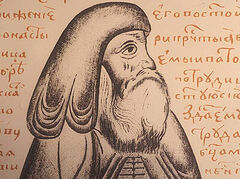
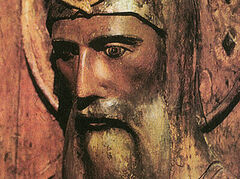
Today, October 11/24, the Orthodox Church honors the memory of St. Philotheos Kokkinos, one of the most prominent holy archpastors in the history of Orthodoxy, who took an active part in the political life of the Byzantine Empire and the Church of Constantinople, the author of the Lives of saints and liturgical texts. St. Philotheos, a disciple of St. Gregory Palamas and an apologist for hesychasm, took a direct part in the Church life of the State of Muscovy and influenced the destiny of Russian Orthodoxy.
 St. Philotheos Kokkinos was born around 1300 in Thessaloniki into a poor family. The saint’s native city was a hub of intellectual and religious life. At birth, the future Patriarch was named Phokas. Together with his friend Iakovos from the noble Maroulis family, he was taught by the Byzantine scholar and grammarian Thomas Magister (†1346), confidential advisor to Emperor Andronikos II Palaiologos (ruled 1282–1328). Phokas worked in his kitchen as a cook to pay for training.
Eventually, Phokas decided to become a monk and went to a monastery situated in the vicinity of Thessaloniki. Around 1325, he met his future teacher, St. Gregory Palamas, who at that time had not yet been ordained. At the age of about thirty, Phokas took monastic vows with the name Philotheos, which means “God-loving” in Greek, and went to the Vatopedi Monastery on Mt. Athos. There his mentor was St. Sabbas the Younger, a “Fool-for-Christ” (†1349).
Later, St. Philotheos struggled at the Great Lavra of Mt. Athos where his spiritual father was St. Herman (Maroulis) the Athonite (†1336), the uncle of his friend Iakovos. Before he reached the age of forty, St. Philotheos had been ordained a hieromonk, after which he returned to his native city of Thessaloniki and became abbot of a monastery there.
After the death of Emperor Andronikos III Palaiologos (ruled 1328–1341), troubled times began in the empire, since his son, the heir, was only nine years old. Two opposing parties tried to influence the young John V Palaiologos. The Byzantine Civil War broke out. The Great Domestic John VI of the Kantakouzenos family and the Emperor’s widow Anna of Savoy (1306–1365), who was backed by Patriarch John XIV Kalekas of Constantinople (1334–1347), competed with each other.
Archpastoral Ministry and the Defense of Hesychasm
Six years later, in 1347, the confrontation ended with the reconciliation of the houses of Palaiologos and Kantakouzenos (Cantacuzene). At a meeting of the Holy Synod headed by John V, convened by Empress Anna of Savoy, Patriarch John Kalekas was condemned and deposed. The Synod appointed Isidore Buchiras as Patriarch of Constantinople (1347–1350), who later appointed St. Gregory Palamas to the cathedral of the city of Thessaloniki, and St. Philotheos Kokkinos appointed Bishop of Heraclea.
The Metropolinate of Heraclea was a position of honor, since the Metropolitan of Heraclea was the exarch of all Thrace and Macedonia, second in honor after the Patriarch, and had many vicar bishops subordinate to him. The saint tried to avoid being appointed to this cathedra, as he sought unceasing prayer in solitude.
As St. Philotheos confessed in his writings, serving in Heraclea was not easy for him. He found the social inequality, disobedience and the lack of morals in the flock very difficult to bear. St. Philotheos longed to retire and devote himself to solitary prayer, but at the same time he did not want to do anything that displeased God. Sometimes he went into a cave with a view of the Marmara Sea, next to which a small Church of Christ the Savior stood on the cliff. There he prayed, among other things, that his doubts about his desire for seclusion would be dispelled, and the will of God would be revealed.
In 1351, the Genovese invaded Heraclea of Thrace. A great number of its inhabitants were murdered or captured, the city was destroyed, and its churches were looted. St. Philotheos actively helped the victims. Risking his life, he negotiated the ransom of prisoners, sought financial support to help them, and participated in the reconstruction of the city.
The saint played an important role in the Hesychast Controversy. He was involved in it from the time he became a monk. The controversy began when the empire sought rapprochement with the Catholic West, as it was being conquered by the Ottomans. Against this background, the learned man Barlaam the Calabrian started arguing that the problem of the dogmatic differences between our Churches should be addressed “dialectically,” and the contradictions should be resolved through compromises, suggesting a rational and pragmatic approach. He spoke on behalf of the Byzantine Church, worked out a project for the reunification of churches and, having received the approval of the secular and Church authorities of Byzantium, he went on a mission to Pope Benedict XII.
He was opposed by representatives of the local tradition, led by St. Gregory Palamas, experienced monks and men of prayer—ascetics who were convinced that a believer is able to enter into direct personal contact with God and that theology should not be based on assumptions, like philosophy, but on the experience of communion with God (Church and personal alike). The monks passed on their methods of concentration and direction of attention from teacher to disciple. They were called “hesychasts”. They could not agree with Barlaam’s statements based on compromises.
St. Gregory Palamas and St. Philotheos—his follower—were of the same mind. Philotheos wrote two treatises on the Light of Tabor and against Akindinos. He took part in a Church Council dedicated to hesychasm and wrote its Tomos. St. Philotheos was the author of the Life of St. Gregory Palamas and was involved in his canonization.
His Service As Patriarch
In 1353, St. Philotheos Kokkinos was elected to the patriarchal throne. The first period of his tenure did not last long—less than a year and a half; but it was during this period that St. Philotheos managed to perform important acts for the history of the Russian Church and Russia in general. He installed St. Alexei (Byakont; †1378), who came from Moscow, at the metropolitan cathedral of “All Russia” and moved the Metropolinate from Kiev to Vladimir-on-Klyazma. This way he helped Moscow in the fight against Lithuania, since Metropolitan Alexei did not have access to Kiev.
The second period of his Patriarchate began in the autumn of 1364 and lasted almost twelve years. Throughout these years, St. Philotheos exerted a great influence on the internal and foreign policies of the Byzantine Empire, strengthening the ties of the Patriarchate of Constantinople with other Orthodox Churches. He was a defender of the Orthodox faith and constantly tried to restore the unity between the Orthodox peoples of Europe, paying great attention to changing the political situation in Russia.
In 1374, Patriarch Philotheos sent gifts to St. Sergius of Radonezh: a cross-reliquary with particles of the relics of the Forty Martyrs of Sebaste, of the new martyrs of Lithuania Athanasius, Eudoxia, Eleutherius and Theodosia the Virgin, with a particle of the True Cross, which is now kept at St. Serapion’s Chamber of the Holy Trinity-St. Sergius Lavra, a monastic paraman and schema, and a letter with his blessing to introduced the cenobitic rule of monastic life in his monastery. St. Sergius turned to Metropolitan Alexei for advice and, with his blessing, introduced the cenobitic rule at his monastery, which later spread throughout the Russian Church.
 Frescoes at the Cathedral of St. Gregory Palamas (Thessaloniki): Sts. Philotheos Kokkinos and Gregory Palamas On December 2, 1375, Patriarch Philotheos consecrated the Bulgarian monk Cyprian (†1406), his former cell-attendant, to the Metropolitan cathedral of “Kiev, Russia, and Lithuania”. This act was unusual and seemed untimely, since the holy Metropolitan Alexei of Kiev and All Russia was still alive, but Patriarch Philotheos took such a step to preserve Orthodoxy in the Lithuanian lands—a Catholic province had been established in the Grand Duchy of Lithuania while there had been no Orthodox bishops there for a long time.
He tried to preserve the unity of the metropolitanate when the Orthodox flock of the Lithuanian State was in danger of joining the Catholic Church owing to political intrigues. The metropolinate was divided because part of it was situated on the territory of the Grand Duchy of Lithuania and was bereft of church administration. The purpose of Cyprian’s installment was to prevent losing part of the Russian Church. It was assumed that after Metropolitan Alexei’s death, Metropolitan Cyprian’s authority would extend to the Moscow part of the metropolis.
In mid-August 1376, Emperor John V Palaiologos was forced to abdicate as a result of a coup organized by his eldest son Andronikos IV (ruled 1376–1379). Following the coup, St. Philotheos was removed from the Patriarchal throne—probably because of his refusal to crown the usurper—and retired to a monastery in Constantinople. The saint reposed at about the age of eighty. He was buried with royal honors at the Akataliptou Monastery. Miracles occurred at his grave, and he was venerated as a saint.
The relics of St. Philotheos repose at the Great Metropolitan Cathedral in honor of St. Gregory Palamas in Thessaloniki. To the right of the entrance to the cathedral is a fresco of Patriarch Philotheos, who seems to be guarding his teacher. During the saint’s lifetime, his prayers and hymns were translated into Slavonic. Over thirty of his works spread widely in Russia.