Part 1. On the “First Russian Revolution” and Terrorism
Part 2. Long traditions of Anti-Russian lies
 Attack by terrorists from the Polish Socialist Party. Newspaper “Illustrated News,” May 26, 1906, Krakow.
10. Mass Terror and Its Victims
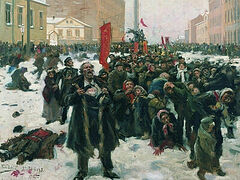
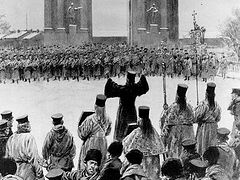
The conceived and prepared “big lie” gives birth to serious consequences. In our case, the local terrorist action of January 9, supported by an information campaign, gave impetus to mass terror and diversions, which wound down only by 1910.
Very contradictory facts have accumulated concerning the number of victims of this civil confrontation. In official data from the Ministry of Internal Affairs and other law enforcement agencies, more or less accurate figures often appear, related to state servants from the highest ranks to the lowest, against whom targeted attempts on life were directed. The number of these murders from 1901 to 1910 mentioned in sources is about 4,500 people.
In one historical source, it is said that “in only one year (from October 1905), 3,611 state officials were killed and wounded.” By the end of 1907, the number of officials who were killed or maimed by militants exceeded 4,500 people. To this must be added 2,180 killed and 2,530 wounded private individuals. From January 1908 to May 1910, 19,957 terrorist acts and expropriations were noted, as a result of which 732 officials and 3,051 citizens died, and 1,022 officials and 2,828 private individuals were wounded.
In another often-quoted source, it is reported that in 1907, on average eighteen people died at the hands of terrorists every day—that is, 6,570 people per year. These data were mentioned in a report to the State Duma and are not doubted; however, they do not match with other information.
And finally, the most important total figure of victims of the civil confrontation of the first decade of the twentieth century, which has entered the vast majority of studies, is 17,000 (sometimes 20,000 is mentioned). Despite the fact that this is a colossal number of victims, it can also be doubted as understated, since it is unknown whether, for example, the death penalties of terrorists or the victims of mass so-called “agrarian terror” in the Baltic regions, or the acts of terrorists in Poland and even in the Caucasus are included in this number.
And certainly the victims of Jewish pogroms (from both sides) are not taken into account here. After all, only in October 1905, according to Jewish sources, there were 690 pogroms in 102 geographical points (this is more than eighty percent of all pogroms over ten years), as a result of which 1,622 died on both sides and 3,544 were wounded. In other Jewish sources, it is said that during the October pogroms of 1905, 3500 to 4000 people were killed, and about 10,000 were wounded.
The question of Jewish pogroms is the most controversial in historiography and requires very careful and objective investigation
The question of Jewish pogroms is the most controversial in historiography and requires very careful and objective investigation. Literally every fact is interpreted from different sides with diametrically opposed political assessments. The difficulty in this question lies in the fact that the element of spontaneity of the opposing sides, for example, the creation of self-defense detachments on one side or the other, is not always taken into account and accepted by historians trying to explain the actions of “pogromists” and “rioters” as manifestations of “orders from above.”
In particular, one side believed and still believes that behind the pogromists always stood the will of government officials, with the support of Church authorities, or Black Hundred leaders. Now, more and more often, careful studies by historians appear, exposing such a politically motivated approach.
One of the most terrible and tragic forgeries, fitting into the system of the “big lie,” was the publication on May 18, 1903, in the English newspaper “The Times” by the correspondent in Russia D. D. Braham (Braham Dudley Disraeli, 1875–1951) of a telegram from the Minister of Internal Affairs V. K. von Plehve to the governor of Kishinev on the eve of the Jewish pogrom, where “the minister in clever evasive expressions advised that if extensive disorders against Jews occur in Bessarabian province, then he, Plehve, asks in no case to suppress them with weapons, but only to exhort.” This falsification was reprinted by hundreds of newspapers in Europe and the USA; it became the subject of condemnation by many politicians. The conclusion was made that behind the pogroms stands the power of the tsarist government. At the same time, the fact of the official refutation of this lie and forgery was ignored, as well as the expulsion from Russia of correspondent Braham for this low act. Mass demonstrations took place. Neither then nor after were there even attempts to present any evidence of the authenticity of the minister’s text. As for V. K. von Plehve himself, this provocative forgery cost him his life when on July 15, 1904, terrorist E. Sozonov threw a bomb into his carriage. The mastermind behind the assassination was the social revolutionary Evno Azef.
 Square at Warsaw Station. Remains of the minister’s carriage. Photograph by Karl Karlovich Bulla.
Now let us turn our attention to the persistent accusations against the Orthodox Church of inciting Jewish pogroms.
Immediately after the Kishinev pogrom in April 1903, in the Resolution of the Holy Synod, not only were there no, even veiled, calls for pogroms, but violence was defined as a shameful and unacceptable crime for Christians. The Church resolutely condemned the bloodshed, the Synod called on the clergy to take measures to eradicate enmity against Jews. This position of the Church never changed throughout the troubled times.
In October 1905, the Synod instructed the clergy “to use all their pastoral influence to eliminate internecine strife among the population, teaching it in its behavior and in relation to neighbors to act in the spirit of Christian universal brotherly love.”
Orthodox hierarchs, such as Metropolitan Flavian of Kiev, Archbishops Anthony (Khrapovitsky) of Volyn and Zhitomir, Dimitry of Kherson, Anastasy of Voronezh, Bishops Platon of Chigirin, Pitirim of Kursk, Parfeny of Podolsk, Innokenty of Tambov and Shatsk, publicly condemned the pogroms, and addressed the population with exhortations not to riot, “to stop your hands from violence, pogrom, and all kinds of plunder and injustice,” “to preserve Christian meekness and peacefulness toward all non-believers and foreigners.”
Contemporary historian S. A. Ilyin writes:
“Bishop Parfeny of Podolsk called on the subordinate clergy in case of ‘anti-Jewish disorders’ to go out with cross and epitrachelion, and ‘by the power of persuasion to tame the raging crowd.’ The vicar of the Kiev diocese, Bishop Platon of Chigirin, during the height of the pogrom, performed a procession through the streets of Podol, several times knelt before the enraged crowd, and begged to spare the life and property of Jews. The gratitude of Jewish communities was expressed in thankful addresses, memorial gifts, promises ‘to pray to God for the health and longevity’ of the Orthodox prelates.”
It is time to consider the facts of terrorist activity on the outskirts of the Russian Empire, which led to mass victims but may not have been included in the general statistics.
For example, after 1907, according to the Police Department, 3,060 terrorist acts occurred in the Caucasus, of which 1,732 were classified as politically motivated robberies, as a result of which 1,239 people died and 1,253 were wounded. The Viceroy of the Caucasus, Count Vorontsov-Dashkov, reported the following general data on manifestations of political banditry in the region: 3,219 in 1905, 4,138 in 1906, and 3,305 in 1907.
According to the chancellery of the Governor-General of the Baltic Region A. N. Meller-Zakomelsky, in 1905 to 1906 more than 1,700 terrorist acts and 3,076 armed attacks were recorded. In 1907, only in two Baltic provinces—Livland and Courland—1,148 terrorist acts were committed, as a result of which 324 people died, mainly police and soldiers. Over two years (1905 to 1906), as a result of terrorist actions in the city of Riga, 110 police officials were killed, which amounted to more than a quarter of the entire police garrison. As a result, a state of martial law was declared.
The rural district in Courland was almost completely controlled by terrorists, who were called “forest brothers.”
The rural district in Courland was almost completely controlled by terrorists, who were called “forest brothers.” The cities of Tukums, Talsi, Madliena, Maliene, Dobele counties were subjected to armed attacks, which completely came under the control of the “forest brothers” under the leadership of the Latvian part of the RSDLP.
“Terror, as a rule, was applied against Baltic barons and their managers. But besides them, attacks were carried out on Orthodox priests, volost elders and their assistants, officials and teachers who did not fulfill the demands of agitators to support the rebels. Such persons the ‘forest brothers’ declared ‘spies,’ sentenced to death and killed.”
In total, damage to estates and castles in the Baltic region amounted to 7,818,614 rubles. In 1905 to 1906, in the Livland and Courland provinces, 459 estates were burned and destroyed—more than forty percent of all estates. A similar picture was observed in other Baltic provinces.
 Street in Warsaw after the explosion of a bomb by militants of the Polish Socialist Party.
In the Kingdom of Poland in 1905 to 1907, combat detachments of three leading political parties operated, including more than ten thousand terrorists. During this time, in 1,108 settlements, 3,166 combat actions were committed (in 1905–1,441, in 1906–1,090, in 1907–635). “The number of killed as a result of terrorist acts and deceased police officers for 1905 and the first four months of 1906 was 127 people, wounded—207 people.”
According to another source, terrorists killed 790 military, gendarme, and police officers and wounded 864. According to a third source, only in the Warsaw district from October 1905 to the end of February 1908, terrorists killed or wounded 327 official and 631 civilian persons: during the same period in other Polish districts, another 1,009 official and civilian persons became victims of revolutionary terror.
The Consul General in Warsaw A. Murray wrote to the ambassador in St. Petersburg that in one day, August 15, 1906, more than two hundred people suffered, mainly police.
 Joseph Piłsudski, head of the Polish state Curiously, one of the leaders of the combat terrorist detachment of the Polish Socialist Party was the future head of the Polish state, Joseph Piłsudski, who for money supplied Japan with information of a military nature, organized diversions on the railway in 1905, and later led the robberies of banks and mail cars. As a result of one of the robberies, guards were killed and thirty thousand rubles were expropriated, another—more than two hundred thousand. Even while a student at Kharkov University in 1887, he was arrested for trying to find poison necessary for carrying out the plan to assassinate Emperor Alexander III, and was sentenced to five years of exile in the Irkutsk region.
The difficulty in the statistics of victims lies in the fact that the actions of combat detachments of terrorists, for example, the SRs, were very clearly planned, and now it is possible to compare these plans and the implementation of what was conceived. But there were carefully conspiratorial groups of terrorists, for example, the combat faction of the Bund, which has hardly been studied by historians. And vice versa, there were semi-spontaneous unmanaged terrorist teams, for example, the Maximalists and anarchists, whose actions were spontaneous, and sometimes entirely inexplicable.
The terrorist operations of the SDs (RSDLP) were both planned and spontaneous. In this regard, V. I. Lenin’s secret instructions to his followers in 1905 to 1906 on carrying out terrorist acts are important (Appendix IV).
February 4, 1905:
“It would be desirable and, from our point of view, necessary for agreement that instead of a general call for ‘individual and mass terror,’ the task of joint actions should be directly and definitely set as the immediate and actual merger in practice of terrorism with the uprising of the masses.”
April 18, 1905:
“To frighten with Jacobinism at the moment of revolution is the greatest vulgarity. Democratic dictatorship, as I have already indicated, is not ‘organization of order,’ but organization of war. Even if we were to seize St. Petersburg and guillotine Nicholas, we would have several Vendées before us. And Marx understood this perfectly when in 1848 in the New Rhenish Gazette he recalled the Jacobins. He said: ‘The Terror of 1793 is nothing other than the plebeian way of dealing with absolutism and counter-revolution.’ We too prefer to deal with Russian autocracy in a ‘plebeian’ way.”
October 16, 1905:
“Let detachments of from three to ten, to thirty, etc., people be organized immediately. Let them arm themselves at once, whoever can, with a revolver, a knife, a rag with kerosene for arson, etc. <…> Instructors should give detachments brief and simple recipes for bombs, an elementary account of the wholekindtype of work, and then leave all activity to them. The detachments should immediately begin military training on immediate operations, immediately. Some will immediately undertake the murder of a spy, the explosion of a police station; others—an attack on a bank to confiscate funds for the uprising <…> do not fear these trial attacks.”
Later on October 16, 1905:
“The tasks of the detachments of the revolutionary army <…> The detachments should arm themselves, with whatever (rifle, revolver, bomb, knife, brass knuckles, stick, rag with kerosene for arson <…> pyroxylin charge, barbed wire, nails (against cavalry) <…> Even without weapons, detachments can play a most serious role: <…> 4) climbing onto the roofs of houses, upper floors, etc., and showering the troops with stones, pouring boiling water, etc. <…> Preparatory [works] include obtaining all kinds of weapons <…> (acids for pouring over policemen) <…> as soon as possible proceed to military actions for the purpose of <…> obtaining funds for the uprising (confiscation of government monetary funds) <…> To begin attacks, under favorable conditions, is not only a right, but a direct duty of every revolutionary. Murder of spies, policemen, gendarmes, explosions of police stations <…> seizure of government monetary funds <…> Detachments of the revolutionary army should <…> act as an armed force, beating Black Hundreds, killing them, blowing up their headquarters, etc., etc.”
August 29, 1906:
“And that partisan war, that mass terror which is going on in Russia everywhere almost continuously after December, will undoubtedly help teach the masses the correct tactics at the moment of uprising. Social democracy must recognize and adopt this mass terror into its tactics. Of course, organizing and controlling it.”
The victims of terrorist attacks by SDs in December 1905 in Moscow (the so-called “December uprising”) were counted, unlike those who suffered as a result of the pogroms of departments and representations of the Union of the Russian People in 1906 to 1907—the most numerous party in Russia (more than four hundred thousand registered members). Terrorists in their doctrinal worldview statements assured that they fought exclusively with exploiters, but in fact they did not disdain the murders of people from the poorest strata of society—peasants or workers, if they considered themselves monarchists and patriots of Russia.
The explosion of two bombs in the St. Petersburg “Tver” tea house at the beginning of 1906, which was a gathering place for the poor of the capital for charitable purposes, is a telling example. Moreover, the Bolshevik terrorists shot at people fleeing from the tea house with revolvers, as a result of which two were killed and many injured.
A large number of terrorist acts took place at rallies, processions, and marches held by the Union of the Russian People
This incident became the impetus for dozens of murders and attempts on members of the Union of the Russian People throughout the Russian Empire: in Chernigov province, in Nezhin, Rostov-on-Don, Ufa, Odessa, Tiflis, Pochaev, Simferopol, Kiev, and others. A large number of terrorist acts took place at rallies, processions, and marches held by the Union of the Russian People. Among the victims of these terrorist actions were mostly workers, peasants, clergy, merchants, and even children.
It should be taken into account that the number of accidentally injured or killed from politically motivated arsons (for example, in “agrarian terrorist acts” in the Baltic region) cannot be counted if they were not entered into police protocols.
If all these circumstances are summed up, it can be assumed that the total number of victims (killed and wounded) of the terrorist war should be doubled—that is, at least 35,000.