Part 1. On the “First Russian Revolution” and Terrorism
Part 2. Long traditions of Anti-Russian lies
 January 9, 1905 on Vasilievsky Island / Bloody Sunday, 1905. Painting by Vladimir Makovsky. State Central Museum of Contemporary History of Russia, Moscow.
7. “Bloody Sunday” (January 9)—a Prepared Provocation
It is believed that the actions of the terrorists in 1905–1907 were provoked by the authorities, who brutally suppressed the peaceful procession of workers on January 9 led by the priest Georgy Gapon.
Let us objectively examine this question. Without exaggeration thousands of studies have been written about January 9. But many important facts have been omitted in foreign and Soviet publications.
Thousands of studies have been written about January 9. But many important facts have been omitted in foreign and Soviet publications.
Let us begin with the fact that the terrorists began to act actively from the summer of 1901, when the Minister of Public Education Professor N. P. Bogolepov was killed (by the terrorist P. V. Karpovich). After that, in 1902, the Minister of Internal Affairs D. S. Sipyagin was killed (by the Socialist-Revolutionary S. V. Balmashev), and there were attempts on the life of the Vilna Governor V. V. von Wahl (by the Bund member G. D. Lekhter) and the Kharkov Governor I. M. Obolensky (by the terrorist F. K. Kachura). In 1903, the Ufa Governor N. M. Bogdanovich was killed (by the terrorist O. E. Dulebov). In 1904, the Governor-General of the Finnish Governorate N. I. Bobrikov was killed (by the terrorist E. Shauman), and the Minister of Internal Affairs V. K. Plehve (by the Socialist-Revolutionary E. S. Sozonov).
In addition, Japanese and English intelligence services throughout 1904 prepared the consolidation of opposition forces for a large-scale action intended to shake the Russian Empire and destroy the Russian monarchy, under the pretext of the absence of democracy and all kinds of freedoms in Russia. At the same time, it should not be forgotten that at that time, out of 102 countries in the world, there were seventy monarchies; in the West, there existed a totalitarian colonial system of world governance, widespread capital punishment, discrimination in voting rights, and legalized slavery in allied countries.
 Drawing from an English newspaper depicting the attempt on the Emperor’s family during the Epiphany water blessing in January 1905. In the fall of 1904, a conference of revolutionary parties of Russia was convened—with Japanese money: the “Union of Liberation,” Socialist-Revolutionaries, national (Finnish, Polish, Georgian, Latvian, Belarusian) socialist parties. A plan was developed for legal and illegal (including overtly terrorist) forms of struggle against the Russian autocracy. This plan predetermined all the events of 1905. For several months the combat squad of the Socialist-Revolutionaries prepared the physical elimination of the Tsar and the Moscow Governor-General Grand Duke Sergei Alexandrovich, whose murder was committed on February 4, 1905.
The attempt on Emperor Nicholas II occurred on January 6, 1905, during the rite of the Blessing of Water on the Neva on the day of the Baptism of the Lord. During the salute, two shots of grapeshot hit the pavilion where the Tsar was standing and the windows of the Winter Palace. Five shrapnel bullets whistled past Nicholas II without touching him but wounded the eye of policeman Peter Romanov and the manager of the Maritime Ministry Fedor Avelan.
In total, there were 101 shots, but it was precisely in the shots directed at the Winter Palace that there was shrapnel.
All the numerous descriptions of this incident are divided into testimonies of those who believed it was criminal negligence on the part of the artillerymen and those who believed (like the Tsar) that it was a staged attempt—in total, there were 101 shots, but it was precisely in the two shots directed at the Winter Palace that there was shrapnel. From the reports of the witness to the shelling—the American Ambassador McCormick—to the State Department:
In total, there were one hundred one shots, but it was precisely in the shots directed at the Winter Palace that there was shrapnel.
“The projectile, apparently fired from one of the salute guns and directed at the structure erected for today’s ceremony, killed one policeman and wounded several others, and also broke several windows in the palace… Most of the people I talked to agree with me that this did not happen by accident, and this opinion generally prevails.”
The appointed commission decided to hush up the matter, since the diplomatic corps, headed by the English Ambassador Charles Hardinge, was present at the Blessing of Water. It was determined not to make a fuss and to pretend that in Russia there was a “stable situation.” Some believed that otherwise, due to loans taken from Western banks for the war with Japan, Russian assets could collapse.
The suggestion was made about the participation of Socialist-Revolutionaries or anarchists in this attempt, but there was a version politically advantageous precisely in those days to the revolutionaries, that the attempt was allegedly prepared by the military from the “tsarist opposition”—echoes of this version can be found in M. Gorky’s novel, The Life of Klim Samgin, one of whose characters accused the Chairman of the Committee of Ministers S. Yu. Witte and Grand Duke Vladimir Alexandrovich of the shots at the Tsar. The commission arrested five military personnel responsible for the shots. One officer by the name of Kartsev, who assured that he had checked the guns, later committed suicide. It is understandable that in this situation, the Tsar’s family left St. Petersburg and departed for the palace in Tsarskoye Selo, where they permanently resided.
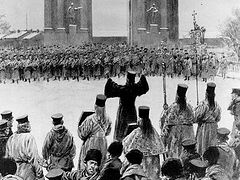
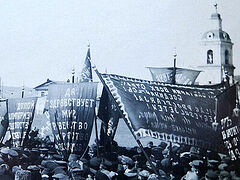
Additional troops were introduced into the capital. Messages prohibiting any demonstrations were posted on houses. The English and French press, covering the events of January 9, wrote that the workers did not violate the prohibitions, as this was a procession of priests with icons (in fact, the priest Gapon and company forcibly took several icons and banners from one of the chapels). However, the Socialist-Revolutionaries and agents of the RSDLP1 accompanying the procession were armed and fired at the military. Activists provoked the demonstrators to beat Cossacks and soldiers.
 Georgy Gapon and I. A. Fullon in the “Assembly of Russian Factory Workers of St. Petersburg.” Having learned that the workers’ petition of January 3, which was read at meetings of factory workers and employees and initially contained exclusively economic and “trade union” issues, the police, under the influence of advisors from revolutionary parties (Union of Liberation, Socialist-Revolutionaries, Social Democrats), were beginning to take on increasingly politically-colored content (for example, the convocation of a Constituent Assembly, the adoption of a Constitution, and the cessation of the war with Japan). They attempted to restrain the priest Gapon through church channels, and on January 8 decided to arrest him. Father Georgy did not appear for a meeting with Metropolitan Anthony and went underground. The rebels fashioned from “Pop Gapon”2 not just the image of a leader of the workers’ movement, but the leader of the revolution.
The provocation of January 9 was paid for with Japanese money and informationally prepared by England. This was a conspiracy.
The provocation of January 9, as it later turned out, was paid for with Japanese money and informationally prepared by England. This was a conspiracy. And there is no need to be afraid to speak about it. Let us recall that talk about conspiracy theories and conspiracy theory, usually accompanied by smirks from opponents, is always advantageous to the conspirators, who slyly attribute it to paranoia and thereby discredit the very subject of discussion. But in reality, are there no secret conspiratorial communities—terrorists, bandits, spies, mafia, corrupt officials, special services, smugglers, sectarians, or revolutionary underground? Most often, these groups act covertly, strive to take over the media in order to acquire political weight, control and manage public opinion, and informationally support the political initiatives or economic interests of their group. Naturally, in most cases conspiracy is difficult to expose. But as the Gospel says, For there is nothing hid, which shall not be manifested; neither was any thing kept secret, but that it should come abroad (Mk. 4:22); for nothing is secret, that shall not be made manifest; neither any thing hid, that shall not be known and come abroad (Lk. 8:17).
The time has come, and that which was kept secret about 1905–1907 has become manifest. For example, the historian of this period K. V. Kremenetsky (USA) has published a dozen articles scrupulously proving the man-made nature of the myth created in Europe about the “first Russian revolution,” the falsified character of the “autobiography” of Georgy Gapon, the creation of which the priest himself was indirectly related, and the information blockade of real facts from this period. The correspondence of diplomats and politicians of various countries have now been published, revealing the history of all-round support from their side for terrorists operating in Russia, and the procedure for financing armed struggle on our territory.
Now one can speak with confidence about the creation in this period of a consolidated interstate project of “big lies” about Russia.
Now one can speak with confidence about the creation in this period of a consolidated interstate project of “big lies” about Russia.
One of the important reasons for this consolidation was the fear of the Russian Empire’s economic growth—which at the turn of the centuries began to outpace the leading European countries. Over forty years (1861–1901), the length of railways increased thirty-nine times. The growth rates of industry over the same period multiplied seven times (over the same period in Germany—five times, in France—two and a half times, and in England—two times). In the south of Russia, the largest industrial centers in Europe appeared with mining, metallurgical, and machine-building factories. For the first time in monetary policy, the “golden ruble” was introduced, opening the gates for foreign investments. Especially frightening to Europe and the USA was the significant increase in Russia in coal and oil production. Not to mention the Russian export of timber, grain, and textiles, which historically were the main sources of obtaining free funds necessary for the industrial development of the country and its military sovereignty. Only internal turmoil and chaos could stop Russia in its economic progress and increase in defense capability.
Only internal turmoil and chaos could stop Russia in its economic progress and increase in defense capability.
The duration of the turmoil depends on the organization of opposition forces and on money—very big money. It is believed that the financing of the rebellion was provided by Japan. Even the amount was named and later confirmed by documents as at least one million yen spent in 1904–1905.3 However, the preparation of the rebellion, informational support, incitement, coordination of actions, and collection of donations for the revolution were provided by England and the USA. All this also cost considerable money. To be convinced of this it is sufficient to study the history of the activities of the “Society of Friends of Russian Freedom” in London and New York. In particular, the banker Jacob Schiff financed Russian revolutionaries through this organization from 1905. In America, a great role in supporting the rebellion and collecting money was played by the writers Jack London and Mark Twain, who personally participated in this.
The future leader of the Kadet Party, Pyotr Milyukov, who was on a lecture tour in the USA in 1904–1905, was struck by the “most extensive description of reliable events” of “Red Sunday” in the American press, although now it is clear that the facts in these descriptions were significantly distorted. For example, the presence of weapons among the “peaceful procession” on January 9 was in every way concealed and later denied, but now this fact is confirmed both by documents on one side and by testimonies on the other. It was they who provoked the retaliatory use of weapons by policemen and military personnel.
 January 9, 1905. Cavalrymen at the Pevchesky Bridge detain the procession’s movement to the Winter Palace.
Let us recall that demonstrations came from eleven city points, but bloodshed occurred only in three or four. For example, there is this testimony:
“Well, on Morskaya they could not help but shoot,” said the gentleman. “There they [the protestors] began killing officers. I myself saw how several people rushed from the sidewalks to a general who was passing by in a cab, knocked off his hat, and began beating him on the head, face, and back, until the soldiers approached.”4
Let us cite more examples from published documents—for example, reports of the prosecutor of the St. Petersburg Judicial Chamber E. I. Vuich to the Minister of Justice N. V. Muravyov from January 4–9, 1905. We are interested in the reports from January 9, which contain details related to armed provocations. We read:
-
“Someone from the workers hit the sergeant-major on the head with an icon, and a shot from a revolver was fired at another [officer] of lower rank”;
-
“By shots, the assistant bailiff of the Peterhof district Zholtkevich was severely wounded by a bullet in the back through and through, and the district supervisor Shornikov was mortally wounded and soon died in the hospital”;
-
“On Morskaya Street, two shots from revolvers were fired at the detachment of the Horse-Grenadier Regiment, which was under the command of officer Solovetsky”;
-
“There were several cases of attacks on generals, officers, and cadets. Among the victims are known General Rudanovsky and General-Major Elrich, assigned to the General Staff, of whom the first was beaten, and the second received a knife wound to the temple and was sent to the palace hospital”;
-
“Another group of factory workers attacked the policemen… and, having taken away a saber from one of them, inflicted several serious wounds on him”;
-
“The crowd… approached the nearest houses on the 4th and 5th lines, from where a shot was soon fired at the troops.”
 Emelyan Mikhailovich Yaroslavsky, chairman of the “Union of Militant Atheists” and the Anti-Religious Commission under the Central Committee of the RCP(b)—Central Committee of the VKP(b). Or this eloquent testimony by Emelyan Yaroslavsky, who later (after the 1917 revolution) was the creator of the organization “Union of Militant Atheists,” who boasted that he was an armed participant in the events of January 9. In 1926, he wrote:
“I remember how on the eve of January 9, Gapon told the workers at one meeting: Do not take weapons with you, take breadrolls with you, because you may have to wait, and you will get hungry. I spoke after Gapon and told the workers: do not take breadrolls with you, but a good revolver. If anyone has grenades, take grenades, because they will not feed you with breadrolls but with lead, and you need to have something to respond with.”
Here is the testimony of the Gaponite worker A. E. Karelin (1922):
“It must be said that neither Gapon nor the leading group believed that the Tsar would receive the workers or that they would even be allowed to reach the square. Everyone knew well that the workers would be shot, and therefore, perhaps, we were taking a great sin upon our souls.”
In the memoirs of another Gaponite worker N. M. Varnashev (1924), we read:
“Everyone clearly realized the moral responsibility for the impending victims, for no one had any doubts about the bloody reprisal… Autocracy and the popular notion of the ‘Tsar-Batiushka’ associated with it must drown in blood shed by the Tsar and his clique. On whose heads the blood of the innocent will fall—time will judge.”
One of the close associates of the priest Georgy Gapon, journalist A. I. Matyushensky, in his curious work, Behind the Scenes of Gaponism. A Confession, (1906) wrote:
“I pushed women and children into the slaughter in order to more surely achieve the set goal. I thought: The destruction of adult men will be forgiven, but women, mothers with infants at their breasts—never! So let them go, I thought to myself, let them perish—and with them, the only symbol that has shackled Russia with chains of slavery, torment, and groans.”