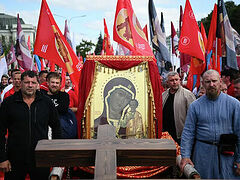
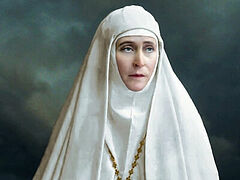
On November 1, 1864, a daughter, the future Grand Duchess Elizabeth the New Martyr, was born into the Protestant family of Grand Duke Louis IV of Hesse-Darmstadt and Princess Alice, daughter of Queen Victoria of Britain. Every year, in the historic imperial Estate of Ilyinskoye Usovo in the Krasnogorsk district of the Moscow region, the St. Elizabeth Cross Procession takes place. We talked with Mother Elizabeth (Smelik), the Abbess of the Convent of St. Mary Magdalene Equal-to-the-Apostles in Gethsemane (the city of Jerusalem), who usually participates in this procession, about why it is so close to the hearts of Orthodox Christians, and not only from Russia.

—Mother Elizabeth, you recently took part in the St. Elizabeth Cross Procession. Please tell us about this event.
—The procession takes place every year in the Krasnogorsk and Odintsovo districts, where the estate of Empress Consort Maria Alexandrovna (1824–1880), Emperor Alexander II’s wife, was situated. Maria Alexandrovna had health issues, and doctors recommended that she exchange rainy St. Petersburg for a more temperate climate. So Maria Alexandrovna ended up in the Ilyinskoye Estate near Moscow, which became her summer country home. Maria Alexandrovna opened a hospital, a pharmacy and a school for peasants there. Subsequently, the estate was inherited by Maria Alexandrovna’s son, Grand Duke Sergei Alexandrovich and his wife, Grand Duchess Elizabeth Feodorovna. In the fall, the family would move to the warm winter mansion in the neighboring village of Usovo. This move from the summer mansion to the winter one became the route of the cross procession.
—Mother Elizabeth, how long has this cross procession existed? Who initiated it?
—The St. Elizabeth Cross Procession has been held annually since September 2011 on the Sunday closest to Grand Duchess Elizabeth Feodorovna’s name day (September 18). Its route was drawn up by the Elizabeth-Sergei Educational Society Foundation for the Revival of the Traditions of Mercy and Charity.
—Is the procession dedicated to the holy Royal Martyrs?
—The procession is chiefly dedicated to the estate owners: Empress Consort Maria Alexandrovna, Grand Duke Sergei Alexandrovich and his wife, the holy Grand Duchess Elizabeth Feodorovna, but many people also walk in the procession with icons of the holy Royal Passion-Bearers Tsar Nicholas II and his family. This year [the interview was taken in 2024.—Trans.] we also mark the bicentenary of the birth of Maria Alexandrovna, the 160th anniversary of the birth of Grand Duchess Elizabeth Feodorovna, the 140th anniversary of the wedding of Sergei Alexandrovich and St. Elizabeth Feodorovna, the 160th anniversary of the imperial Estate of Ilyinskoye Usovo and the 150th anniversary of the birth of Hieromartyr Sergei Makhaev (1874–1937; feast: November 19), a close companion of Sergei Alexandrovich and Elizabeth Feodorovna. This year’s procession is dedicated to so many memorable dates!
 Grand Duke Sergei Alexandrovich and Grand Duchess Elizabeth Feodorovna
—How long does the procession last? What is its usual route?
—This procession is not hard to walk: it lasts for several hours and is about three or four miles long. It starts with the Divine Liturgy at the Church of the Icon of the Savior, “Not Made with Hands”, in the village of Usovo and at the Church of the holy Prophet Elias in the village of Ilyinskoye. After the services, everyone meets by St. Elias Church and from there at around noon with prayer and singing the procession participants walk to the village of Usovo. Along the way, they pass by the historic buildings of the infirmary, opened by Grand Duchess Elizabeth Feodorovna in memory of her assassinated husband; the maternity home in Ilyinskoye, built by the decision of Grand Duke Sergei Alexandrovich in memory of Grand Duchess Alexandra Georgievna, the wife of his brother Grand Duke Pavel Alexandrovich who died in childbirth in Ilyinskoye; and the building of the public primary school in Usovo, founded by Empress Consort Maria Alexandrovna. These buildings are now used as museums.
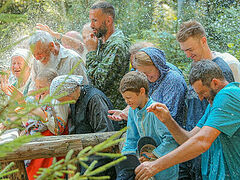
En route the procession meets the Moskva River. They cross it on a pontoon bridge and on rafts. While crossing the river, they normally read the akathist to Grand Duchess Elizabeth the New Martyr, and pray for Russia. This year, God blessed us with good weather, and the crossing was not difficult. In previous years, when it rained, it took a long time for everybody to cross the river. People would get wet and frozen, and it was a bit of a challenge. After crossing, the procession participants arrive at the church of the village of Usovo, the terminus of the procession, where they celebrate a prayer service to the holy Royal Martyrs and St. Elizabeth the New Martyr.

—Mother Elizabeth, the St. Elizabeth Cross Procession is not yet as famous as, say, the “Royal Days” Cross Procession in Ekaterinburg. How many people participate in it?
—There were about 5,000 participants this year. The procession was headed by Bishop Theognost of Bronnitsy and the retired Metropolitan Joseph (Maslennikov). There were many clergy and monastics, and some abbesses take part as well. Many families walk with children.
—Are the procession participants mostly from Russia?
—You are right. They come from Moscow, the Moscow region, St. Petersburg, Arkhangelsk, Kaliningrad, Perm, Ekaterinburg, Kaluga, Bryansk, Vologda... And I flew from the Holy Land. Our Convent of St. Mary Magdalene is closely connected with the Imperial Family.
—How exactly?
—In 1859, Emperor Alexander II founded the Palestine Committee, chaired by Grand Duke Konstantin Nikolaevich. Its main task was to establish churches, hospices and other charities in the Holy Land. Maria Alexandrovna, Emperor Alexander II’s spouse, took the most active part in the work of the Imperial Palestine Society. She donated funds for the construction of a school for Arab girls and a hospital for pilgrims.
Five years after Empress Maria Alexandrovna’s death, Emperor Alexander III and his brothers decided to build a church in memory of their mother and in honor of her Heavenly patroness—St. Mary Magdalene. Archimandrite Antonin (Kapustin; 1817–1894), the head of the Russian Ecclesiastical Mission in the Holy Land, was involved in the construction of the church. He showed the site for the possible construction of the church on the slopes of the Mount of Olives, not far from the Tomb of the Mother of God. The Grand Dukes liked the plot and decided to buy it, but there were difficulties with registration. The Ottoman Empire, which ruled the Holy Land at that time, did not want to sell it to Russia. Then Russia hinted at a possible war with Turkey, and the plot was immediately registered.
In 1888, the church was consecrated. Grand Duke Sergei Alexandrovich and his wife, Grand Duchess Elizabeth Feodorovna, attended its consecration. At that time, she had not yet converted to Orthodoxy. When St. Elizabeth Feodorovna saw the church of snow-white Jerusalem stone, her heart was so touched that she said she would love to be buried there. The Lord answered her prayer. After her martyrdom in Alapaevsk, the relics of Sts. Elizabeth Feodorovna and Nun Barbara arrived in the Holy Land in a roundabout way with great obstacles and are now in our church. And the name of Empress Consort Maria Alexandrovna is commemorated here at every Liturgy. That’s the link our convent has with the Imperial Family, which is why I am here to take part in the St. Elizabeth Cross Procession.

—Mother Elizabeth, despite the extremely tense situation in the world, you were not afraid to come this year to participate in it.
—I had participated in this procession several times. This year is very special—the bicentenary of the birth of Maria Alexandrovna. In the village of Usovo, near the building of the public primary school that Empress Maria Alexandrovna founded for peasant children, a monument was unveiled to her and her sons—Grand Dukes Sergei Alexandrovich and Pavel Alexandrovich. I wanted to take part in this event.
—What are your impressions after the procession?
—Many impressions! I am very happy to meet people. I meet both old acquaintances and new people here. A lot of interesting people walk in this procession. And, of course, the general prayerful atmosphere is inspiring.

—Mother Elizabeth, what advice would you give to those who have not yet participated in the St. Elizabeth Cross Procession yet? Those who are afraid that they won’t be able to walk all the way?
—You can drive towards the end of the procession and walk a little with everybody. It is very important to pray at the churches at the beginning and at the end to feel the power of such an event. I hope that those who have not yet taken part in the St. Elizabeth Cross Procession will not fear and be sure to take part.