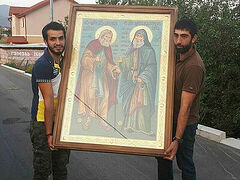
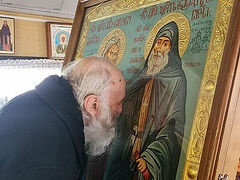
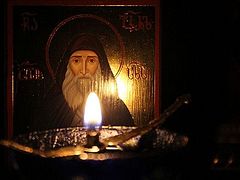
November 2, 2025, marks exactly thirty years since the Venerable Gabriel (Urgebadze) reposed in the Lord. The earthly journey of the Elder of Samtavro concluded, yet his love, prayers, and merciful care have remained with us, becoming an invisible mainstay for millions.
We publish three stories shared by Constantine Tsertsvadze, the author of films about the Venerable Gabriel, recounting vivid instances of the Elder’s merciful love, which Constantine himself witnessed.

“You will come to my film!”
For me, the words, “I believe that Elder Gabriel does not abandon us,” have lost their initial form, as this belief has transformed into an indisputable, living knowledge. I do not merely believe—I see, breathe, and feel the Elder’s invisible, grace-filled hand. Father Gabriel came to me during the most severe moments of my life—in 2011, when my father passed away in my arms, and in 2015, when the tragic news of my brother Joseph’s death shattered my soul. And, of course, the Elder’s invisible presence was clearly felt during the production of the films “The Elder’s Diadem” and “I Am Waiting for You at Samtavro…”
In the winter of 2017, we had another screening of the film The Elder’s Diadem at the Pokrovskie Vorota Cultural Center in Moscow. I remember concluding my brief introduction about the film’s creation. The lights dimmed in the hall—and literally, from the very first frames, a sound of weeping came from the back rows. This happened often: many people who saw our films said they could not watch them without tears. But when the sounds of weeping escalated into bitter, heartbroken sobs, we had to stop the screening.
We helped the crying woman calm down. And when she was able to speak, something happened that caused everyone to freeze in sacred awe: “Please forgive me! I cannot help but repent and testify to a miracle,” she said. “In the 1980s, our group went on a tour to Georgia. One day, we were walking along the central avenue of Tbilisi. Our attention was drawn to a strange priest who, dressed in ragged clothes, was walking and shouting: ‘Love Christ! Love Catholicos Ilia! Love... Love...’ And a few people were following him, repeating: ‘Amen!’”
The woman confessed that, to her, who not a church-goer at the time, this seemed so unusual and, at the same time, ridiculous that she burst out laughing, thinking, “What a madman. And what is this? Probably some kind of sect.” And at the very moment this thought flashed through her mind, the strange priest, as if reading her thoughts, turned around, looked directly at her, and, as she put it, “very funnily” said:
“You came to Georgia and started judging everyone. Go on, laugh! Just watch out that this laughter doesn’t turn into tears! You will come to my film! You’ll come, where else will you go!”
And he continued on his way. She took the words, “watch out that this laughter doesn’t turn into tears,” as a curse. And now, decades later, seeing those frames on the screen, she recognized him.
“I saw him on icons, but I couldn’t recognize him. But here, in the video... My God! That is the very eccentric! My Elder Gabriel!”
We were stunned, deeply shaken by this clear testimony to the Elder’s clairvoyance. His prophecy was fulfilled in the literal sense, turning the laughter of judgment into tears of repentance, and doing so during the screening of the film about him.
 The second, equally memorable, instance is connected to my goddaughter, Ketevan. From a young age, she showed a delay in speech development, followed by impaired social skills, withdrawnness, and irritability. Doctors suggested autism. I learned about this upon returning from a long trip, during which we had traveled with the icons of the Venerable Seraphim of Sarov and Gabriel of Samtavro. I did not take this news as a tragedy then, seeing people with autism as those who perceive the world in special colors. But, of course, this did not eliminate the difficulties.
On my next visit, I brought an little reliquary with the relics of Elder Gabriel. We lit candles and read the Akathist. Three-year-old Ketevan was initially unable to focus on the prayer, but after a few minutes, she calmed down, began kissing the icons, and pressing the image of Elder Gabriel to her heart. Later, we took her back to my place. In the car, as we drove, I turned on a video segment about the Elder that we were preparing at the time. A few minutes passed, and Ketevan, reaching out her hand to the phone screen, suddenly laughed and pronounced: “Babua!” (which translates from Georgian as “Grandfather”). A shudder of reverence for this miracle overtook us.
And after that, the presumed autism vanished as abruptly as it had appeared. Ketevan soon began to talk and socialize. She is seven years old now. She is a wonderful girl, does well in school, and dearly loves her “Babua”—Elder Gabriel.
And the third incident, which I have never publicly recounted, occurred at the end of 2020. I underwent emergency surgery. The situation required such immediate intervention that I was completely bewildered and physically did not have time to go to Samtavro to venerate the Elder’s relics. I only called my spiritual father to ask for a blessing and prayers. When I was taken into the operating room, I felt on the verge of a nervous breakdown. The surgeon and his assistants, those wonderful, kind people, tried in every way to calm me down. I was especially afraid of the anesthesia. I prayed silently to the Elder, distraught that I had not been able to venerate his relics. And, of course, I asked St. Luke (Voino-Yasenetsky), the great physician and saint, to intercede for me and bless the hands of the operating medics.
I remember my anxieties about the anesthesia. Previously, when I had surgery, I was given an intravenous anesthetic, and the doctor asked me to count to ten. I remembered nothing after “four.” This time, I did not know that they would be administering an inhalation form of anesthesia, not intravenous. A mask was brought, and I decided it was just oxygen. And then a storm of thoughts began in my head: “When the doctor tells me to count to ten, which language should I count in?! In Georgian—for Elder Gabriel, or in Russian—for St. Luke?” What was I thinking?... But the doctor said, “Alright, Kostya, breathe in.” And I inhaled the anesthetic with all my might, thinking it was an oxygen mask. Naturally, my memory cut off at that point—until the intensive care unit.
 I was half-asleep, without the strength to open my eyes. Suddenly, I distinctly heard the Elder’s prayers. And later, as I regained consciousness, I recalled Elder Gabriel entering the ward and inviting St. Luke to follow him, with words full of his unique humor:” Your Eminence, here is Constantine, who speaks both Georgian and Russian well. Will you help him? He prays to you in Russian, and to me in Georgian. He likes to show off!” St. Luke was smiling and blessing me, the doctors, and the ward with the sign of the cross... As a result, I was moved to a regular ward the very next morning after the operation. The doctors were amazed, saying they had not expected such a quick transfer. And after only three days, I was discharged from the hospital altogether, with them calling my recovery incredibly rapid. After all that I have lived through, after these living, tangible miracles, how can I not be astonished and full of wonder? Many reproach me: “You’re always busy with films about the Elder; why more films?” But how can I stop? How can I not strive to make sure that as many people as possible learn about the Saint’s love, his humor, his clairvoyance, and his teachings, if I have seen him face to face in the most critical minutes of my life?
My creative work is not a job, but a vocation. Through our films, I want to convey to the world the message of the light that shines from Samtavro. I cannot be a cold spectator of his life. I rejoice in every miracle, live through every word, and become steeped in every thought of our texts, music, and video.
Frame by frame, I die together with Father in his sorrow, loneliness, and the world’s misunderstanding, as if I found myself with him in prison and the psychiatric ward where he suffered torments for Christ’s sake. It is impossible to write texts for a film or an article, or to process a script, without feeling this pain, which is necessarily connected with joy in Christ. And so, by God’s mercy, the work of our creative team becomes a reflection, a mirror of your and my love for the Elder. And this mirror will soon show the Father’s light to the world.