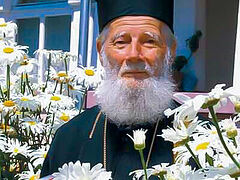
Before his repose, Abba Iulian (Lazăr) was the most visited confessor of the Romanian Prodromou Skete on Mt. Athos. His spiritual children, monks, and laymen would come from all over, crossing land and sea to receive his advice and help. He chose the monastic path at the age of twenty and entered Sihăstria Monastery. He spent thirty years there in the school of Romanian eldership under the care of the great Elders Cleopa (Ilie) and Paisie (Olaru) and others. In 1977, when the Sihăstria brothers went on pilgrimage to Mt. Athos, Hieromonk Iulian remained on the Holy Mountain. The blessed Elder was ninety-seven when he reposed on March 10, 2023. He had spent forty-two years as a spiritual father in Prodromou Skete. The following interview was published in the “Familia Ortodoxa” magazine in 2011.
***
—Father, our times are difficult for all people. All kinds of sins have multiplied as if we’re living through the last times—and they’ll come, as is written in the sacred books, when love between neighbors grows cold and there will be no path from brother to brother. What should we Romanians, a Christian people that seems so far removed from Christ, do in these times of great trials?
—First of all, let us delve into the word of the Savior, Who tells us: Whatever you do, without Me ye can do nothing (Jn. 15:5). That means that whatever we do, we must always flee to Him, for He alone teaches us the right faith. And let us live by faith, as it says in the Acts of the Apostles: Let us seek God, For in Him we live, and move, and have our being (Acts 17:28). From here, from this search, begins the approach to God, which takes place in conversation with God. To pray means to converse with God, whether we’re praying with someone or alone, and God accepts our prayer. This is how a Christian’s life should be, so he can always be with God. But as Holy Scripture and the Holy Fathers teach us, this is possible only if we pray unceasingly.
Pray without ceasing, pray without ceasing, pray without ceasing (1 Thess. 5:17)—thus the Apostle Paul has been exhorting us since 64 AD, when he wrote the Epistle to the Thessalonians. That means our commandment has always been the same: to pray incessantly. This word is addressed to all people, to all Christians, not to monastics and priests only. For at the time when the holy Apostle wrote this epistle, there were no churches, no priests, no monasteries. There were only Christian communities, founded by the Holy Apostles, where the faithful broke bread and communed of the Body and Blood of Christ. I think we’ll be asked about this word of the Apostle Paul, which was written for us, when we depart for the other world. For he clearly says: Pray without ceasing, not: “If you want to, if you can, then pray without ceasing.”
—Father, but people have children, things to take care of… How can they pray without ceasing?
—And what does this prayer mean? To do good, to act like God is there with you. And if a man has some difficulties, then whatever they may be, let him cry out: “God, help me!” And this is prayer: “God, don’t leave me!”—instead of saying or thinking something else. Then, praying unceasingly means protecting your thoughts and thinking only good things. For thinking and doing bad things doesn’t come from God. God means only good; God is love.
You can see, however, that the mass media, TV, internet, and all those kinds of things seriously hinder us from loving God. For the Apostle James says quite beautifully: Ye adulterers and adulteresses, know ye not that the friendship of the world is enmity with God? (Jas. 4:4). After all, what does the mass media bring us if not the spirit of this world?
So whoever wants to be a friend of the world becomes an enemy of God. Don’t think you won’t become an enemy to God if you’re a friend of the world… Friendship with the world is everything starting from comfort, laxity… This is where a man begins to separate himself from God. After all, at first people tell themselves that they’re with God but also with the world, but this doesn’t last long. The Revelation of St. John the Theologian clearly says that we have to be either cold or hot, but since thou art lukewarm, and neither cold nor hot, I will spue thee out of my mouth (Rev. 3:16). That is, you’re neither one thing nor the other—you’re lukewarm: This way is good, and that way is good, and this is good, and that is good. Such is life in the spirit of the times.
 —Neither separating from the world, nor seeking God more fervently...
—It’s the same as serving two masters. But you can’t serve two masters; you can’t serve God and mammon (Mt. 6:24). What communion hath light with darkness? (2 Cor. 6:14). And this is how a man begins to gradually separate himself from God.
And drawing nearer to God is to reject everything: Reject the world, all the passions of the world, the debauchery of the world, which begins with too much comfort—but today man just wants to live better and better. And until a man closes himself off from everything that the world brings, he can’t find God. So in order to find God, he has to leave the world, leave all that surrounds him and prevents him from finding God and living in Him.
—But a man thinks: “Ok, so I’ll leave the world, but what will I receive in return?”
—When we left the world, we drew near to God—it’s not possible any other way. And if Christ is with us, then we can do everything, because we know that we can’t do anything without Him. This is the life of a Christian: to seek God at all times in all things.
But maybe someone will say now: “But I have my own things to take care of: I have children, I have to work, so how can I find God?” You’ll find God, oh man, you’ll find Him. If you have troubles, then always call out: “God, help me!” Then, wherever you may be, God will be with you.
I found this in The Art of Prayer1—the writings of the Holy Fathers on the Jesus Prayer: “Have a sense of the presence of God and the fear of God.” That is, wherever you are, act and behave with the thought that you’re standing before God—because you are. We’re all standing before the face of God. God is invisible, incomprehensible to the human mind, but in Him we live, and move, and have our being, as is written in the Acts of the Apostles (17:28). We’re always before God, no matter what we do or think. And God sees and hears everything—we must always keep this in mind. It’s a great thing.
—Father, what can we do to be more aware that we’re always standing before God?
—There’s a really beautiful prayer you can say when you begin speaking with God, when you go into your room to pray: “Lord, I thank you, Lord, that you allow me to speak with You.” Then you’re talking to God! Man speaks with God! Think about the fact that you’re speaking with God—it’s a great thing. You’re speaking with God, and He wants it; He calls us to speak with Him: Because it is written, Be ye holy; for I am holy (1 Pt. 1:16). That’s how God wants us to be—to be holy, to be near Him.
So, go to your room and begin: “I thank you, Lord, that you allow me to speak with You, O God.” And then say to Him: “Forgive me, Lord, that I sinned, thinking I was alone; but I did it before Your face, O Lord. Everything I thought, everything I did, was before Your face. But I was insensitive and didn’t think of You.”
This is where man begins. And reaches compunction of heart, tears, and the point where he would never want to depart from God again. For then the grace of God descends, for the gift of tears comes, and man thinks about his life and says: “Lord, it was before Your face! And I’m perplexed by my life, I tremble before Your face when I think about my life. Everything I thought, everything I did, took place before Your face.
And that’s the way it is; everything happens before the face of God. We’ll never be able to hide from God. We’re not alone and never were. Every sin we’ve committed, all the good we’ve done—all of it was before the face of God. And this prayer is very beautiful—a prayer through which man comes to contrition of heart and repentance. After all, what does God wants from us? For us to cast away all sins—this is repentance, to cast off all the sins we’ve committed.
“Lord Jesus Christ, Son of God, have mercy on me, a sinner”—this is a prayer we know from St. Nicodemos of the Holy Mountain. Many have labored in it and have attained a high measure. There are other good prayers that can also be repeated. If you cling to another prayer, that’s also good, as well as prayers to the Mother of God. There’s a prayer that’s sung at the litiya: “Rejoice, Virgin Theotokos, Mary, full of grace, the Lord is with thee. Blessed art thou among women and blessed is the fruit of thy womb, for thou hast borne the Savior of our souls.” Man, if you say this prayer, it’s like a prayer offered by the angels—after all, it comes from the Gospel of Luke: Hail, full of grace, the Lord is with thee… Blessed art thou among women, and blessed is the fruit of thy womb (Lk. 1:28, 42). This is very beautiful! Some people learn one, some another.
And “Lord Jesus…” Whether you’re walking somewhere, or waiting in some hall… Say this prayer for ten minutes every day—at least ten minutes, or a quarter of an hour, in a quiet place. Sit, as it’s said, on a bench as high as the palm of your hand—be careful not to fall off it—and say: “Lord Jesus…” This is done for a quarter of an hour, then twenty minutes—if you can, then longer. And the swarm of thoughts that will attack you then-- from this point on you certainly need a spiritual father to reveal this to. This is the work of prayer. The saints practiced this too.
One spiritual father told me that one of his disciples would say, “Lord Jesus Christ…” as she did housework. Her children heard her and also began to say the prayer—and they weren’t even ten yet. And since they repeated it all the time, the prayer took root in them, and the children would say it even in their sleep.
—Why is it good for parents to pray out loud at home?
—It’s good for the children to hear it, because then it enters into their minds. If you give a child something, it enters his mind and spins around in there—just like that. Let prayer spin around in there rather than something else.
—That means when the mother and father are home, they could say first this prayer then another as they do some manual labor.
—When they’re doing some work—“Lord Jesus Christ…” or any other prayer. There are also some very beautiful words from Mt. Athos: “Seek Jesus, for He is hidden in the commandments: By fulfilling His commandments, you uncover Him. The whole of the faith is contained in the commandment He gave: Love God and your fellow man.”2 This is the whole of the Law.
To be continued…