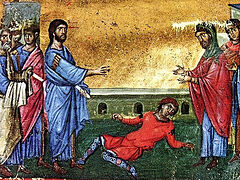
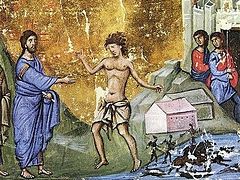
The Miracle of the Gaderene Swine. Briton Riviere, 1883.
Today’s Gospel reading (Luke 8:26–39) tells of the Gadarene demoniac. This account appears in three Gospels, and accordingly, it is read three times a year. Two of those readings are appointed for Sunday Liturgies, which shows how greatly the Church values this passage. Let us read it together today.
And they arrived at the country of the Gadarenes, which is over against Galilee (Luke 8:26)—so begins this reading.
The “country of the Gadarenes” refers to the region around the city of Gadara. Today, the ancient Gadara is represented by the vast ruins of Umm Qeis, the remains of which still testify to the city’s former grandeur. Near Gadara lies the city of Gergesa, mentioned by the Evangelist Matthew in his version of this same story about the possessed man (Matthew 8:28). The ruins of Gergesa are even more striking and abundant—three churches, two magnificent marble amphitheaters, and numerous columns still speak of the wealth of those cities. Most of these structures were built after the Roman conquest in 63 B.C., but even during the time of Christ’s ministry, these cities were prosperous.
The tombs of Gadara, in which the demoniac dwelt, are caves hewn into the limestone rock. The few present-day inhabitants of Umm Qeis still use them for various purposes.
Gadara lies about fifteen kilometers from the Sea of Galilee, which has led some historians to suggest that the biblical “Gadara” might refer to a different city altogether. Whether this is so is difficult to say. However, the Gospel does not say “the city of Gadara,” but rather “the country of the Gadarenes,” which may refer either to the outskirts of the city or simply to the general direction. Moreover, the Gospel itself notes that the man was driven by demons into the wilderness (cf. Luke 8:29)—that is, into uninhabited desolate areas.
But let us proceed in order.
The first thing that strikes us in this story is the encounter between Christ and the demoniac.
The man possessed by demons did not flee in terror from the Lord; rather, when he saw Him from afar, he ran to Him and worshiped Him (cf. Mark 5:6). In trembling, creation bows before its Creator—even such a creature as this, who had fallen away from the Creator’s will...
To whom, then, can unbelieving people be compared, if even the demons, though unwillingly, bow before God?
And Jesus asked him, saying, What is thy name? And he said, “Legion,” because many devils were entered into him (Luke 8:30).
In case someone does not know, a “legion” was a Roman military unit.
How many soldiers do you think were in a legion?
At different times the number varied, but by the New Testament era, a legion usually consisted of five to six thousand infantrymen, plus several hundred cavalry. Imagine that!
You know, sometimes before we take an extra bite at the table, or judge someone, or do something improper, we think, “What harm could come from this? Nothing terrible will happen.”
But in truth, there is no bottom to the abyss of our fall.
Just as countless demons can enter the body of one man, so the soul can absorb a countless multitude of sins—and still not be filled, not be satisfied with its lawlessness.
When it takes in too much food, even the stomach turns itself inside out; but the soul may not do so—unless a person himself strives to cleanse it. That is why the Lord has set a limit to our earthly existence.
And they besought Him that He would not command them to go out into the deep (Luke 8:31).
What happened next we know well: a great herd of swine was feeding nearby, and the demons entered into them.
The Evangelist Mark even tells us the number of the herd—about two thousand (cf. Mark 5:13). From this we can see that the word “legion” was hardly an exaggeration.
The demons entered into the swine, and, hating all life with a deadly hatred, immediately drove them into the lake to drown.
From this example, we can understand what the unclean spirits would do to the human race if the Lord did not restrain them.
And then the most striking part of the story begins.
When they that fed them saw what was done, they fled, and went and told it in the city and in the country. Then the whole multitude of the country of the Gadarenes round about besought Him to depart from them; for they were taken with great fear (Luke 8:34–37).

An astonishing thing!
A great miracle has just taken place: The terrible and uncontrollable demoniac who had terrorized the whole city is now healed.
He sits quietly, in his right mind, speaking sensibly.
Beside him stands the Man who healed him—clearly no ordinary man, about whom the Gadarenes must already have heard.
And yet they ask Him to leave their city!
What is the reason?
Surely in their town there were the sick, the paralyzed, the leprous, who needed the Healer of bodies; surely there were publicans and sinners, whom Christ came to seek?
Or perhaps—was it simply a matter of the swine?
Imagine this: You raise a few pigs for sale. In Gadara, they clearly raised pigs for trade—for the Jews did not eat pork, but much of the population of the towns around the Sea of Galilee was still Jewish.
Obviously, then, they were raising pigs to sell to the Gentiles, especially to the Romans. So—you’ve invested in six or more piglets (for those who know, profit in pig farming begins only when there are at least six).
You have struggled to raise them, and now, with joy, you are counting your expected profit—when suddenly Someone appears and heals one filthy, deranged beggar in such a way that all your precious pigs end up at the bottom of the lake! What a “miracle,” indeed...
There are several patristic commentaries on this passage that completely contradict one another. For example, Blessed Jerome of Stridon—a saint venerated more in the West than in the East—writes the following: “That they asked Him to depart out of their borders they did not do out of pride, as some suppose, but out of humility, for they considered themselves unworthy of the Lord’s presence, just as Peter, when catching fish, fell at the feet of the Savior and said, Depart from me, O Lord, for I am a sinful man (Luke 5:8).”
However, in this case, it is difficult to agree with Blessed Jerome. After all, St. Peter also said such words, but followed the Lord nevertheless, understanding that He alone had the words of eternal life (John 6:68).
Here, however, we see something entirely different. Much closer to the truth seems the interpretation of Blessed Theophylact of Bulgaria, who writes: “Astonished by the miracle, the inhabitants of that city came out to Jesus, but when they heard the details, they were even more afraid. Therefore they begged Jesus to leave their borders. They feared lest they suffer something worse. Having lost their swine and lamenting that loss, they rejected even the presence of the Lord.”
Indeed, if this Prophet, without even entering the city, had already caused them such material loss, what more might He do if He came into Gadara? Some “prophet,” indeed! So much money and effort wasted, and for what? For the sake of helping a social outcast, a madman, a wretch despised by all.
Such logic was precisely the mindset of the Jewish elite of the time; they expected the coming of an earthly king in glory, who would restore Israel’s former power and bring prosperity to every Israelite individually. Only such a worldview can explain the strange behavior of the Gadarenes.
The same thought is found in St. John Chrysostom, who writes: “That the inhabitants of that city were in a state of insensibility is clear from the outcome of the event. They ought to have fallen down and worshiped Christ, and marveled at His power; but instead, they sent Him away and besought Him to depart from their borders.”
This final lesson is perhaps the most important in today’s Gospel reading, because we ourselves often resemble the foolish and greedy Gadarenes—and we do so without even realizing it, all while outwardly continuing to lead what seems to be a “church-going” life. How many times does Christ come to meet us with His grace, and how many times do we, like the Gadarenes, say to Him:
“No, Lord, I can’t receive You today. Today I want to watch a new film, or visit some friends, or browse the shops, or simply rest—I’m so tired, You know that Yourself. Come back tomorrow instead. Tomorrow I’ll definitely read the Akathist, make some prostrations for my ailing friends, or read the Gospel. Oh, and tomorrow is Wednesday—perfect for a fast. (And if it doesn’t work out tomorrow, I’ll move it to Friday—better yet, to the weekend, so I can thank God for the week gone by.)”
And so, day after day, we are ever more sucked into the swamp of vanity and spiritual sloth.
We cherish our “swine”—those earthly attachments and passions we nurture and protect within our hearts—and we so dread parting with them… that we are ready to trade away divine grace for their sake.
The Lord is meek—He is meekness itself. Just as He once heeded the request of the Gospel swineherds and departed from their borders, so too He will listen to us and withdraw from the borders of our hearts. But then, only a few ruins will remain of our own personal “Gadara” …