Minelaying vessel “Prut”, 1914. Photo: Russian State Archive of the Navy
On October 29, 2025, one hundred eleven years have passed since the heroism of Hieromonk Anthony (Smirnov) of the Black Sea Fleet.
In recent times, attention to the history of the First World War is expressed mainly in addressing local and regional topics, studying individual personalities, and major anniversary events. A small number of book publications are represented mainly by collections of archival documents and memoir literature of state, political, and military figures, which is largely due to the relatively limited number of naval combat episodes in the Black Sea Fleet, compared to operations on the land front. The First World War, in historical perspective, belongs to the relatively recent past. However, the subsequent political transformations—the revolution, the Civil War, and the formation of a state with a different ideology—long displaced the events and their heroes from public discussions.
In this regard, particular significance can be found by turning to the heroic heritage associated with the actions of the minelayer “Prut”—the heroism of the crew and the ship’s priest, Hieromonk Anthony (Smirnov). In recent years tentative discussions have been held within the religious community considering the question of possible canonization of the navy hieromonk.
In August 1914, the Russian Empire entered the world conflict. On the eve of the war, the population of the Sevastopol municipal district was about seventy-two thousand people. On October 16, 1914, martial law was declared in the city; in the fortress district, alcohol prohibition was introduced, mass events were prohibited, and the checkpoint regime was strengthened.
At the beginning of hostilities, the minelayer “Prut” was not one of the new ships; by this time, it had been in service for about thirty-five years. The vessel was accepted into the Black Sea Fleet in 1895 as a training ship for the machinists’ school. In the summer of 1905, a mutiny occurred on board, which ended with the arrest of the participants and the execution of the instigators. In 1909, the ship was converted into a minelayer; it became the largest vessel of this class in the Black Sea Fleet. Along with performing combat tasks, the vessel was used as a training base for students of the mine school, as well as for transporting members of the imperial court and baggage of the Imperial family along the sea line Sevastopol–Yalta.
Vasily Smirnov was born in 1844 in the Samara province, in the family of a priest, and from an early age chose spiritual service. Upon graduation from the Samara Theological School, at the age of nineteen, he arrived at the Moisky Holy Trinity Monastery. The ecclesiastical records characterized him as “very good, capable for the position of treasurer.” The abbot of the monastery at that time was Hieromonk Aaron (Sokolov), who had fought in the Crimean War. The monk spent fifteen years in the monastery. Then, at his request, he was transferred to the Sedmiozernaya Bogorodichnaya Hermitage near Kazan, in whose records his behavior is characterized as “very good.” In 1881, the thirty-eight-year-old Vasily Smirnov took monastic vows with the name Anthony and soon transferred to the Kazan St. John the Forerunner Monastery. Here he performed the duties of confessor at the Kazan Theological Academy and the women’s Bogoroditsky Monastery, which speaks to his high standing and theological expertise. In the spring of 1903, Father Anthony was transferred to the Vysokogorskaya Uspensko-Nikolaevskaya Churkinskaya Hermitage of the Astrakhan Diocese, and three years later—to the Bugulminsky Aleksandro-Nevsky Monastery (Almetyevsk Diocese), where he celebrated his sixty-fifth birthday. The reports of this period of service also contain exclusively positive evaluations.
 “The Heroism of Father Anthony.” Artist: Sergei Alekseevich Makarov, 2021.
The key turning point came in 1909, when he was sent to the fleet for a five-year pastoral service on the military vessel “Prut.” The ship’s priest was provided with a separate cabin, allowed to approach the vessel from the starboard side—a privilege of commanders and holders of the Order of St. George. Going ashore was permitted once a week, on Thursdays, after morning prayer. In the report of 1914, it was noted: “He treats the lower ranks excellently and with love, in all respects a very respected pastor and person.” The ship’s commander characterized him as “very capable for educational and moral guidance activities.”
On October 16, 1914, without a formal declaration of war from Turkey, a strike was inflicted on the city from the ship guns of the German-Turkish battlecruiser “Goeben.” It was answered by eight coastal batteries and the ship “St. George the Victorious.” On this day, miscalculations occurred, as a result of which the “Goeben” passed through a deactivated minefield. The modern German battlecruiser, the flagship of the Turkish fleet, was transferred to the Ottoman Empire by the German side and was distinguished by powerful artillery and mine-torpedo armament. The cruiser “Goeben” was justifiably characterized as an “immeasurably strong enemy.” The operation of the enemy fleet against Russian Black Sea ports began with the aim of inflicting significant damage to the Naval Forces of the Russian Empire and drawing Turkey into the war. The cities of Odessa, Feodosia, Kerch, and Novorossiysk were also subjected to strikes.
The combat logs record the approach of the ships near Cape Chersonese and the fleet’s attempt to stabilize the situation. The “Prut” was returning from Yalta, previously sent to transport an infantry battalion to Sevastopol, but soon received an order to proceed to the base for mine laying. The encounter with the “Goeben” occurred in the area of Cape Chersonese. The destroyers “Lieutenant Pushchin,” “Zhivuchy,” and “Zharky” came to the aid of the minelayer; during the attacks, one of them caught fire, and the crew suffered losses. After some time, with another hit, the “Prut” was seriously damaged.
In conditions of increasing threat of capture of the ship, a decision was made to scuttle it, which predetermined the drama of the subsequent actions of the crew. The order was given by the ship’s commander, Captain Second Rank Georgy Bykov, since the presence on board of seven hundred mines created a risk of powerful detonation, and allowing secret armament to fall into enemy hands was impermissible. The primary risk taken into account was of the enemy capturing the ship before it sank. Lieutenant Alexander Roguzsky initiated the explosion of the powder magazine but perished himself. Contemporaries evaluated this heroic act as “exceptional,” even against the background of numerous examples of heroism during the war.
After the enemy’s signal “I propose you surrender,” to the minelayer, in response, the St. Andrew’s flag was raised, the command was given to abandon the vessel and make their way to the shore on their own.
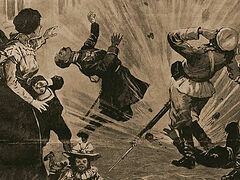
The fire from the “Goeben” on the sinking ship continued, and a fire broke out on the “Prut.” After the enemy’s signal of “I propose that you surrender,” to the minelayer, the St. Andrew’s flag was raised in response and the command was given to abandon the vessel and make their way to the shore on their own. Due to a shortage of boats and the presence of wounded, the ship’s priest refused to take his place, giving it to the sailors. He said these words: “Save yourselves, I have already lived out my life in this world.” The monk donned his vestments, went out onto the burning deck with the Gospel and blessed the sailors, after which the ship with the raised flag slowly went under the water. In the information about Hieromonk Anthony, it is recorded: “Place of death—the sea near Sevastopol.” In that year, his five-year term of naval service was to end.
In the information about Hieromonk Anthony, it is recorded: “Place of death—the sea near Sevastopol.”
The sinking of the “Prut” was a tangible loss for the fleet. The situation that developed after the battle, complicated by errors of naval specialists and the loss of part of the crew, affected the timing and content of the initial reports about what happened. Part of the crew, including the commander, ended up in captivity. Probably for this reason, local and central publications did not immediately report on the battle. According to various data, twenty-six sailors perished along with the ship. In December 1914, the Crimean Herald published the decision of the Holy Synod “to call upon the Orthodox clergy on the nearest established day for commemoration to raise everywhere the name of Hieromonk Anthony at the divine service,” after which commemorations of the ship’s priest of the Black Sea Fleet were held in all churches of the Russian Empire.
The journal Historical Herald published in 1915 detailed recollections of the last days of the priest’s life. He was described as a highly moral and deeply believing pastor. Several episodes of his clairvoyance a few days before the tragedy were also reported. According to eyewitness recollections, on the eve of the battle, Father Anthony told acquaintances: “Why should my things drown in the sea? Take them and keep them.” Shortly before his death, declining a promotion with transfer to a first-rank vessel, he replied: “No, let me go down with the ‘Prut.’” The essay speaks of the priest’s foresight of tragic events, indicating that the pastoral entourage called him a “lamp of faith and virtue.” He did not leave the sailors and officers of his ship, going with them on the last combat mission.
He did not leave the sailors and officers of his ship, going with them on the last combat mission.
On November 7, 1914, Archpriest of the military and naval clergy G. I. Shavelsky presented to the Holy Synod material on the heroism, following the consideration of which in the Church Gazette a call was published “On the raising everywhere of the name of Hieromonk Anthony at the divine service during the commemoration of those who laid down their lives in battle for Faith, Tsar, and Fatherland.”
Soon the edition, In Memory of the Glorious, was published with a photograph of the ship and a list of those who perished on the “Prut,” where along with the sailors are given the names of Lieutenant Roguzsky, Midshipman Smirnov, and Hieromonk Anthony (Smirnov). Of interest are publications in regional diocesan gazettes, published in the places of the monk’s service, where all of them call the priest “their pastor.” Thus, the Astrakhan Diocesan Gazette in May 1915 published an article “In Memory of the Pastor-Hero, Former Resident of Astrakhan,” where it is reported that “Father Anthony was a personality of high morality, deeply believing, a deeply convicted Christian and humble.”
Father Anthony became the first Russian military priest and the only one in the fleet to be posthumously awarded the Order of St. George of the fourth degree.
Father Anthony became the first Russian military priest and the only one in the fleet to be posthumously awarded the Order of St. George of the fourth degree. The Sevastopol press emphasized the unprecedented nature of such respect for the memory of a “simple hieromonk,” and it was also reported about the wide international resonance of the heroism, comparing the death of the “Prut” with the legendary cruiser “Varyag.”