For of Him, and through Him, and to Him, are all things (Rom. 11:36). We often forget this commandment about vigilance against earthly sorrow...
Sergei Fudel
On November 7/20, the Russian Church honors the memory of Hieromartyr Cyril/Kirill (Smirnov), Metropolitan of Kazan. The troparion to this saint begins as follows: “Like the radiant sun, today thy memory has shone forth, O Holy Hierarch and confessor Cyril, illuminating the hearts of the faithful with rays of grace / to glorify God Who is wondrous in His saints and Who granted thee strength in confession and patience in tribulation.” Indeed, during his lifetime the Metropolitan of Kazan showed strength in faith and steadfast patience in tribulation. Let’s take a closer look at his life.

The future new hieromartyr (secular name: Constantine Ilarionovich) was born in 1863 in Kronstadt to a deeply religious family. His spiritual mentor was St. John of Kronstadt. In 1887, Constantine graduated from the St. Petersburg Theological Academy with a Masters in Theology. Constantine was distinguished from his fellow students by his candor, sincere desire to serve the Church of Christ selflessly, and the gift of the living word of a preacher. After marrying a priest’s daughter, he became rector of the Church of the Nativity of the Most Holy Theotokos and a teacher of the Law of God in St. Petersburg. In 1900, he was transferred to serve in Kronstadt, where he was in close contact with his spiritual mentor. St. John of Kronstadt wrote in his will the desire that Fr. Constantine serve his funeral after his death (at that time his spiritual son was already the Bishop of Gdov). His daughter and wife died tragically soon after, and he petitioned for the monastic tonsure.
After becoming an archimandrite, Fr. Cyril obediently went to Persia to head the Orthodox mission in Urmia. There he fruitfully undertook translation, printing, educational, church-building and charitable activities under harsh external conditions. Fr. Cyril was awarded for his labors in Persia. In 1904, by order of Emperor Nicholas II, who knew the talented priest personally, he was presented to the Holy Synod as a candidate for Bishop of Gdov and became vicar of the St. Petersburg Diocese. From the very first days Vladyka Cyril zealously set about performing his new obediences. At that time, the approaching tragic godless times were already felt in St. Petersburg. As an example, on the feast of Theophany the police demanded that he put a vat of boiled water on the bank of the Neva River for its blessing, which the bishop turned down. One of his contemporaries, the spiritual writer Sergei Nilus (1862–1929), wrote about this: “Fortunately, not everyone has yet departed from the anchor of our salvation, and in St. Petersburg the Lord has preserved for His chosen ones one bishop who has not agreed to compromise his faith for the sake of peace with the enemies of the Church of Christ... Cyril of Gdov is the name of this bishop. May his name be blessed throughout all generations.”1
Soon Bishop Cyril was given a separate diocese, of Tambov. His contemporaries wrote about him in a local newspaper as follows: “The new bishop made a captivating impression with his cheerfulness, kindness and fatherly treatment of everyone.”2 In the land of Tambov, Vladyka was close to the people, setting reception hours for ordinary people, and introduced in churches the joint singing of such prayers as the Creed, Our Father, and “It is truly meet”. He liked to celebrate long services, according to the rule of the Monastery of the Kazan Icon of the Mother of God in Tambov. He preached vividly and fervently. In particular, he stressed the importance of observing fasts: “As an archpastor, I must warn you that the day will come when all those who do not recognize fasts and take the rules of the Church lightly will regret it bitterly.”3 In another sermon he called out, “Don’t believe that it’s easy to attain salvation!... It is not in vain that the Church so honors the Holy Cross as a symbol of our salvation... In order to inherit the Heavenly Kingdom we must exert all our strength and stand at the height of our rank… We must cherish the time of our earthly life that the Lord gives us as a great treasure, and not waste a single crumb of it on fun, debauchery, public merrymaking and all sorts of foul things.”4
Vladyka Cyril did not neglect the future pastors of the Church, visiting the Tambov Theological Seminary, to the delight of the seminarians, exhorting them to remember the heights of pastoral ministry and the importance of living according to the Gospel. St. Pitirim, Bishop of Tambov (†1698; commemorated July 28/August 10), was canonized under him, and charitable activity and aid to those in need gained strength.
With the outbreak of the First World War, Bishop Cyril often visited the hospitals and remote parishes of the diocese, bringing joy, hope and encouragement to those who met him and listened to him. But dark clouds were gathering over the Russian Church, and it was becoming more and more dangerous for him to make such journeys.
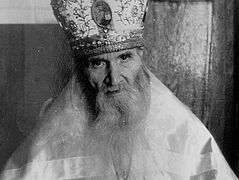
 Bishop Cyril (Smirnov) of Gdov, photograph of the early twentieth century The future hieromartyr took the Emperor’s abdication from the throne hard, presciently warning the flock of the difficult times ahead: “For all of us now is a time ... of concentrated, careful and thoughtful attitudes towards all the details of our lives; and for many it is a time of such a great podvig, under the weight of which the Redeemer of the world Himself—the Lord Jesus Christ—fell exhausted. But He carried His Cross all the way to Golgotha, after which the dawn of the universal resurrection shone forth.”5
Soon he went to St. Petersburg, which the new Government had renamed “Petrograd”, to participate in the Local Council of the Russian Orthodox Church of 1917–1918, where he was elected a member of the Holy Synod and one of the candidates for the Patriarchal throne.
In March 1918, Bishop Cyril was elevated to the rank of Metropolitan. His first arrest for “counterrevolutionary agitation” followed almost immediately. Two years later, he became the head of the Kazan Metropolia, followed by a second arrest and imprisonment in the Butyrka Prison in Moscow. There he was in the same cell with Archbishop Guriy (Stepanov; †1937), the then Abbot of the Moscow Sretensky Monastery.
In 1922, St. Cyril was arrested again. This time he ended up in the same cell with Archbishop Thaddeus (Uspensky; †1937; commemorated December 18/31 and October 13/26) of Tver and Kashin, an amazingly pure servant of God, who afterwards received a martyr’s crown as well. Hieromartyr Cyril recalled: “We were placed in a large cell together with thieves. There were no vacant bunks, we had to live on the floor, and we settled into the corner. The terrible prison environment among thieves and murderers had a depressing effect on me… Unlike me, Vladyka Thaddeus was calm, and as he sate in his corner on the floor he thought about something all the while, praying at night. One night, when everybody was asleep and I was sitting in anguish and despair, Vladyka took my hand and said, ‘It is a truly Christian time for us. Our souls should not be filled with sadness, but with joy. Now our souls must be open to podvigs and sacrifices. Don’t be despondent—Christ is with us.’ My hand was in his, and I felt as if some stream of fire were running down my arm. In a matter of a minute, everything changed in me. I forgot about my lot, and my heart became calm and joyful.”
Prince Sergei Eugenievich Trubetskoy (1890–1949), who was with Hieromartyr Cyril in the Taganka Prison, wrote that at that time inmates were allowed to celebrate services. According to him, it was Metropolitan Cyril who headed the 1920 Paschal service at the prison. “As always happens at Pascha, plenty of people came. Vladyka’s Paschal robes, sparkling with silver and gold, were sent from the outside. All radiant and in heavy brocade, Metropolitan Cyril censed, spreading in all directions not only incense but also clouds of flame escaping from the censer. He held red Paschal candles in his hand. ‘Christ is Risen!’—’In Truth He is Risen!’ resounded in the prison corridors. Many had tears in their eyes, although the men here were mostly harsh and used to a lot of things… He bore his cross with dignity and simplicity to the end, setting an example to many and being a silent reproach to many as well. I will always remember his last blessing when they were taking me out of the cell.”6
There is a sticheron about this event in the service to Hieromartyr Cyril: “Hymning Pascha in the cold dungeon and seeing the Lord with the eyes of faith, those who were in bonds with thee, O holy Cyril, marveled at the reverence of thy ministry” (Ode 7).
 Metropolitan Cyril (Smirnov) in the Lubyanka Prison. Photo from the 1934 case Between his incarcerations, Vladyka Cyril visited the family of Hieromartyr Ilia Chetverukhin (†1932; commemorated December 5/18) in Moscow, as his son recalled. “I wanted to kiss the footprints of Metropolitan Cyril (Smirnov)!... In the winters of 1919–1920 and of 1920–1921 with severe frosts, Metropolitan Cyril’s visits were a joy and consolation for our family. He came by accident, always knocking on the back (kitchen) door, cold and probably as hungry as we were. He didn’t bring us any treats or kindling wood, but the room became brighter, warmer and more joyful. Vladyka never disdained what my mother offered him, and he went to church with my father... With the arrival of Metropolitan Cyril, everybody would cheer up. As he spoke, we children, though not always understanding it, saw how attentively, with great interest and reverence our parents listened to him and how their faces brightened. Vladyka always devoted some time to the children, asking us as if we were adults about our affairs, saying something serious and affectionate, and giving us books as keepsakes.”7
The period of exile began in Vladyka Cyril’s life. The Russian spiritual writer Sergei Fudel (1900–1977), who was also sent into exile, left us the following testimony about him: “The image of Metropolitan Cyril of Kazan, is of course indelible in my memory. Tall, very handsome, and still robust, despite his age, he carried his greatness and purity through the prisons of Russia. I remember him entering our small and incredibly bug-ridden cell of the Vyatka Prison, as if it were the splendid reception hall of a bishop’s palace… He was not wearing a bulky and ridiculous fur coat, but a warm fur cassock, firmly belted with a strap like an ancient caftan, a high fur hat and a scarf twisted at the top, with the ends on his chest, as Moscow cabmen once did. It was if the Russian folk hero Ilya Muromets had become a priest in his old age… Christmas of 1922 found us in that cell, and Vigil was celebrated there, with the metropolitan loudly singing the festive canon along with one Socialist Revolutionary… We were standing in front of a bare wall, there were no vestments, but the irmoi of the canon, as always, sounded out affirmitively… It was absolutely impossible to lose heart in the presence of the old metropolitan… There was no hierarchal unctuousness in him at all. I remember him receiving me at confession in his room in exile. An epitrachelion on a silver wave of hair falling to his shoulders, a blue prayer rope threadbare from prayer in his hand, and his deep voice saying: ‘We priests see our special mission in this sacrament.’ Then his hand pressed my head to his chest, and I felt the slight chill, the smell of the epitrachelion, and all the warmth of this very simple man.”8 Fudel rightly described Metropolitan Cyril as “a pure and faithful servant of Christ.”
In December 1922, Hieromartyr Cyril was sent into exile in the Zyryan territory (now the autonomous Republic of Komi west of the Urals), where Hieroconfessor Athanasius (Sakharov; †1962; commemorated October 15/28), Bishop of Kovrov, languished at that time. They became friends and a spiritual bond developed between them. Bishop Athanasius regarded Metropolitan Cyril as his spiritual mentor. They celebrated services in a humble taiga house. They both rejected the controversial Declaration of Metropolitan Sergei (Stragorodsky; †1944). From exile, Vladyka Cyril tried in vain to admonish the latter for having chosen the wrong path, for which he was deprived of his see in Kazan. In his testament before death, the holy Patriarch Tikhon appointed Metropolitan Cyril first candidate for Patriarchal Locum Tenens. Sadly, he never assumed this post. In the summer of 1934, St. Cyril was sent to the Butyrka Prison, and from there, exhausted by constant arrests and interrogations, to a faraway south Kazakhstan region. There, Vladyka found consolation in correspondence with his counterpart—Metropolitan Joseph (Petrovykh; †1937), who also opposed the abovementioned Declaration and lived nearby. In his last exile, Metropolitan Cyril was taken care of by his spiritual daughter Nun Eudoxia.
On March 7, 1937, Vladyka Cyril, along with Metropolitan Joseph, was imprisoned in the city of Shymkent (Kazakhstan). Until her own arrest, Mother Eudoxia did her best to help her spiritual father, bringing him food and warm clothes to prison. Life in the cell was unbearable; the inmates were not allowed to sleep, and the thin soup was impossible to eat. During the interrogation, Metropolitan Cyril stood firm, rejecting all charges against him of “calls to overthrow Soviet power, establish a monarchy” and others, without revealing a single name to the investigators. In November 1937, the NKVD Troika issued the following verdict: “Constantine (Cyril) Ilarionovich Smirnov shall be shot and his property confiscated.” On November 20, he was executed by a firing squad at Lisiy Ovrag near Shymkent.
In August 2000, at the Jubilee Bishops’ Council of the Russian Orthodox Church, Hieromartyr Cyril was canonized with the other New Martyrs and Confessors of Russia. The icon, dedicated to the glorification of the host of our holy New Martyrs, depicts on its last panel the moment of the execution of Vladyka Cyril and his companions. He is shown with his arms raised in prayer, which once again reminds us of his labors of faith.
“A pillar and sacrifice of the Church of Christ, O Father, thou didst wisely keep Her steadfast against the temptations of the evil one, destroying the enemy’s designs with firm mind, and preaching the Apostolic Church united, O blessed Cyril, glory of Russian hierarchs—pray for our souls to be saved,” the Holy Church addresses St. Cyril in the kontakion to him with these words. His example teaches us how to courageously stand for the faith of Christ in tough and sometimes unbearable conditions, not succumbing to the temptations and pressures of this world, but remembering the words of the Savior: Let not your heart be troubled: ye believe in God, believe also in Me (Jn. 14: 1).
 The martyrdom of Hieromartyr Cyril, Metropolitan of Kazan (fresco, the Church of the New Martyrs and Confessors of Russia in Butovo, Moscow)
The very strong personality of St. Cyril also shows us how important it is to acquire such qualities of the soul as simplicity, humility, and above all love, which constitute spiritual beauty and are characteristic of true disciples of Christ. Holy New Hieromartyr Cyril, pray to God for us!