In the name of the Father, and the Son, and the Holy Spirit!
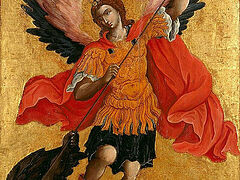
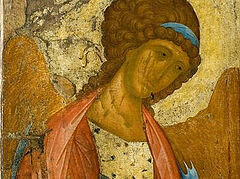
Today the Holy Church celebrates the memory of Holy Archangel of God Michael and all the honorable Heavenly Bodiless Powers. What is this world of bodiless Powers about which we learn mainly from Holy Scripture, from Holy Tradition, the Live of the Saints, and some of us—from our own personal experience?
According to the words of Holy Scripture, the angelic world, like people and everything that exists around us, were created by God: In the beginning God created heaven and earth (Gen. 1:1). But heaven was created before the material world. That is, the spiritual world, the angelic world, consisting of the greater part of the hierarchy unknown to us, was created before the world that we can see, feel, and materially know. “When the stars were created, all the angels hymned Me with a loud voice” (cf. Job 38:7), we read in the Old Testament Book of Job. So, when the heavenly firmament was being created the angels had already been created and glorified God.
Gregory the Theologian says of the creation of angels: “Since it was not enough for the goodness of God to be occupied only with contemplating Itself, but it was necessary that this goodness be poured out ever further and further—so that the number of those who receive its benefaction might be as great as possible, for this is the property of the supreme Divine goodness—God first conceives the angelic heavenly powers. And the thought became deed, accomplished by the Word and perfected by the Spirit. And since the first creatures—the angels—were pleasing to Him, He then conceived another world, material and visible.”
The Greek word “angelos” means “messenger,” “emissary.” What does he announce? With what mission does God send him? He announces first of all God’s will for people, because those people who abide in the doing of God’s commandments, strive to make their lives correspond first and foremost with God’s will. This is the same vector, the same direction, and striving as of the angels, and therefore angels abide closely with those people who live in a godly manner. And to the contrary, the heavenly angels depart from those people who consciously oppose God’s will and His commandments. And those people come closer to other angels—from which may God protect us!—fallen spirits under the heavens. They get closer to that portion of angels who once fell from the divine hierarchy of the angelic ranks.
It is hard for humans, perhaps even impossible, to fathom the world in which the angels live. By all appearances, it stands very far from the capabilities of our awareness. When by God’s will the angels appear to worthy people, they take on an appearance that people are accustomed to; but this does not mean that this image corresponds to their nature. They take on an image in which we can see them. When by God’s will angels appear to people, they appear not as they really are, but in an transformed appearance in which people can see them, as St. John Damascene explains.
And many of us have read in the life of Venerable Matrona the story of the tollhouses a soul passes through after death, but few pay attention to a small remark contained in the description of these terrible after-death trials: “And all of this is but a certain image that makes talk of the tollhouses comprehensible to man.” We can conclude that the world of angels, which encompasses the whole Universe, is for the most part just as invisible to us as the unexplored boundlessness of God’s creation, which man’s science and even imagination are still unable to fathom.
However, the angels are close to human beings in that, on the one hand, they are called bodiless and immaterial—yet only in comparison with us, but not with God. For when compared with God, they are found, again in the words of St. John of Damascus, to be “gross and material, for only the Divine Nature is entirely immaterial and bodiless. Though angels immeasurably surpass human beings in their spiritual powers, they nonetheless depend on space and place; they depend on matter, even though they can appear instantaneously wherever they need to be. At the same time, they possess the power to overturn the laws of nature.”
 Archangel Gabriel. Fragment from a fresco in the Church of St. George, 11th c., village of Kurbinovo, N. Macedonia. Photo: philologist.livejournal.com
Many of us recall the Life of the Athonite monk, who as a young man was thrown into the sea by impious lovers of money, with a stone hung from his neck. Despite the fact that the church where the angel of God brought this young man from out of the depths of the sea was closed, the angel was able, through closed doors, through the walls (the Lord knows by what laws unknown to man this was done) to set this young man in the middle of a closed church. When the brothers came in the morning and saw him, they were amazed and perplexed. This stone still lies under the holy altar table in the Athonite Dochiaros Monastery as a living testimony.
Angels have the quality, like people, to perfect themselves. The holy fathers say that they are not in a state of spiritual status quo, but ascend from strength to strength, come nearer to God, and enrich themselves with the knowledge of that immeasurable treasure—the glory and grace of God. This is also something that we can say about them based on the holy fathers.
The angelic world is immeasurably greater than the human world. St. Cyril of Jerusalem describes it thus: “Imagine,” he says, “how numerous are the people of Rome. Imagine how numerous are other coarse peoples now in existence, and how many have died over a hundred years. Imagine how many have been buried over a thousand years. Imagine the people, beginning with Adam to the present day, what a great multitude. But this is still immeasurably little in comparison with the angels, of which there are more. They are the ninety and nine sheep, while the human race is but one sheep. From the vastness of that realm, one may judge the multitude of its inhabitants. The earth we dwell upon is like a single point at the center of the heavens; therefore the heavens surrounding it—the universe—contain as many more inhabitants as they contain more space. The ‘heavens of heavens’ hold an immeasurable number of them. If it is written that ‘thousands of thousands ministered unto Him, and ten thousand times ten thousand stood before Him,’ this is only because the prophet could express no greater number. And I think that the human mind cannot contain such a number at all.” Thus spoke the great teacher of the Church, St. Cyril of Jerusalem, about the number of angels.
The apostle Paul in his Epistle to the Ephesians says that Christ is in heaven far above all principality, and power, and might, and dominion (Eph. 1:21), and testifies that amongst the angels are hierarchal, angelic degrees, the names of which are also mostly unknown to us. We only know those ranks that we learn from Holy Scripture.
What is the purpose of the spiritual world of angels? How is it connected with us? How can we come into contact with this world? This world is immensely spiritual in comparison with human life and character. In order for us to live in contact with the angelic world, so that they would be our helpers and protectors, we have to take care primarily that we live according to God’s commandments and do God’s will; for if we do not do it, if we will be flesh, then according to Scripture, as we know from the Old Testament, God will “not take pleasure in those people, for they are flesh.”
Many people, like simple-minded children, mistakenly think that what they can acquire materially will give them some kind of joy, satisfaction, happiness, or bliss. But this may be mankind’s greatest mistake, made over its entire existence. The human soul finds peace only in God. And if we try to replace this by means of money and prosperity directed at receiving pleasure, at being surrounded by everything that is highly valued in this world, then sooner or later we will inevitably reach a crisis—because when a man receives everything that can be had on this earth, he comes closer to an awareness of his mistake, that he is trying to replace spiritual food with material food, which is completely unnatural for us. You can’t feed a wolf with grass, or a sheep with meat—it’s against nature. It’s the same with human nature—in order for the human soul to be at peace, he must take in spiritual food. And in this, the human soul is akin to the angels. The angels have reason and will, but they do not always manifest themselves to the fullest extent before people.
 The Holy Tradition of the Church has told us of one instance when a pious priest who concelebrated the Liturgy with angels fell into error. He considered that Melchizedek, King of Salem, was the son of God. The saints always showed great sensitivity toward each other and those around them, and they did not dare rebuke him. They sent one of the godly wise holy hierarchs to bring this man to reason and truth. What did this holy hierarch do? He came to him and said, “You know, I myself can’t understand whether Melchizedek is the son of God or a son of man. Please pray, and God will reveal it through your prayers. I know that the angels concelebrate with you, that they are present with you when you serve the Divine Liturgy.”
The next day, the elder said, “You know, hierarch of Christ, Melchizedek is a son of man.” The hierarch asked, “How do you know?” The elder replied, “Because I asked an angel, and the angel informed me by God’s will that Melchizedek is not the son of God, but a son of man.”
That elder asked the angel, “But why didn’t you tell me this earlier? I was in such error.” The angel answered him, pronouncing very important words: “It is not pleasing to God that people receive instruction from angels; rather it is pleasing to God that people receive it from other people.”
Angels play a particular role in human history when there are wars between the peoples of the earth. In the books of the Old Testament, we recall that the angels stand around those who fear God and do His will, and deal cruelly with those who go against the ones who are zealous for the glory of God. We recall how the angel of the Lord in the Old Testament destroyed 185 thousand warriors of the Assyrian King Senachirim. And those who are familiar with the history of Ancient Rus’ remember the mysterious manifestations connected with the battle on the Izhora River, which was fought by the still very young St. Alexander Nevsky. In this bloody battle that went on with the Swedes on one bank of the Izhora, a great multitude of the enemy soldiers were killed, and the foe was routed. But when the Russian soldiers crossed to the other bank of the river, they saw there a countless number of enemy soldiers killed by someone, although no Russian warrior had stepped foot on that shore.
But at the same time, God’s angels as the conductors of God’s goodness take care to turn people away from the perilous path they’ve taken. This happens both in times of war and peace. Let’s recall a story connected with the prophet Elisha.
The King of Syria was displeased because the prophet Elisha knew about all the plans of the enemy forces before they were carried out. No military espionage with all our modern equipment could have so accurately informed about the enemy’s movements, and even its leaders thoughts, like the prophet Elisha informed the King of Israel.
The King of Syria learned of this and said to his generals: “Do you know that through the prophet Elisha the King of Israel immediately knows everything we says in our bed chambers? Let us go and capture him.” And the King of Syria sent a huge army to the land of Israel. And when the prophet Elisha and his disciples awoke, they saw this countless number of chariots and riders around them. One disciple was horrified and said, “How can we prevail against such a terrible army?” Elisha replied, “They who are with us are more than those with them.” The prophet prayed, and the eyes of his disciple opened; and he saw a countless array of Heavenly forces, standing on the prophet Elisha’s side. The prophet Elisha prayed, and the Syrian forces were stricken with blindness. Then the King of Israel asked, “Should I put them to death?” The prophet answered, “No, because you did not subdue them with arrow or sword. Feed them, give them to drink, and let them go in peace” (cf. 4 Kings 6:11–22).
Truly, the angels stand close to us. And we sometimes do not even understand, in those outward forms of the sacraments performed in the Church, how close we may come to the angels. In the words of the holy fathers, in the sacrament of Baptism, when the newly-baptized approaches the font, in his heart lives an evil spirit who has woven a net there. This is why the priest reads the awesome exorcism prayers, in order to cast this impure demon from the heart of the man. According to the teaching of the holy fathers with which we are familiar, in part from the Philokalia, we know that after Holy Baptism the devil no longer has a place inside the heart; he can only inflict harm from the outside, through thoughts, or temptations. But inside the heart God has come to dwell, and a Guardian Angel is appointed to that person.
 But you will say that these examples are all far from our own lives. Are there any appearances of angels to our contemporaries? Yes, all the time; it happens to each one of us. We can often feel how angels sing in our souls, or dark powers approach us with their ominous fog and murkiness.
I recall one example. One of my classmates in the early ‘80s went to the Pskov Caves Monastery as a pilgrim. It was during Great Lent. In those days there were no guesthouses or hotels, or any place for the great number of pilgrims who went there to lay their heads. So, he arrived at the monastery. He saw the prosphora baker Fr. Ieronim and asked him, “Batiushka, where do you bless me to spend the night?” He said, “I have two elderly ladies living in a little house over there, an old hut; go to them and tell them I blessed you to stay with them. The pilgrim went to them, settled in, but realized he had forgotten to bring an alarm clock. So he asked them, “Tell me, do you have an alarm clock? The services start early in the morning and I don’t want to oversleep.” They said, “We don’t need an alarm clock, we pray to our Guardian Angel.” The pilgrim asked, “And then?” The little old ladies replied, “An angel will wake you up. What time do you want to get up?” He answered, “I need to wake up every day at 5:15.”
The pilgrim returned in great amazement, as if he’d seen a great miracle. He said that every day, without exception, at precisely 5:15, it was as if someone’s tender, barely tangible hand touched him in the morning and woke him.
I can be like this for each one of us if we strive to be zealous as the angels for the glory of God, that we would be in communion with the Creator of all, the Creator of heaven and earth, our Creator and Provider.
Let us remember the words of today’s festal kontakion: “O Archangels of God, servants of divine glory, leaders of the angels and instructors of men, ask for what is beneficial to us and great mercy, for you are the leaders of the bodiless hosts.” Let us ask for what is beneficial of this unknown, enormous and boundless angelic world; let us ask that the Angels of God would be with us on all our paths, preserve us, and lead us to salvation—to that place where we ourselves might become like unto them, hymning the goodness and glory of God. Amen.