St. Philaret (Drozdov) On December 2 according to the new calendar the Holy Church honors the memory of St. Philaret (Drozdov), Metropolitan of Moscow and Kolomna. St. Philaret was an extremely important figure in the history of the Russian Church of the nineteenth century: an incomparable theologian, a wise public figure, a true ascetic, and an excellent preacher. The troparion to the saint praises the holy life of this talented man: “Having acquired the grace of the Holy Spirit, O Divinely wise Hierarch Philaret, thou didst preach truth and righteousness to people with thy enlightened mind, with a contrite heart thou didst show peace and mercy to the suffering; and as a teacher of faith and tireless guardian thou didst preserve the Russian flock with the staff of uprightness. Therefore, as thou hast boldness before Christ our God, pray that He confirm the Church and grant salvation for people and our souls.” Let’s look at his personality and ascetic labors in more detail.
Vasily Mikhailovich Drozdov (the future Metropolitan Philaret) was born in 1782 in the town of Kolomna near Moscow into a long line of clergymen. First the young man entered the Kolomna Seminary and then he ended up at the theological college of the Holy Trinity-St. Sergius Lavra. There he was assigned to preach at the refectory church, and then, with the blessing of Metropolitan Platon (Levshin),1 another major Church figure of the early nineteenth century, he became a preacher at the Lavra and teacher of Greek and Hebrew. Metropolitan Platon spoke of him as follows: “I write like a man, and he writes like an angel.” Indeed, the Lord endowed the future saint with the great gift of the word, which was later noted in the troparion to the saint.
The young teacher was faced with a choice regarding his future path in life. He wrote to his father about it: “It is somewhat difficult for me to make a choice about my future. But, unable to clear up its darkness, I calm down, averting my gaze from it, and wait for the falling of the rays that should show me the way. Maybe some will call it light-mindedness… But it seems to me that a few years of indecision are more excusable than a moment of rashness when it comes to a lifetime. Let anyone who wants to run after the wandering fire of happiness do so. I walk calmly ...”2 Finally, on November 16, 1808, with the approval of Metropolitan Platon, he took monastic vows with the name Philaret in honor of St. Philaret the Merciful. Immediately afterwards, Metropolitan Platon ordained him hierodeacon, and a year later he became a hieromonk.
Next Fr. Philaret was invited to St. Petersburg to work as a teacher, first at the seminary, and then at the Academy where he taught students dogmatic theology and Church history. At the St. Petersburg Theological Academy his gift of the word was revealed in all its beauty and fullness. In 1811, he was elevated to the rank of Archimandrite “for his distinction in preaching the Word of God.” In 1812, he became rector of the St. Petersburg Theological Academy and professor of theology.
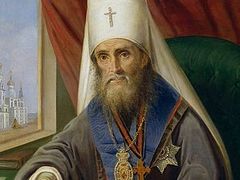
A colorful verbal portrait of the future saint made during his lifetime has survived: “Philaret was ... of average height, swarthy, with medium dark blond hair, had a long beard, a radiant face, looked cheerful, had sharp and penetrating eyes, was modest, strict and agreeable; his gait was slow and deliberate. His voice was quiet, high-pitched, but clear; he spoke sharply and wisely, but more to the mind and less to the heart. He explained the Holy Scriptures with ease, as if everything were flowing out of his mouth. He attracted the students to listen to him in such a way that when his lessons were over, there was always great eagerness to hear more, without eating and drinking anything. He left strong impressions of his manner of teaching; it seemed to everyone that everything he taught was true, pleasant and perfect… He was a wise and eloquent speaker, and a skilled writer. Everything proved that he had studied the sciences extensively... Philaret alone was the power, beauty, dignity and glory of the Theological Academy.”3
Against the background of the spiritual state of Russian society in the first half of the nineteenth century (in particular, the spread of freemasonry and the Westernizers movement), the saint started working on interpreting the Old and New Testaments and translating the Holy Scriptures into Russian. It became the principal work of his life. He translated the Gospel of John himself, reading the original Greek Septuagint and the Hebrew Masoretic text.
 Longer Christian Catechism of the Orthodox, Catholic, Eastern Church In 1817, he was consecrated bishop. In 1823, his Longer Christian Catechism of the Orthodox, Catholic, Eastern Church was published, which became extremely popular among the people and was republished over and over again, up to the present day. In 1821, the saint became the head of the Archdiocese of Moscow, and in 1826 he became metropolitan. As a member of the Holy Synod, St. Philaret took an active part in the life of the Church and society.
In 1830, there was an outbreak of cholera in Moscow. Concerned about his flock, Metropolitan Philaret ordered prayer services and cross processions to be held during this period. He himself prayed on his knees for deliverance from the epidemic, and the scourge receded. The saint enjoyed the love of the common people and was a man of prayer. It is known that healings through his prayers took place already in his lifetime. According to his contemporaries, in addition to his very high intellectual talents, Metropolitan Philaret was famous for his humility, modesty and lenience towards people in general and specifically towards their misdeeds. He tried to ignore and forgive the mistakes of those subordinate to him, hoping for their reform.
Any work related to the service of God is accompanied by temptations, as the Holy Scriptures say: My son, if thou come to serve the Lord, prepare thy soul for temptation (Sir. 2:1). The higher and more glorious the service, the more the temptations. This is precisely what happened in the case of St. Philaret. The holy archpastor was maligned, slandered and falsely accused of wrongdoings, but he took it with peace of mind: “It is better to respond to censure with meekness than with censure. Clean water should be used to wash off dirt. You can’t wash away dirt with dirt... Slander can drive you out, lead you into poverty or throw you into prison: it’s very hard. Isn’t it easier when slander passes by your ears like the wind?... Bitter cannot be sweetened with bitter, but only with sweet. Similarly, bitter cases cannot be sweetened by a bitter judgment about them, while meekness, patience and love not only can sweeten what has flowed from a bitter source, but also correct the bitter source.”4
Metropolitan Philaret was a pillar of the Russian Church in the nineteenth century and enjoyed high moral authority in society. Both high-ranking officials and bishops, as well as ordinary people, turned to him seeking his counsels. And he received everyone with love, wisdom and humility. His contemporaries described the saint as follows: “A beacon of intelligence; subtle reasoning, a clear and brilliant expression of thoughts, a fiery gaze, purity, benevolence and virtue, as if you smell the holiness of God in the presence of Philaret.”5
A person becomes a saint by knowing the love of Christ by experience. St. Philaret taught his flock: “Do you want, according to the commandment of Christ, to acquire perfect love that embraces even your enemies? Reflect on how this is possible. In people you often find flaws, vices, and sometimes hatred towards youreself: and this makes you inclined to disrespect such people and turn away from them, even unto mutual hatred, and not to love. How can we acquire love for everyone? If you make up your mind and train yourself to look with patience at the shortcomings and vices of others, and even at their hatred of you, you can come to love everyone without ceasing to hate vices. But without patience that is impossible... Tell me, what do you think makes you a Christian? The true faith? Know that Christianity knows no true faith other than that which loves mankind. There is no love of God if there is no love of fellow human beings.”6
At the same time, the saint revealed the “recipe for holiness” to his contemporaries and their descendants—that is, to us: “Do holy things and be holy... Rather simple ways to satisfy great demands: namely, reject lusts and try to purify yourself from the impurity of the flesh and spirit. To the extent that a person actively and faithfully strives to cleanse himself from impure deeds, desires, passions and thoughts, the sanctification of God descends upon him through the Church and its sacraments… If God extends you His generous hand with earthly blessings, then extend your grateful hand to help your neighbor in need. To sacrifice your wealth for the poor, your strength and energy for the weak and sick, and your heartfelt sympathy in their troubles; in a word, to sacrifice from your abilities and labors for everyone, as long as they need it—this should be the nourishment and delight of your life… Learn not to value riches too highly, not to covet pleasure, not to pursue fame, not to be captivated by luster, to love simplicity and quiet mediocrity, not to despise poverty when you see it in others, and not to fear it.”7
His spiritual instructions are also important: “With a suspicious eye you can fall into misanthropy; if you want to have love for your neighbor, you must have a simple eye. An excess of trust is better than an excess of suspicion. For too much trust is my error, but too much suspicion is an insult to my neighbor... humility alone can bring peace to the soul. A soul that is not humble, incessantly torn apart and agitated by passions, is dark and restless like chaos. Strengthen it with humility; only then will the true light appear in it and a harmonious world of right thoughts and feelings will form in it.”8
One of the saint’s contemporaries left such memories of his mighty personality: “Metropolitan Philaret was a perfect monk, a pure virgin, and a keeper of the vows of purity… Say whatever you want to Philaret—he will hear you out patiently not only when it is foolishness, error, or delusion, but also when it is unfavorable to his personality. Philaret will answer and give you guidance, judging by merit of what is asked, and surely without animosity, and especially without future revenge... Philaret is so great that he even sees the smallest and knows how to sympathize with him… I do not know of a single case where Philaret would retract his words, especially in important and sublime matters; this testifies not only to his great wisdom, but also to its correctness... Philaret is a warm-hearted and sincere teacher who does not handle the Word of God deceitfully (2 Cor. 4:2); he thinks at home and in the recesses of his soul exactly the same as he speaks.”9
 St. Philaret (Drozdov)
St. Philaret loved church services, celebrating the Divine Liturgy every Sunday, always preaching and blessing the people. He made it an important task of the clergy to educate the flock, and therefore under him teachers at the Moscow Theological Academy began to translate Patristic writings into Russian. Being an ascetic and a man of prayer, he greatly venerated his holy contemporary—St. Seraphim of Sarov. The final version of the epoch-making Manifesto on the Emancipation of the Serfs of 1861 was written by the saint’s hand.
The holy archpastor was also renowned for his gift of clairvoyance. Thus, one day a married couple with the surname Simansky came to him with their little daughter. The saint took his panagia10 off his chest and gave it to the girl, saying that a Patriarch would need it. It was the nineteenth century, and the Church was still going through a long Synodal period, but he foresaw clearly that the patriarchate would be restored.11
On November 19, 1867, after countless fruitful labors in the vineyard of God, the holy archpastor peacefully fell asleep in the Lord.
Originally Metropolitan Philaret’s relics rested at the Holy Trinity-St. Sergius Lavra, but when the Cathedral of Christ the Savior in Moscow had been reconstructed, his relics were enshrined to the right of its altar. Now anyone can come there and ask for the saint’s prayerful intercessions at the Throne of God. “As a true imitator of St. Sergius, thou didst love virtue from thy childhood, O Blessed Philaret. As a righteous pastor and blameless confessor, after thy blessed repose thou wast subjected to mockery and abuse from the godless, but God has glorified thee with signs and miracles and shown thee to be an intercessor for our Church.” Thus the Holy Church addresses St. Philaret in the kontakion to him.
With his virtues, love for God and his neighbors, and his talents, the Holy Metropolitan sets us a very high example of life and faith. His theological writings and homilies are full of saving edification for the Christians of the twenty-first century as well.
Holy Father Philaret, pray to God for us!