From the Lives of the Holy Hierarchs of Moscow: Peter, Alexis, Jonah, Macarius, Philip, Job, Hermogenes, Tikhon, Peter, Philaret, Innocent, and Macarius
 Photo: hramsvelisaveta.moseparh.ru
Today the Holy Church commemorates the primates of the Russian Orthodox Church who shone forth by their deeds of piety and by their wise governance of Christ’s flock—the holy hierarchs Peter, Alexis, Jonah, Macarius, Philip, Job, Hermogenes, Tikhon, Peter, Philaret, Innocent, and Macarius. These Russian primates shepherded the Church at different times, yet all, through their zeal for the salvation of the souls entrusted to them, shared one and the same spirit of Christ’s love, being ready to lay down their lives for their neighbors. In times of hardship for the Church, they steered the ecclesiastical ship and preserved it amid the tempestuous sea of worldly passions. Time has not dimmed the heroic deeds of these meek and courageous, humble and majestic saints—monks, pastors, and statesmen—the Hierarchs of Moscow, who by their lives bore witness to the mighty creative power of Orthodoxy.
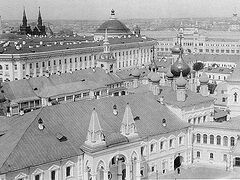
After the Mongol yoke, renewed Rus’ began to rise, when the Lord chose as her archpastor and spiritual leader the “humble and divinely wise Peter,” revealing to him the future destiny of Moscow—the primatial city, the heart of Orthodox Russia. St. Peter instructed that he be buried in the Cathedral of the Dormition in the Moscow Kremlin (1326), and the shrine of his holy relics became the cornerstone and blessing of the great work—the gathering of the Russian land.
The labor of St. Peter was continued by St. Alexis, spiritual father and mentor of Grand Prince Dmitry Donskoy. He devoted his entire life to serving the unity of Rus’, then torn by civil strife. A friend and spiritual companion of St. Sergius of Radonezh, he united spiritual perfection with political wisdom and courageously interceded for his homeland before the Tatar khans. The victory on the Kulikovo Field became possible only through his tireless labors and his primatial prayers before the Lord. The saint reposed in 1378.
The glorification of the wonderworking relics of St. Alexis marked the beginning of the primatial ministry of St. Jonah, a worthy successor of the Russian primates. In 1439, the Latin-minded Isidore was installed as Metropolitan in Constantinople. St. Jonah, a zealous defender of true veneration of the Holy Trinity, endured much toil and sorrow in exposing the false shepherd in the name of faith and piety. He became the first Primate of the Autocephalous Russian Church. His blessed repose took place in 1461. In 1596 Patriarch Job established the feast of St. Jonah to be celebrated in the Synaxis of the Moscow Hierarchs on October 5.
In the sixteenth century, Russia was the only Orthodox country not under foreign domination. In 1547, in Moscow—the stronghold of Orthodoxy—the coronation of the Tsar of All Russia took place, performed by St. Macarius. Now all Orthodox Christians throughout the world looked with hope and trust to the one Orthodox monarch. The saint convened Councils in Moscow that revealed “new wonderworkers,” as the newly canonized Russian saints were then called. These Councils gave rise to a great spiritual awakening in Russian society.
The primatial ministry of St. Philip, Metropolitan of Moscow, was brief but filled with the service of truth and mercy. Once a noble boyar, he exchanged the courtly robes for the coarse garment of a wanderer. For many years he labored in the Solovetsky Monastery, where he became abbot. At the behest of Tsar Ivan the Terrible elevated to the Russian Metropolitanate, St. Philip called the tsar to mercy and courageously denounced him for shedding innocent blood. The tsar’s fury was shattered against the unyielding meekness of the hierarch, who remained faithful to the commandments of love until his martyr’s death.
The first Patriarch of the Russian Church, Job, celebrated the Divine Liturgy daily and knew by heart the Gospel, the Psalter, the Epistles, and many prayers. In the difficult time of national turmoil at the beginning of the seventeenth century, St. Job displayed true Christian patience, fearlessness, and courage. Seeking to halt the actions of the False Dmitry,1 he issued patriotic appeals to Russian armies and governors, denouncing the destroyers of order in the state who had also brought disorder into the Church.
Saint Hermogenes, while still a parish priest, took part in the glorification of the wonderworking Kazan Icon of the Mother of God and composed both the Account of Its Discovery and the Service in its honor. The Lord later raised St. Hermogenes to the patriarchal throne during the Time of Troubles. This Spirit-bearing elder and Patriarch became truly the Guardian Angel of Moscow, torn and tormented by enemies, and the inspirer of the nation’s struggle for the liberation of the capital and the whole Russian land from “foreign occupation.” His martyr’s death was the worthy crown of his holy life.
Metropolitan Philaret of Moscow stood at the head of the project to translate the Bible into Russian—the version known as the Synodal Translation. He also composed the Christian Catechism. In all things, St. Philaret defended the interests of the Church, even when it required him to come into conflict with representatives of secular authority. A zealous defender of Orthodox statehood, he was the author of many legislative documents of the Russian Empire. Masterful in the use of language, Metropolitan Philaret greatly enriched the treasury of ecclesiastical eloquence.
In 1867, St. Philaret reposed, and St. Innocent was appointed in his place. By his kindness, accessibility, and simplicity of manner, he won the love of clergy and laity alike, manifesting in himself the image of a loving father and pastor.
St. Macarius (Nevsky) is known as a kind restorer of peace in the Athonite disputes over the Name of God. His conscience could not reconcile itself with the harsh measures used against the Russian Imyaslavtsy on Mount Athos—followers of the ascetic teaching of inner stillness (hesychasm). In 1914, the hierarch established a special Commission under the Holy Synod, which determined that the teaching of the Imyaslavtsy was Orthodox and contained no heresy.
Patriarch Tikhon was called the “people’s intercessor,” the “elder of all Russia.” His was a sanctity majestic in its simplicity. During the years of persecution and schism, he preserved the Church in the purity of Orthodoxy. He saw the root of the nation’s misfortunes in sin: “Sin has corrupted our land,” he said, and urged, “Let us cleanse our hearts with repentance and prayer.”
In his governance of the Russian Church, Metropolitan Peter followed in the path of St. Tikhon—the path of steadfast defense of Orthodoxy and uncompromising opposition to the Renovationist schism, which provoked the extreme displeasure of the Church’s persecutors. In 1937, the holy Hieromartyr Peter was executed by firing squad.
Time has not dimmed the deeds of these meek and courageous, humble and majestic holy monks—pastors and statesmen alike—the Hierarchs of Moscow, who by their lives bore witness to the mighty, creative power of Orthodoxy. In celebrating the memory of all the Russian hierarchs on a single day, the Church renders equal honor to each of them as heavenly protectors of the city of Moscow and intercessors for our homeland.
Prepared using materials from the official website of the Vvedensky Optina Pustyn Stavropegial Monastery