Photo: Pinterest In the name of the Father, and of the Son, and of the Holy Spirit!
Dear fathers, brothers and sisters! Today we celebrate the feast-day of the holy Apostle Andrew the First-Called.
In today’s Gospel reading dedicated to this holy apostle, we heard about his miraculous calling. As a disciple of St. John the Baptist and Forerunner, he heard him say of the passing Messiah, Behold the Lamb of God, which taketh away the sin of the world (Jn. 1:29). And astounded by these words, the Apostle Andrew followed Christ with another disciple of John the Forerunner. They stayed with Him that day, as it is written, because they went to see where He lived, how He lived, and what He did (cf. Jn. 1:38–39). And amazed by this Man—true Man and true God, Christ the Savior of the world—he came to his brother Peter, telling him that We have found the Messias, which is, being interpreted, the Christ (Jn. 1:41).
It would seem that he was just an ordinary fisherman casting his net into Lake Galilee with his brother. A man of very simple rank and occupation. But this man became a great apostle, a disciple and witness of Christ—one of the twelve who will be the judges of the twelve tribes of Israel and the whole world (cf. Mt. 19:28; Lk. 22:30).
There were many fishermen on Lake Galilee, because everyone who lived near it was mainly engaged in fishing for a living. But there were only four among them who became great disciples of Christ. These are the Apostle Andrew, his brother Peter, a chief apostle, and two brothers and sons of Zebedee, whom Christ called “sons of thunder” (cf. Mk. 3:17)—John the Theologian and the Apostle James. We venerate them, former ordinary fishermen, as pillars of the universe.
Why? Because these men had a very reverent attitude towards the knowledge of the Messiah. They had a kind of human activity that was crude, basic and far from any intellectual life. But nevertheless, this did not prevent them from constantly remembering, thinking about, and considering the idea that the Messiah Christ was coming. That is, their lives were centered in this religious expectation of the coming of Christ: the expectation that the old Israel was supposed to live in, waiting for the coming of the Redeemer. And it was precisely with this deepest anticipation that this man and these simple fishermen lived. Therefore, once they had heard that here was the Lamb of God, which taketh away the sin of the world, they left St. John the Baptist; although he was of course a great prophet and wonderful man sent from God. All the people of Israel knew this, not least those who were close to him. So St. Andrew followed Jesus and became convinced that He truly is Christ. And once St. Andrew realized and accepted this knowledge, this message with his heart, he gave up all his earthly pursuits and soon became a disciple of Christ, following Him in His earthly ways throughout the land of Israel.
You and I have various human occupations, but the example of the holy Apostle Andrew tells us that the focus of our life, its core, should be faith in Christ, the hope of the salvation of our souls, the hope that Christ did not just come into this world to save man, but that He came to save each one of us. And whether we will be saved or not depends on you and me, for the Lord wants to save everyone. But alas, not every person wants to be saved. Although we often say this, unfortunately it is not always confirmed by our lives, deeds, and the whole range of our life activities.
Not everyone is able to abandon everything and follow Christ. This option is given to both you and me. First of all, there is monastic life, when people renounce everything in the world for the sake of wholeheartedly serving God, conversing with Him, and abiding in His presence. There is also life in the world, but, nevertheless, like the apostles before their conversion to Christ, we can live a spiritual life—and must live like this. The core, the main focus of our lives should be precisely in this knowledge of God, the desire to live according to His commandments, and the desire to follow Christ on all the paths of our lives. No matter what we may do, where we may be or with whom we may spend time, we must remember that we are Christians. Our actions, our way of thinking, our words must manifest the Christian essence in us. But, alas, if this is not the case, then we should at least regret it. However, we think that there is nothing bad, or even worse—we don’t care about it and live any old way.
Looking at his labors as a preacher, at his life full of sorrows, we can say that the Apostle Andrew set us an absolutely different example. Following Christ, the disciples not only rejoiced and were comforted by the grace of God, which comes from the Holy Spirit and the Son of God Himself, but they were also reviled and denounced by many during Christ’s lifetime; and They were even more harshly persecuted after the arrest and death of Christ. After the Resurrection of Christ—although many came to believe in Him, and the Holy Spirit descended upon the apostles, renewing them, strengthening them, and giving them wisdom, power, and boldness to preach the Gospel around the globe—wherever the apostles went, there were those who converted to Christ, hearing their preaching. But there were also very many people who persecuted, hated, and slandered the apostles, inflicting wounds on them and beating them up. They cast stones at St. Andrew and defamed him in every possible way.
But what is amazing is that he carried this love for Christ throughout his life, becoming a genuine disciple of his Teacher and Divine Savior.
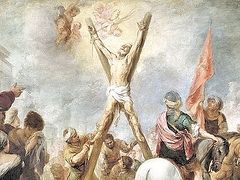
When St. Andrew was bound to a cross in the shape of the letter X, which we now call the St. Andrew’s Cross, the grace that he had received in this Divine revelation, the joy of the cross of Christ and the joy of bearing the cross, was so enormous that he prayed to his Teacher and God that the soldiers who later came to take his body down from the cross could not do so. St. Andrew tasted the joy that is unfathomable to our human mind, accessible only to a heart that has truly tasted the grace of God. And in this joy of the cross, St. Andrew acquired final salvation, because the great Light shone around him on the cross, and with a prayer to God, “receive my spirit in peace,” he commended his holy soul—courageous, like his name (Andreas), which translates from Greek as “courageous”, “manly”, and united with Christ forever.
May the courage of his soul, his faithfulness to God, following his Teacher throughout his earthly life be a model for you and me. May he teach us not to cling to earthly things, to not be constantly absorbed into vain, futile and fleeting things, because all this is like the fashion of the world, as the Apostle Paul says, that passeth away (1 Cor. 7:31). But the Glory of God remains forever. People will inevitably give an answer to God. This world passes very quickly. And this life, as the Apostle James writes, is like a vapor, that appeareth for a little time, and then vanisheth away (Jm. 4:14). Like vapor from your mouth in the cold or steam from hot water, it appears for a twinkling—so is our human life. We need to keep this in mind. And what happens to us after our death—which is unavoidable for each one of us, whether we want it or not—directly depends on our choices in our earthly lives. This is not to say that the Lord judges strictly, but rather that we are too lazy and self-indulgent. We do not choose God as the main value in our lives. And it is precisely in this that the Apostle Andrew is an example to us. If we are imperfect—and we are certainly imperfect, but we also do not strive for perfection—then he is a reproach to us. Let us pray to St. Andrew that through his prayers the Lord will give courage to our souls to be faithful to Christ throughout our earthly lives, so that we will not be separated from Christ after death. Amen.