At the beginning of winter, when days get shorter and nights get longer, the world around us seems to freeze, waiting for the light. The heart prepares for the coming of Life. At this time, you want to sort out all your thoughts, slow down and quietly wait for the coming happiness.
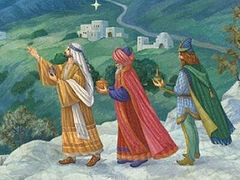
The Nativity Fast is a direction of our souls, the path of grateful anticipation of the Savior. Like the Magi, we follow the Star of Bethlehem towards the Nativity. However, our journey, like Lent, lasts for forty days (from November 28 to January 6), and this is no coincidence! Christ spent exactly forty days in the wilderness in prayer and fasting (Mt. 4:1–11; Mk. 1:12–13; Lk. 4:1–13); and the Prophet Moses, as we know, prayed for forty days waiting for the Tablets of the Covenant (Ex. 34:28). It comes that we imitate them this way, preparing ourselves for the greatest of events—the Incarnation of God.
Although it bears resemblance to Lent, the Nativity Fast is less strict. This is owing to the fact that it is not mournful, but joyful; we are in glad anticipation of the feast (literally the Birthday of Christ), therefore, during this fast we are allowed to eat fish on all days except for Wednesdays, Fridays and the final strict days preceding the feast itself (from December 20/January 2 to December 25/January 6). The strictest day is, of course, Christmas Eve—the day before Christmas. According to the Church Typicon, on this day we are not supposed to eat anything until the first star—symbolizing the Star of Bethlehem—appears in the skies.
However, it is important to remember that fasting is not just about food. St. John Climacus said: “Abstaining from food is the work of angels.” It is vital for us humans to keep in mind that true fasting is an all-round fast. It not only concerns the stomach, but also all our senses. This is the period when it is especially appropriate to fix for ourselves a “fast” for the eyes: spending less time in the bustle of social media and aimlessly watching entertainment; a “fast” for the ears: to be more attentive and heedful to the words that we hear and utter, avoiding foul language, judging and empty talk; and a “fast” for the heart: consciously doing good works, being more merciful, forgiving offenses and striving for reconciliation. During this period, we put off all everyday chores and fuss. Just as the brightest light is lit in the stillness of the night, so the most sincere prayer is born in the stillness of the heart. Fasting is that very blessed stillness that we create in our souls in order to hear the footsteps of the coming God.
This inner joy and anxious anticipation find their embodiment in external preparations. This feeling is especially vividly conveyed in childhood memories, where faith and tradition were one. This is how the Russian and Soviet children’s author Claudia Lukashevich (1859–1931) described this holy and jolly bustle in her home in the book entitled, My Sweet Childhood:
“On Christmas Eve, we had no lunch, but only had breakfast, looking forward to the evening. The dining-room and living-room were tidied, the floors, tables and chairs were washed, waxed and everything was put in order. Then a sheaf of new, unthrashed rye (‘holy kutya’) would be brought and placed in the corner of the dining room—in front of the holy icons. And The floor would be entirely covered with fresh fragrant hay. A Christmas tree would be fixed to the walls and above the doors. All this was done in remembrance of the cowshed and the manger where the Christ Child was laid.
“Before dusk, we went to wash in the bathhouse, put on clean underclothes, and walked sedately to the hall, where the whole family was already getting together. It smelled of apples lying on the windows and the resin from fir branches. We would seat ourselves on the couch and wait quietly... Waiting for the first star to appear in heavens.
“Once the first star had become visible in the dark sky, one of the grown-ups would announce: ‘The star has appeared!’ We would spring up from our seats and run to the dining-room. There, on a table covered with a white tablecloth, there already stood bowls of kutya made from wheat with honey and raisins, and stewed compote (‘vzvar’) of dried apples, pears and plums.
“After saying a prayer, our father was the first to approach the table and have some kutya. We, the children, and the whole household followed him. After kutya, we were seated at the table and served a fasting dinner: fish, mushrooms, kissel (thin berry jelly), and fasting pies with cabbage and mushrooms. But we were allowed to eat a little, as we fasted strictly until the first star.
“After dinner, we, the children, would dash to the hall and begin singing the Christmas troparion: ‘Thy Nativity, O Christ our God, has shone to the world the Light of knowledge …’ We sang loudly and gaily, and there was such light and exhilaration in our souls!”

It is to this childlike, pure faith and joy that the Nativity Fast leads us. Having walked through it on the path of prayer and abstinence, we will shake off our adult vanity and the weight from our souls in order to celebrate Christmas with the same bright thrill.
The Nativity Fast is our step towards God. Having made it, we will behold the most cherished star light up in the firmament of our souls, which will show us the way to the Divine Infant lying in the manger.