Even in the Soviet era, the Lord did not forsake Russia, a country were atheism thrived and Christ was denied. In spite of everything, be it prohibitions, ridicule or persecutions, the Church on earth has always managed to withstand. There are numerous facts in the history of the Church of God helping people by their prayers. But I was especially struck by the story that I heard at the beginning of my integration into the Church life.
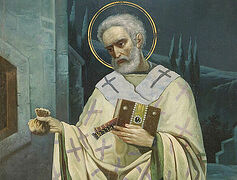
 Nicholas Roerich. St. Nicholas, 1916
During the heyday of the Komsomol and Communism, there were still religious mothers and grandmothers who baptized their children and grandchildren, contrary to the country’s policy. If there was no church nearby, they would baptize them on their own: “In the name of the Father, and of the Son, and of the Holy Spirit”, dipping their babies into ordinary water. And when they found themselves near an active church, they hastened to have their loved ones baptized fully through Chrismation.
So did one mother, baptizing her baby, loving him tenderly and entrusting him into the hands of the Lord. She baptized him, as her grandmother had taught her, and began to raise him, as God had inspired her and as religious old women had taught her. She prayed for him whenever possible. And seeing her son’s indifference to matters of faith from childhood, she did not impose anything on him. She would make the sign of the cross after leaving him in the kindergarten, and then when escorting him to school; and when the time came to fulfil the duty to his country, she blessed him to join the army. He served, returned with awards for good service and success, and immediately decided to enroll in a naval college. At first, his mother was upset. She tried to dissuade him, but it was useless—he was eager to go to the sea, which meant that they would see each other at best once every six months. But there was nothing to be done. Another send–off. She embraced him again, kissed him, and blessed him furtively for the journey. That’s probably the fate of real men’s mothers. It’s a pity that sometimes they are non-believers, as was the case with this mother’s son.
Several years passed. Her son graduated from the naval college, and for excellent studies he was immediately assigned to a merchant ship plying the Mediterranean Sea between capitalist countries. He passed the KGB vetting, was a Komsomol member, a candidate member of the Communist party, an activist, an athlete, with a good knowledge of navigation, and morally stable. Everything was fine for the admission committee, but not for his mother’s heart. The son departed, and the mother began to pray even harder.
To make a long story short, his vessel suffered a severe shipwreck and the sailors were struck by the merciless elements. So much so that many had nothing to cling to. The tempest did not abate, and the fatigue of those who remained at sea took its toll. And few on the nearest ships heard the SOS signal.
Our sailor, his mother’s only son, was exhausted after fighting the waves. A little more—and he would have drowned. But suddenly he saw a gray-haired old man in royal robes walking along the waves of the raging sea. And he had a sturdy wide plank in his hands. He threw it to the sailor with the words:
“If it weren’t for your mother’s prayers, I wouldn’t have rescued you!”
And he vanished.
Thus, dumbfounded by the sudden appearance of St. Nicholas, he was able to hold on to the plank thrown to him until help arrived. But it was only later that he would learn from his mother that it was St. Nicholas the Wonderworker himself who had appeared to him and rescued him.
An Old Man
“And here is the story of my great–grandparents,” my friend began her narrative. “My great-grandmother’s name was Christina, and my great-grandfather’s name was Martin. They were peasants, natives of the Smolensk province, and were born in the second half of the nineteenth century.
 Konstantin Lemoch. Little Sister, 1890
“The huts in their village were small and set very close to each other, there was little land, and the plots, accordingly, were tiny. The family was not large by the standards of that era, only four children. And since everything was too close, a single spark could set the whole house on fire instantly. Our family fell victim to fire more than once. And when Stolypin’s agrarian reforms took place, they were given a relocation allowance, and they came to the Omsk region in Western Siberia where they set up their own farm. They were very happy and satisfied. There was a lot of free land—just don’t be lazy, and work!
“My great-grandfather kept so many animals that even my great-grandmother wondered why he needed so many horses. After all, they were part of his household without any special needs, neither as a draft force. But, apparently, he loved them so much and was able to afford them, and so he could not resist the temptation to have a whole herd. Everybody worked a lot, their sons grew up and were good helpers, and the great-grandfather himself was still strong, like his wife—they were in the prime of life.
“And now the haymaking season came. And they needed a lot of fodder. The farm was big: horses, cows, and sheep. So they mowed hay for all of their animals. My great-grandmother was on a haystack, raking hay. My great-grandfather was down, the others next to him, and they only just had time to throw up the dried grass, pushing it up. The sun was at its zenith, the heat was scorching, and sweat was dripping into their eyes. And, apparently, someone decided to move away, either to drink some kvass or to take a break for a minute. I don’t know how it happened, but somebody had left a pitchfork leaning against the haystack prongs up.
“And when it was lunchtime, my great-grandmother began to slide down from the haystack. And she ran right into the pitchfork, practically sitting on it! It was a terrible sight. There were absolutely no doctors in the village to treat her. Only some old healers, some herbs, maybe some lotions—all of that was useless here. My great-grandmother was getting worse and worse, and it became clear that she was not long for this world. But it was too late to go anywhere, all the more so in the haymaking season, and it was pointless to search for doctors. And it was not customary at that time to rush around. They decided that since God had allowed such a situation, He would sort it out. If you survive, that’s fine; if you don’t survive, then that’s His will.
 Abram Arkhipov. Visiting the Sick, 1887
“The sun continued beating down, and my great-grandmother was moved into a barn, where it was cooler and easier for her to live out her last days, maybe even hours. She began to lose consciousness. And afterwards she told her children and grandchildren: ‘I don’t know whether I was asleep or awake, but a small, gray–haired old man with a bald patch came into the barn and said, “Cheer up, Christina, why are you so sick?... the Lord wants you to live longer.” And then he blew on me, so much so that I really felt the breath. It felt so light all over my body. And that was all. It was only later that I realized who had come to me.’
“The old man disappeared, but my great-grandmother opened her eyes and at first couldn’t understand what had happened. But it was from that moment on that she began to recover. Her health was restored and she lived for many, many years. My great-grandparents had passed away by the 1960s, having survived both the formation of the Soviet Government and the Great Patriotic War, and they were both in their nineties.”
A Rope in the Sea
It was a hot day, too hot. For a group of priests from Siberia, Israel was a serious challenge due to its climate. Some of them even considered canceling the trip, fearing the sweltering heat, but Vladyka himself paid for the tour and insisted on the pilgrimage. Ben Gurion Airport was behind them, and in front of them was the Mediterranean Sea, sparkling with the rays of the sun. There was hot sand underfoot and the unbearably scorching sun all around. The group scattered along the beach, with some of the pilgrims already splashing in the hot waves. In Israel, the air was +37 degrees Celsius, and so was the water.
“Let’s go to a more secluded place,” suggested Protodeacon Ilia, a former athlete who knew Israel like the back of his hand. He took pilgrimage groups twice a year.
 St. Nicholas the Wonderworker saves the drowning The other fathers, trusting the expert, followed him. They walked a couple of blocks and found themselves in a deserted place. Instead of a beach, huge rocks lined the shore, clearly left over from the coastal defensive line. The sea remained calm, still sparkling in the sun, and the priests, throwing off their cassocks, boldly rushed for relief from the unbearable heat into the gentle waves.
Fr. Dionysy was well built, but he did not have a mountain of muscles like Fr. Ilia. And having swum to his heart’s content, he decided to turn back first. But, swimming with all his might, he suddenly felt the resistance of the water and realized that he was being carried into the sea by the undercurrent. The shore began to recede, and the first thing that came to his mind was not to panic. After struggling with the waves for a long time, he felt that he had run out of energy. There was only one thing left—help from above. And he cried out with all his heart: “Lord have mercy! St. Nicholas, help me!” And in an instant he saw a rope dangling from the shore a couple of yards away. With all his strength, he rushed towards it and, grasping it, started moving back. The resistance of the sea current was so violent that he had to wrap the rope around his right arm and, thanks to it, move slowly.
He had no more energy, his muscles were like stone, and his body was no longer obeying him. And only at the moment of complete exhaustion, when the thought flashed through his mind: “I have no more strength—what will be will be”, when exhausted by the struggle with the elements, Fr. Dionysy resigned himself to going to the bottom, and suddenly his feet felt pebbles. This immediately gave him the strength for a final push, and he practically crawled ashore. He understood that if someone was having the same trouble, he would not be able to help them. And everybody else having the same trouble. When all of them, by the mercy of God, crawled ashore, they were silent for a long time, and only their lungs, like bellows, took in air for their bodies worn out by the sea. Fr. Ilia was also silent, as a professional athlete who had never previously known defeats on land or in water.
Who knows what awaits these priests in the future, and this story will serve them as edification. But next time, it may be in the sea of life.