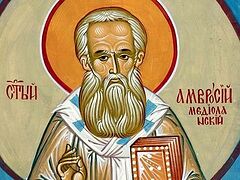
Giovanni di Piamonte. St. Ambrose of Milan On December 20 according to the new calendar the Holy Church honors the memory of St. Ambrose of Milan, a theologian, hymnographer, preacher, and active Church figure of the fourth century.
The future saint was born around 339 into a noble family in the city of Augusta Treverorum (now Trier in Germany). After the death of the head of the family, his mother moved to the Roman Empire’s capital. Being a representative of the Roman nobility, the young man received a classical education, studying philosophy, poetry, rhetoric, grammar, and law. He became a lawyer, but did not stay in this position for long. An intelligent, well-trained young man, he was appointed governor of Milan at the age of thirty-two.
Two years later, a heated dispute broke out in Milan between the true believers and the heretical Arians. As the governor, St. Ambrose attempted to resolve the dispute and addressed the crowd. His speech found a great response among the people, and someone shouted: “Ambrose for bishop!” However, the talented speaker remained silent, as he had no intention of becoming a priest or a bishop. At that time, he was still a catechumen preparing for Holy Baptism. St. Ambrose tried to refuse, insisting that he was unworthy of such a rank, but the people kept shouting: “Ambrose for bishop!” On the instructions of Emperor Valentinian I (ruled 364–375), whom the future saint did not dare contradict, he was baptized and a month later became Bishop of Milan.
Thereupon, Bishop Ambrose distributed all his possessions, embarking on a strict ascetic path, following the words of Christ from the Gospel: If thou wilt be perfect, go and sell that thou hast, and give to the poor, and thou shalt have treasure in Heaven: and come and follow Me (Mt. 19:21). St. Dimitry of Rostov wrote in his Life of St. Ambrose: “St. Ambrose took great care to improve the clergy of the Church. Living among them, he himself set them an example of how to combine a strict ascetic life with the duties of a pastor of the Church. He was a man of great abstinence, long vigils and labors; Every day he mortified his flesh by fasting, which he interrupted only on Saturdays, Sundays and on the feasts of the most venerated martyrs. He was diligent in prayer day and night, and did not shy away from the labor of writing books with his own hand, unless he was restrained from doing so by bodily illness. Being strict with himself, he was kind, affectionate and approachable to everybody. The poor found a protector and a friend in him. St. Ambrose rejoiced with those who rejoiced and wept with those who wept. If having fallen someone confessed his sin to St. Ambrose, the bishop wept so much that he inspired the penitent to tears.”1
Such an episode from St. Ambrose’s Life is worth mentioning as well: “During St. Ambrose’s stay in Rome, a respected woman who lived across the Tiber River asked him to celebrate the Divine Liturgy in her house. On learning of this, another woman, who was paralyzed, ordered herself to be carried there. While the saint of God was praying, she touched the edge of his robe, kissed it, and instantly regained her health. The news of this miracle spread throughout Rome.”2
Before embarking on a military campaign against the Goths, the new Roman Emperor Gratian (ruled 367–383) asked the saint to set forth in writing for him the confession of the holy faith. And St. Ambrose wrote books about faith for the Emperor, known as a treatise entitled, De Fide. This treatise is the central dogmatic work among his writings, where, in addition to the direct addressee, he sought to attract other readers—that is, you and me. Specifically, the following lines from there are edifying: “Christ said: Not every one that saith unto Me, Lord, Lord, shall enter into the Kingdom of Heaven (Mt. 7:21). Faith, August Emperor, must be deep, as it is written: For the zeal of Thine house hath eaten me up (Ps. 68:10). With a faithful spirit and a pious mind let us call upon the Lord Jesus, believe that He is God, and receive from the Father what we ask for in the name of His Son. The Father wants to be asked through the Son, and the Son desires us to approach the Father.”3
 Peter Rubens. St. Ambrose of Milan and Emperor Theodosius St. Ambrose was an ardent opponent of both paganism and Arianism. He persuaded Emperor Gratian, for whom he was writing a treatise, to remove the statue of a pagan goddess from the Senate building. In memory of the victory over Arianism, he composed the hymn, “Thee, O God, We Praise” (Te Deum Laudamus), which is still sung in churches on the Sunday of the Triumph of Orthodoxy. Here are some beautiful lines in this hymn:
We praise Thee, O God, we acknowledge Thee to be the Lord.
All the earth doth worship Thee, the Father everlasting.
To Thee all angels cry aloud, the Heavens and all the powers therein.
To Thee cherubim and seraphim continually cry out:
Holy, holy, holy, Lord God of hosts.
Heaven and earth are full of the majesty of Thy glory.
In addition, the saint is known as the author of many other hymns. He wrote them in Latin. For example, one of them, “Creator of the Stars of Night”, begins like this:
Creator of the stars of night,
Thy people’s everlasting Light,
Jesus, Redeemer, save us all,
And hear Thy servants when they call.
Thou, grieving that the ancient curse
Should doom to death a universe,
Hast found the medicine, full of grace,
To save and heal a ruined race.
Thou cam’st, the Bridegroom of the bride,
As drew the world to evening-tide;
Proceeding from a virgin shrine,
The spotless victim all divine.
At whose dread name, majestic now,
All knees must bend, all hearts must bow;
And things celestial Thee shall own,
And things terrestrial, Lord alone.
St. Ambrose’s sermon had a profound effect on his contemporaries. Thus, under his influence, Blessed Augustine of Hippo and a queen of Persia converted to Christianity. The saint became one of the greatest preachers and teachers of his age. He wrote numerous theological works on the interpretation of the Holy Scriptures and dogmas. His instructions on fasting during the season of the Nativity Fast are no less important: “As for the words: I wound, and I heal (Deut. 32:39)—the Lord truly wounds sinners with His commands in order to heal them, beats them with the commandments in order to correct them, prescribes fasts, shows the path of abstinence, threatens us with judgment, and to drive away from us the grave fear of Gehenna. He offers us healing, so that, terrified of the future, we can correct our present… Frequent fasting is part of God’s perfections in us; for God Himself always fasts.”
 Photo: Nyblago.org He would talk about giving alms, to which we are especially called during fasts: “There is no doubt that giving alms to the poor can reduce sin, but only when it is combined with faith and love. For what is available to wealth without love?”
He taught poetically on patience: “Heaven itself does not always shine with sparkling stars, with which it is adorned like diamonds; it does not always shine with the rising of the light and turn deep red with the rays of the sun, but sometimes this splendor is covered with clouds… It teaches you to have patience in your own changes.”
St. Dimitry of Rostov wrote: “St. Ambrose was a man of great industry, full of spiritual vigor… He remained in unceasing prayer day and night; he worked diligently... He was filled with care and solicitude for all the churches of the diocese and labored so hard to fulfill the duties assigned to him by God that after his repose five bishops could barely cope with this work. His care for the poor, the crippled, and those in captivity is also beyond all descriptions; he spent his last pennies on them.”
The Bishop of Milan foresaw his death in advance. Having received Communion of the Holy Mysteries of Christ, he peacefully departed to the Lord on the first day of Pascha in 397.
By the example of St. Ambrose’s life, we are convinced that God has a special plan for each one of us, which sometimes differs from our own plans. And when we humbly and fearlessly submit to Divine Providence, the Creator grants us even greater good than we could have ever imagined, encouraging us: Be not afraid, only believe (Mk. 5:36). This saint of God fearlessly defended the true faith in the struggle against the Arians and was glorified by the Church.
The kontakion to St. Ambrose of Milan, tone 3, reads: “Shining forth with Divine dogmas, thou didst eclipse the deception of Arius, O initiate of mysteries and shepherd Ambrose. Working miracles through the power of the Spirit, thou didst heal various passions. O Venerable Father, entreat Christ our God that our souls may be saved.”
Holy Father Ambrose, pray to God for us!