The Greeks celebrate Christmas on December 25—according to the New Julian calendar. On the eve of the holiday, PhD in Philology and researcher of Greek traditions and folklore, Ksenia Klimova, talked with “Tatiana Day” website about Greek carols and Christmas and New Year customs.
 “Christ’s Bread” —a traditional Christmas dish in Greece
—Ksenia Anatolyevna, you have spent Christmas in Athens. How do Greeks celebrate this holiday?
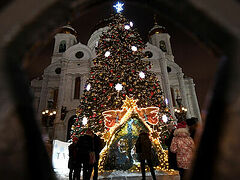
—Christmas in Greece is a holiday of national scale. Everything is festively decorated, Christmas trees stand everywhere. The apex of the winter celebrations is December 25. The New Year is celebrated much less solemnly. Those who usually go to church attend the divine service at the services. But that is far from all Greeks. At Pascha, especially at the procession of the Cross, everyone goes—but Christmas is celebrated mostly at home.
My friends gathered at their aunt’s house. The hostess traditionally bakes “Christ’s Bread” (Christopsomo, Χριστόψωμο) with a cross on top and decorates it with nuts: one nut in the center and four around the edges. The bread is not sweet, unlike the cake of St. Basil, which everyone bakes and eats on January 1 for the New Year.
In general, it is believed that the Christmas table should be abundant with many dishes, because this abundance will correspond to the prosperity and plenty of the entire year to come. The Greeks do not have one specific Christmas dish. Lately, they have adopted the custom of cooking turkey, but this is already a Western influence. Earlier, they roasted lamb or pork; those who were poorer, poultry.
Nuts and dried fruits must be present on the table, because they are very important elements in the symbolic code of any transitional rite. The nut is, in general, a symbol of life, fertility, and so on. One must also certainly place sweets that contain honey—an important ritual product for many cultures.
Among fresh fruits, the most significant at Christmas is the pomegranate, because the pomegranate is a symbol of the coming of a new time. It is used in every transitional rite and especially actively at New Year.
We have testimony that in Byzantium, when the New Year was celebrated on September 1, the pomegranate was also perceived as a symbol of the onset of a new time; it has many seeds, and to give a pomegranate meant, as it were, to wish a person much money, livestock, and other blessings. In traditional culture, a pomegranate was smashed against the threshold of the house at Christmas or on the New Year, on the feast of Saint Basil, so that just as the seeds scattered in the house, so too prosperity would fill the entire house. In traditional culture they also scattered wheat, coins, and grains around the home—performing a symbolic “sowing” of wealth. Today they no longer “sow”; coins and grains are not scattered. But the pomegranate is still sometimes smashed, including in the cities.
 The Pomegranate —a symbol of prosperity
The pomegranate was decorated; coins were stuck into it—expensive ones, in fact. Now they manufacture such coins specifically for the holiday. Any Greek shop today is full of pomegranates in every possible form: plastic, wooden, decorated with beads, gold, silver, bronze, gilded. They are simply exchanged as Christmas souvenirs, given to one another at Christmas.
Pomegranates are also decorated with the blue “evil eye” charms, as in Turkey. This is a well-known Greek tradition; earlier, blue stones were taken from the sea and carried as a protection against the evil eye.
—Returning to Christmas: how do modern Greeks prepare for the holiday?
—For Christmas the city is decorated, and fir trees are dressed. In general, decorating a Christmas tree in Greece is a late custom. At Christmas they might decorate a Christmas “tree”: an ordinary stick to which ribbons and bells were tied. This produced the image of the world tree, known in every traditional culture.

Originally in coastal regions, specially carved wooden ships were decorated for the holiday—hung with ribbons, flowers, and bells. In a village, there would be several such ships, but not in every home; only a prosperous person could spare the time and means to make such a ship. Then children would go around the village with these ships and sing carols.
In some villages, children still go caroling. In Athens, by the way, they also begin to carol a few days before Christmas. True, the ships specially decorated for the holiday are now bought in stores.
The caroling children also carried all sorts of metal objects—pots, frying pans—specifically iron ones, which they struck. The clanging of iron was considered a protective charm that drove away harmful beings. And in general, iron is a symbol of happiness, health, and well-being—horseshoes that people hang, and so on. Today children walk around with musical triangles.
—Do the children go of their own initiative, or does someone organize them?
—Most often schools gather them. They learn the carols specially and then walk around the city, recreating the folk ritual. Of course, the children think they are caroling in order to collect treats. But in terms of cultural tradition, carols are by no means a way of getting sweets or pastries, but a traditional folk procession-rite that is performed on the eve of a great feast. For Christmas they sing carols and visit every house in the village; for the week before Lent they also enter every home and wish for a good harvest.
This ancient tradition was preserved in Byzantium, when, for example, on September 1 (when the beginning of the New Year was celebrated), during the procession they announced the arrival of the new year and wished every blessing.
Historically, it so happened that Christmas coincided with a transitional time (the end of the autumn–beginning of the winter cycle). Rituals of the transitional period existed before the adoption of Christianity. The tradition of the procession remained, and new carol texts appeared which tell of the feast being celebrated.
 The Christmas Ship
—Where did the texts of the carols come from? Have pagan elements remained in them?
—It is difficult to say by whom exactly these texts were written. An interesting story happened with the most famous carol:
Καλήν εσπέραν άρχοντες, αν είναι ορισμός σας,
Χριστού την θιείαν γέννησιν να πω στ’αρχοντικό σας.
Χριστός γεννάται σήμερον εν Βηθλεέμ τη πόλει,
Οι ουρανοί αγάλλονται, χαίρει η κτίσις όλη…
Good evening, noble masters all, if be your gracious will,
Christ’s holy birth this blessed night within your hall to tell.
For Christ is born this very day in Bethlehem the town;
The heavens leap for joy on high, and all creation bows.
It was not written in the vernacular, but in a language very difficult for the ordinary bearer of traditional Greek culture to understand. It was recorded in the nineteenth century, although it may have been based on an earlier text. In Greece practically everyone knows it, they gladly sing it at Christmas, but no one knows the name of its author.
This carol is pan-Greek, and rather urban in type. But for me as a researcher, local variants of carols are of particular interest. For example, on Zakynthos the most venerated saint is St. Dionysios. In one of the carols, the phrase “O Agios” (“Ό Άγιος”) appears, which in translation means “the Saint.” But with the definite article. Usually the central place in a carol is occupied by Christ Himself, and as a rule it is He Who is implied by “Ho Hagios.” On Zakynthos a greater role is assigned here to St. Dionysios, and therefore in this carol, despite the Christmas context, “Ho Hagios” denotes not Christ, but St Dionysios.
Depending on the locality, the character of the wishes may change. For example, on the Ionian Islands, which are close to Western Europe, a girl will be wished to marry a Spanish prince. These are “remnants” of medieval conceptions of the world, of fairy tales which still live in the texts of the carols.
In Mani, for example, Slavs lived in the sixth century. And while in the carols of other regions some great river is mentioned—a symbol of living water—in the Maniot carols they sing of the Slavic Danube. And when you ask informants what the Danube is and where it is located, they say that the Danube is a river, but where it is—no one knows, no one can say.
—And which carols are the oldest? When did they arise?
—It is difficult to say. There is evidence regarding the traditions of the procession-rites, but there are no texts. One may say that the recorded carols begin to take shape approximately from the twelfth century—this can be established thanks to certain realities or linguistic forms mentioned in them. At the same time, earlier relics are still encountered there. However, the precise time of the origin of the carols is unknown.
—The holiday continues for five days from Christmas until New Year?
—Oh yes! During all that time the table remains richly laid, and the holidays continue. And on January 1 another feast is celebrated—the Feast of St. Basil. To this day they perform Podariko (Ποδαρικό). This is the custom in which, on January 1, the first guest enters the house; he must certainly be a good person and enter with his right foot.
—Do they arrange with him beforehand to come, or is it left to chance?
—Sometimes they arrange it specially; sometimes a person may come on his own, knowing that it will please his acquaintances if he performs Podariko, because no one has died in his family recently and he himself is successful.
For New Year they always prepare Vasilopita (Βασιλόπιτα)—a sweet cake in which a coin is baked. The cake of St. Basil bears no Christian symbolism. Today Vasilopita is sold in any supermarket, just as dyed eggs are sold for Pascha. One symbolic slice of the Vasilopita is given to Christ, another to St. Basil.
 Vasilopita with a wish for many years
—And what do they do with those slices?
—Some say that they place them behind the icon until the next year, and then throw them away. Most say that these pieces are still divided and eaten by members of the family.
The coin is still placed in the cake, and they always check who will be the lucky one in the coming year.
—Is St. Basil venerated in a special way in connection with the New Year?
—Of course! It is Saint Basil who brings gifts to the children. In Greek tradition he looks like the Western European Saint Nicholas: a red fur coat, a red cap, a white beard, and a sack of gifts. Only the coat is not long, but short.
—Is that also Western influence?
—No, not really. It is simply that red is a festive color. The New Year carols—the carols of St. Basil—are very interesting. All of them are dedicated to this saint. In the narrative he comes from Caesarea, an unclear, distant, almost fairy-tale land, and he turns out to be a scholar who studied letters for a very long time. And now he goes around all towns and villages, and wherever he comes, they ask him to recite the alphabet:
“Saint Basil, greetings!
Where are you coming from?”
“I am coming from Kritsaritsi, and I am coming to you.”
“Sing us some songs, tell us something—stories, tales.”
“Songs I did not learn, tales I did not learn. I learned letters; I learned to read.”
“Very well, then recite the alphabet for us.”
And when he begins to recite the alphabet, everything most wondrous and important takes place: the world tree blossoms; on its branches appear the four Gospels, and at the center—Christ Himself.
—And do they arrange festivities in which this dialogue with St. Basil is enacted?
—As we do with Grandfather Frost and the Snow Maiden? There are no such enactments. In the house they place a St. Basil doll as a New Year’s decoration—for example, beneath the Christmas tree.
—And the last of the winter feasts—the Baptism…
—The Greeks have very interesting traditions for celebrating Theophany. A great procession of the faithful, led by the priest, goes to some large body of water or to the sea. They throw a cross into the water to sanctify it, and young men dive in. Whoever retrieves the cross is regarded as “the first lad in the village” for the entire following year.