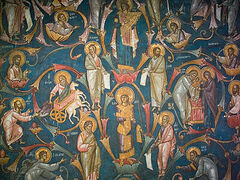
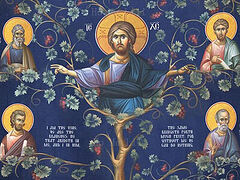
The Parable of the Called and the Chosen. Fresco
Verily, verily, I say unto thee,
except a man be born of water and of the Spirit,
he cannot enter into the Kingdom of God
(Jn. 3:5)
Beloved faithful!
Inasmuch as, by the grace of God, we are on the threshold of the radiant feast of the Nativity of Christ, today we have decided to talk about our spiritual birth. Without it no Christian can be saved, according to the Savior’s word: Except a man be born of water and of the Spirit, he cannot enter into the Kingdom of God (Jn. 3:5). Because That which is born of the flesh is flesh; and that which is born of the Spirit is spirit (Jn. 3:6).
But, my brethren, when and how are we born spiritually through water and the Spirit? We are all undoubtedly born spiritually in Holy Baptism. And what do we Orthodox Christians gain through this birth in Holy Baptism? First of all, in Holy Baptism our ancestral sin is forgiven and we become children of the Church of Christ (cf. Eph. 5:26). In Holy Baptism, together with Christ, we are clothed with renewed life (cf. Rom. 6:4). In Holy Baptism, we receive the washing of regeneration and renewing by the Holy Spirit (cf. Tit. 3:5). In Holy Baptism, we gain the freedom to live in communion with God, being freed from sin and becoming servants to God (cf. Rom. 6:22).
Through Holy Baptism, we have renounced satan and all his works, according to the service of Holy Baptism; we have put off the old man (cf. Col. 3:9), professed the true faith, become children of God by grace (cf. Gal. 4:5), and put on Christ (cf. Gal. 3:27).
We all know that there is only one Baptism (cf. Eph. 4:5). He who rebaptizes a baptized person in the name of the Most Holy Trinity crucifies Christ again, according to St. John of Damascus.1
So far, we have talked about the spiritual birth of a Christian in Holy Baptism and that there is only one Baptism in the Church of Christ. Now let’s talk about other spiritual births that occur both before and after Baptism, as well as about the conditions when Baptism can still be repeated.
Spiritual births before and after Holy Baptism can be repeated whenever necessary for the benefit of human souls. What are these spiritual births that can be repeated? This is, first and foremost, a spiritual birth performed through the word, when a person awakens to a new life in Christ in order to abandon his sins and his perverted faith.
By this Baptism through the word the holy apostles, before baptizing catechumens from the Gentiles, awakened Jews to the true faith in Christ by preaching the Word of God. Thus, we see that after the Descent of the Holy Spirit upon the Apostles the great Apostle Peter preached the Gospel in Jerusalem, assuring His listeners of the Resurrection of the Lord and His harrowing of hell. After this sermon, about 3,000 souls believed in Christ that same day (cf. Acts 2: 41). Do you see that here, too, faith came through hearing, and hearing through the Word of God? This was followed by the Holy Baptism of those who had been awakened to faith in Christ Jesus by the preaching of the word of truth.
It was a spiritual birth before receiving Holy Baptism. The Apostle Paul also teaches about this spiritual birth through hearing the Word of God, saying: For though ye have ten thousand instructers in Christ, yet have ye not many fathers: for in Christ Jesus I have begotten you through the Gospel (1 Cor. 4:15). Elsewhere, St. Paul again calls those whom he had begotten by the word his “children”, saying: My little children, of whom I travail in birth again until Christ be formed in you (Gal. 4:19). He also points out that he begot Onesimus by the word when he was languishing in prison and chains, and says: I beseech thee for my son Onesimus, whom I have begotten in my bonds (Philem. 1:10).
From these testimonies from the Holy Scriptures, as well as from other sources that for the sake of brevity we have not mentioned here, we have learned that there is also a spiritual birth through the Word of God. But, my brethren, let us also know that there is a second spiritual birth, which takes place in the sacrament of confession and penance and is called the “second Baptism,” according to the order of the Christian sacraments.
So, through genuine confession and tearful repentance, spiritual birth is accomplished. St. Gregory the Theologian wrote about this: “When tears of repentance are shed, it is akin to Baptism” (Oratio 39). Therefore, having such testimonies from the Holy Scriptures and the Holy Fathers, the Church teaches that “pure confession is a second Baptism” (The service of confession).2
However, let us not forget that spiritual birth in Holy Baptism with water and the Spirit is not repeated, while we can always be born with the word, confession and repentance with tears whenever it is needed for the benefit of our souls, for their reform and enlightenment. Indeed, if the Most Gracious and All-Merciful God had not established spiritual birth through confession and repentance, truly none of us would have been able to attain salvation. After all, no man is without sin before God. That is why we all need confession, repentance and penance.
However, there is another spiritual birth, which is also performed through confession, but with the addition of a vow to reform. This is the monastic tonsure, which the Holy Fathers understand as the second Baptism.
The last and greatest Baptism, and therefore spiritual birth, is martyrdom—that is, the Baptism by blood received by all the martyrs who were tortured and killed for their confession of the true faith in Christ.
By these methods of spiritual birth, which we have indicated so far, especially by Baptism and confession, the Church of Christ brings to its Bridegroom a great multitude of souls who, by the grace and mercy of God, attain salvation and inherit the Kingdom of God. This truth is clearly shown by St. Ephraim the Syrian:
“Repentance is a gift that bears abundant fruit, because it offers valiant deeds to God in every possible way. Repentance is a fertile field, for it is cultivated at all times. It is a tree of life, for it raises up many who have been killed by sin. Repentance says to sinners, ‘Give me the burden of your sins. This is my profit for my hard work. Do you have faith? Give me the earnings of faith—that is, repentance! It makes your faith effective.’
“God saw that the human race was troubled by the enemy, the devil, and opposed him through repentance for purification. The enemy incites people to sin, but repentance is ready to accept the sinner. The enemy compels people to commit lawlessness, but repentance exhorts them to be converted. He strives to plunge people into despair, but repentance vouches them the hope for salvation…
“The Prophet Isaiah said: In returning and rest shall ye be saved (Is. 30:15). Here, he gives you a testimony—just repent. If a sinner sighs, then at the same moment, along with the sighing, the burden of the serpent will come out of him. Repentance leads people to salvation, and then you will not only sigh, but also shed tears with great anguish. After all, the soul, seeing God as its Father after separation, is aroused to tears. And it sheds tears for two reasons: to incline God to love as a Father, and to purify itself from the serpent’s wickedness.
“Didn’t you hear what King David said? All the night make I my bed to swim; I water my couch with my tears (Ps. 6:7). But first he sighed, and then he shed tears. Let me show you by the example of nature that first the wind rises, and only then does it start raining. First it thunders, and then clouds pour down rain…
“The same Prophet David says, I am weary with my groaning (Ps. 6:7). And the labor of sighing is an abundance of tears of repentance. The labor of sighing is a heartache. Therefore, it is obvious that tears multiply when they are preceded by sighs…
“So, brethren, you should not despair of salvation, having repentance for your mother.”3
Beloved faithful!
I have deemed it apt to show by the example of the words of St. Ephraim the Syrian how great the sacrament of repentance and confession is, and what a great multitude of souls draw close to God through this spiritual birth in genuine repentance.
The Holy Gospel tells us: Likewise joy shall be in Heaven over one sinner that repenteth, more than over ninety and nine just persons, which need no repentance (Lk. 15:7). If there is such great joy in Heaven for one penitent sinner, then how much joy does God have for countless souls that turn to Him with all their hearts?
We also know from another testimony of the Holy Scriptures that God takes no pleasure in the death of the wicked, but rather that they turn away from their ways and live (cf. Ezek. 18:21–32). So, blessed and blessed are those who turn to God with true repentance, abandoning their sins. After all, just as Baptism is the washing away of sins and sanctification of a person (cf. 1 Cor. 6:11), so genuine repentance is the cleansing and washing away of sins, making a person born again and renewed before God. St. Gregory the Theologian says: “I also know a fifth Baptism—that of tears, but it is much more difficult.”4
Repentance is great and greatly loved by God, for it truly does His will. It is the food of God, for through it reason comes to people. The Savior Himself says, My meat is to do the will of Him That sent Me (Jn. 4:34). Thus, repentance is the wondrous bread of God. And the various viands of God are abstinence, fasting, vigilance, unceasing prayer, and submission with humility. For repentance is more pleasing to God than other sacrifices.
St. John Chrysostom writes that doing good works is the bread of our Lord and Master. He goes on to write:
“The righteous propitiate God with their little good deeds more than those who do many works. For God does not look at the deed, but at the intention and will. He does not look at what is done, but at the diligence with which it is done. The widow with her coins surpassed many who offered gold.”5
And St. Ephraim the Syrian teaches again:
“Repentance is a great furnace, brethren, for it takes in copper and turns it into gold, and takes in lead and gives out silver.” He adds: “Repentance has brought great benefits to people, because through it we propitiate God... repentance is great on earth. For it becomes a ladder to Heaven for human souls, leading them back to from where they fell from through sin.”6
Beloved faithful!
This Sunday is called the Sunday before the Nativity of Christ. It is designed to prepare us spiritually for the great feast of the Incarnation of the Son of God through the Virgin Mary in the cave of Bethlehem for the salvation of the world.
The best preparation for Christians, including us, to meet the Savior is repentance, confession of our sins with remorse, and beginning a new spiritual life in Christ Jesus. Behold, the Messiah is coming, the Son of God has been sent by the Father into the world, the Virgin Mary and the elder Joseph are looking for a place for His Birth in Bethlehem, but they cannot find it. The star is preparing to shine in the firmament of the world. The Archangel Gabriel, who has served the mystery of the Incarnation, rejoices. The universe is waiting, the demons are trembling, and people are preparing spiritually to receive the Infant Jesus.
And, my brethren, how do we prepare to receive Christ? The Lord of peace is coming into the world, but will He find a place of peace in our hearts? Have we been reconciled to God by repentance and to each other through forgiveness?
The Savior of the world is coming to us to reconcile the nations, calm our minds, wash away our sins and save our souls. But are we ready to accept Christ? Have we confessed our sins to our father-confessors? Have we wept over them? Have we done our penance? Have we been renewed spiritually by prayer, almsgiving, and reconciliation? Have we been united with Christ in Holy Communion? Or do we keep postponing repentance until the hour of death strikes unexpectedly?
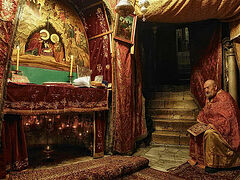
The Virgin Mary found a place for the Birth of the Son of God in the cave of Bethlehem, because no one wanted to give Her shelter. Have we prepared ourselves to give shelter to Christ in our hearts? After all, He does not come to dwell in hearts full of hatred, malice, pride and lust. Christ does not enter houses where drunkenness, infanticide, debauchery and unbelief reign. Christ is not born of the Holy Spirit in hearts enslaved by passions, but most of all by the spirit of arrogance and despair.
Thus, my brethren, let us prepare ourselves, for Christ is coming into the world to reconcile and renew it, because the world can no longer live without Him. He comes to our homes and hearts to be born again, to forgive our sins, to give us His Body and Blood, to transform our withered hearts into a living Church, an altar of prayer and sacrifice.
Let no one be sad and confused! Let no one close the door of his soul to Him. Let no one stagnate in drunkenness and fornication, neglect and unbelief. But let us be cleansed and washed, let us be spiritually renewed, and having reconciled ourselves to each other, let us sing together with the angels:
Christ is born, give ye glory.
Christ cometh from Heaven, meet ye Him.
Christ is on earth, be ye exalted.
O all the earth, sing unto the Lord.
Amen.