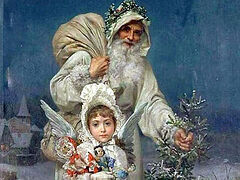
Artist: Vladimir Lutiuk. Photo: joseartgallery.com
White with large snowflakes, Sts. Nicholas the God-Pleaser, Sergius of Radonezh and Seraphim of Sarov are walking through the vast fields in the evening. The snow is drifting in the wind, and the field filled with snowdrifts is crackling from the frost. A snowstorm is screeching. Frost is freezing the lonely snowy ground.
St. Nicholas the God-Pleaser is in an old sheepskin coat and big worn-through felt boots. He has a knapsack on his shoulders and a staff in his hands. St. Sergius of Radonezh is in a monastic cassock. He is wearing a small monastic skufia cap, white with snow, on his head, and bast shoes on his feet. St. Seraphim of Sarov is wearing a white cotton woolen kaftan, walking hunched over in Russian high boots, leaning on a stick... The saints’ gray beards are fluttering in the wind. The snow is dazzling. The holy elders are cold in the lonesome frosty darkness.
“Oh, this naughty frost! Oh, the old joker!” St. Nicholas the God-Pleaser repeats cheerfully. And in order to get warm, he hits his sheepskin coat, become cold from the frost, with his rustic mittens, and hurries off with a frisky old man’s gait, his felt boots creaking.
“Well, how about it! The frost has ‘pleased’ us, old men… So restless—may God calm it down! So restless!” St. Seraphim laughs and skips along, keeping up with the frisky St. Nicholas, with his highboots crunching loud on the resounding frosty path.
“This is quite tolerable!” St. Sergius smiles softly.
“But in the year 1347, it was really frosty. Horribly frosty…” he continued.
“It’s a blizzard. If only we won’t get lost in the field!” says St. Seraphim.
“We will not get lost, Fathers!” St. Nicholas answers kindly. “I know all the Russian roads. Soon we will reach the forest of Kitezh,1 and there, God willing, we will celebrate Matins in a little church.”
“Quicken your step, fathers!...” he adds.
“Lively Nicholas!” St. Sergius exclaims, smiling softly and holding his sleeve.
“So diligent! He himself is from foreign lands, but he came to love the Russian land so thoroughly. Why, Nicholas, have you come to love our nation so darkened by its sins, and now you are walking along its sorrowful paths and praying fervently for our people?” he wondered.
“What do I love it for?” St. Nicholas replied, looking into St. Sergius’ eyes. “Russia is a child!... A quiet and fragrant flower… The Lord’s meek thought... His beloved child… Unreasonable yet beloved. And who will not come to love a child? Who will not be touched by flowers? Russia is the Lord’s meek thought.”
“You have spoken well about Russia, Nicholas,” St. Seraphim whispered gently. “My joys, I want to kneel down in front of it and pray before a holy icon!”
“But holy fathers, what about the bloody years 1917, 1918 and 1919? Why did the Russian people stain themselves with blood?” St. Sergius asked timidly.
 Artist: K. Veshchilov. Photo: pinterest.com “They will repent!” St. Nicholas the God-Pleaser replied with conviction.
“Russia will be saved!” St. Seraphim said firmly.
“Let’s pray!” St. Sergius whispered.
They reached a small, snow-covered church in the forest. The saints lit candles in front of its dark icons and began to celebrate Matins. Outside the church, the snowy forest of Kitezh was humming.
The blizzard was singing.
The saints of the Russian land prayed in a small abandoned forest church for Russia—the Savior’s love and the Lord’s gentle thought.
And after Matins, the three intercessors came out of the church onto the porch and blessed the snowy land, the blizzard and the night in all four directions.