In the name of the Father and the Son and the Holy Spirit!
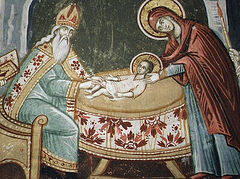
Two great feasts coincide today, beloved. The first is the Circumcision of the Lord and the second is the commemoration of St. Basil the Great. The Church celebrates both with special solemnity. I live; yet not I, but Christ liveth in me (Gal. 2:20), says the Apostle Paul. This is true! A believer must make sure to have a strict and pure life, to do nothing displeasing to Christ, that the Savior’s words might be fulfilled in him: We will come unto him, and make Our abode with him (Jn. 14:23). We Christians firmly believe that just as our Lord Jesus Christ deigned to lie in a stable, in a manger of irrational beasts, so He desires to enter the manger of our irrational soul. The first occurred on the feast of the Nativity of Christ; the second takes place with the worthy communion of the Body and Blood of Christ.
Today, on the eighth day, the Infant Christ, fulfilling the Law, is named Jesus, which means God saves, and thereby gives salvation to the world. This is how the angel explained the great name of Jesus to the Most Holy Virgin Mary: For He shall save His people from their sins (Mt. 1:21). That at the name of Jesus every knee should bow, adds the Apostle Paul, of things in Heaven, and things in earth, and things under the earth; And that every tongue should confess that Jesus Christ is Lord, to the glory of God the Father (Phil. 2:10–11). And we believers receive this sweetest name today together with Christ, because, in the words of St. John the Ladder: “For those who cling to Him, Jesus Christ is enlightenment of the mind, beauty of the soul, health of the body, happiness in the heart, joy in sorrows, and hope for salvation.” “Speak and write about Christ as often as possible; gaze upon His holy icon as often as possible; pray that you might be able to pray to Him unceasingly in spirit and praise Him with your lips without ceasing. All our blessedness is found in the glorification of Jesus Christ!”
And as the young Jesus once entered the Temple, as today’s Gospel tells us, to have a wise and Divine conversation with teachers and scribes, so today He can enter the house of our humble soul to make it, according to the Apostle, the Temple of God, the dwelling of the Holy Spirit; and then His eternal goodness—the words sealed in the Holy Gospel—will never fall silent in the souls of those believers.
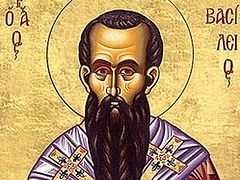
Today we have a magnificent living example of the truth of the words of God in the person of St. Basil the Great, who became, in the words of the Church’s hymns, “a bright ray of the Thrice-radiant Dawn” that is, of the Most Holy Trinity. And therefore the Holy Church glorifies the saint in its hymns with the following significant words: “He brought Christ into his soul through his pure life.” Here it’s fitting to recall the beautiful characterization of the great saint of God given by his faithful friend St. Gregory the Theologian: “O luminous Basil, you treasured little on earth, but brought everything and offered it as a gift to Christ: both soul and body, word and hands. O Basil! Great glory of Christ! Your word is thunder, and your life is lightning!”
 St. Basil the Great and St. Gregory the Theologian. Photo: pinterest.com
Brothers and sisters! I’d like to focus in my homily today on a few facts from his life, which was brief in time but vast in Christian activity. Here were two young friends, St. Basil the Great and St. Gregory the Theologian, who while in Athens, in that large and noisy city full of temptations—that soul-destroying pagan city, in the words of St. Gregory the Theologian—managed to lead a strict and chaste life. “We were strengthened in faith,” says St. Gregory the Theologian, “and we had but one pursuit—virtue. We knew of two roads: One, the first and most excellent, led to our sacred churches; the other led to our academic teachers. All other roads were left to those who wished to take them.” Thus they managed to keep themselves pure, because Christ dwelt in them then.
This purity allowed St. Basil the Great to know God and His creation, to proclaim to the world His ever-existing power and Divinity. His troparion speaks of him “expounding the nature of creatures,” that is, clarifying for believers the nature of the existing world, the wisdom and mercy of God, the purposefulness and beauty of the world. These words of the troparion also indicate the great learning and spiritual wisdom of St. Basil the Great, his deep knowledge of the laws of nature and the laws of spiritual life. “Whenever you take up his Hexaemeron, that is, the book explaining the creation of the world,” says St. Gregory the Theologian, “you converse with God the Creator, you comprehend the words of creation… When we read his moral and practical discourses, we are purified in soul and body; we become a temple fit for God, and an instrument being changed by a Divine transformation.”1
Such is the influence of the words of St. Basil the Great. St. Basil was great before God, and God was pleased with his holy prayer!
The following incident is found in his life. There was a harlot, a great sinner living in Caesarea. The Lord touched her heart with His grace and she began to repent of her sinful life. Remembering her sins, she wrote them down, sealed it up, and gave it to the Holy Hierarch of Christ Basil, tearfully entreating him: “Don’t read it, Father, and don’t open the seals, but only cleanse them with your holy prayer.” The saint took pity on her and went to church and spent the whole night in prayer for her before the altar. In the morning, having received her letter back, the woman opened it and found her sins completely blotted out. Such was the power of the Holy Hierarch’s prayer.
When St. Ephraim the Syrian, who lived in the desert, heard about the glory of St. Basil the Great, he started praying to God to show him what St. Basil was like. Then one day he saw a pillar of fire that reached to Heaven, and heard a voice saying: “Ephraim! Ephraim! As you see the pillar of fire, such is Basil.”
Brothers and sisters in Christ! In St. Basil were fulfilled the Savior’s words: He that abideth in Me, and I in him, the same bringeth forth much fruit (Jn. 15:4). And this spiritual fruit, explains the Apostle Paul, is love, joy, peace, patience, goodness, mercy, faith, meekness, and temperance. St. Basil the Great had all these virtues, and of course, you and I must have all these virtues to a lesser extent in order to be Christians; otherwise we will see the fulfillment of the Savior’s words: If a man abide not in Me, he is cast forth as a branch (Jn. 15:6), that is, he can’t be considered a Christian.
Let us not despair, but let us pray to St. Basil the Great with faith and hope that he might help us bring Christ into our souls, live with the peace of God, live in the joy of the Holy Spirit, live according to the truth of God, and glorify the Lord with mouth and heart. We know how to praise the Lord audibly: in hymns, homilies, in pious conversation. But what if we don’t have a voice? Don’t despair, beloved, for you can praise the Lord with your heart. That’s why the holy Church says that we must glorify the Lord with mouth and heart. Let us entreat St. Basil the Great for help in making this virtue our own, that we might ever praise the Lord!
After all, there is but one obedience in Heaven: The Archangels, Angels, Cherubim, Seraphim and all the saints all praise the Lord. And we’re preparing to move on to eternal life for eternal joy. Let us praise the Lord with our lips and our hearts!
Amen.