Sts. Sergius and Seraphim
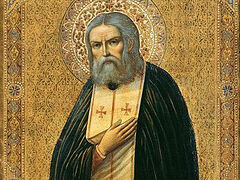
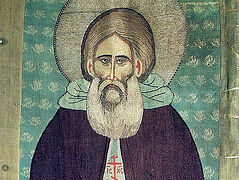
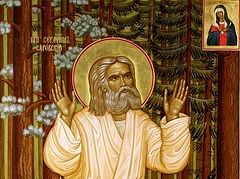
 St. Seraphim of Sarov and St. Sergius of Radonezh Since the time of the Baptism of Rus’, our people have turned their gaze to saints and ascetics of piety, expecting help and inspiration from them, and finding in them consolation, strengthening, and courage. Among such messengers of God on Russian soil, the venerable Sts. Sergius of Radonezh and Seraphim of Sarov have been especially revered. By their lives and ascetic labors, having acquired the grace of God, these venerable saints had an enormous influence on the spiritual life of Russia. This influence was felt not only by their closest contemporaries—it continues to be felt by many generations of their descendants.
St. Seraphim appeared not merely as a spiritual heir and follower of St. Sergius, but in a certain sense as his reflection. If the disciples of St. Sergius founded many cenobitic men’s monasteries, then the name of St. Seraphim is associated with a period of flourishing of women’s monasticism in Rus’. St. Sergius lived under the special protection of God, while St. Seraphim was vouchsafed to be especially chosen by the Mother of God. Both ascetics passed through many years of prayerful solitude in the wilderness forest; both are embodiments of love, goodness, and unity in Christ. This was fully reflected in the monasteries founded by the saints and dedicated to the Most Holy Trinity—the revelation of the Image of unity in Love. The feast day of the Most Holy Trinity—Pentecost—is the birthday of the Church, the day of universal unity in God. And the monasteries of the Most Holy Trinity founded by the holy elders likewise possess great unifying power. These monasteries not only united monks—they became centers of the entire Russian state, centers of Russian Orthodoxy, and a spiritual fortress.
“This is an icon from the relics of St. Sergius—place it upon me when I die, and lay me in the grave with it.”
The inseparable spiritual bond between St. Seraphim and St. Sergius, despite the distance of time between them, runs like a thread through the history of the Diveyevo and Holy Trinity-St. Sergius monasteries. One vivid example of this is the Life of St. Anthony (Medvedev), who served for nearly half a century as the abbot of the Lavra. Fr. Anthony revered Elder Seraphim as a saint even during his lifetime. He himself personally witnessed the extraordinary spiritual gifts of Elder Seraphim—his clairvoyance and healings, his help and consolation.
Father Anthony revered Elder Seraphim as a saint even during his lifetime
Andrei Medvedev decided to take monastic vows under the influence of the abbess of the Arzamas Alexeyev women’s community, Abbess Olympiada (Strigaleva), with whom he was in spiritual communion. In 1818 Andrei became a novice at the Sarov Hermitage. This was the very same hermitage that the young Prokhor Moshnin had joined forty years earlier, and where he had taken the monastic tonsure with the name Seraphim. After Fr. Anthony was appointed builder of the Vysokogorsk Hermitage and St. Seraphim had lifted his vow of silence, the future abbot of the Lavra visited the Sarov Monastery several times a year to converse with the elder.
In January 1831 Fr. Anthony once again set out for Sarov to seek counsel from St. Seraphim. This time he was led to the ascetic for a particularly serious reason—persistent thoughts of his impending death. Then St. Seraphim said to his visitor: “Not so, my joy, not so. Divine Providence entrusts a great Lavra to you.”
At that time the abbot of the Holy Trinity-St. Sergius Lavra, Archimandrite Athanasius (Fedorov), was still alive, and there was no talk of replacing him. Yet St. Seraphim foretold Fr. Anthony’s appointment to the Holy Trinity-St. Sergius Lavra two months before Fr. Athanasius’s death.
 St. Anthony (Medvedev) And so, on Monday of the first week of Great Lent, Fr. Anthony received a letter from Metropolitan Philaret of Moscow (Drozdov), with an enclosed envelope addressed to Bishop Athanasius of Nizhny Novgorod. In this letter Metropolitan Philaret proposed that Fr. Anthony take the position of abbot of the Holy Trinity-St. Sergius Lavra, which had become vacant after the death of Fr. Athanasius, and asked the hierarch of Nizhny Novgorod to release Fr. Anthony as soon as possible from his post as builder of the Vysokogorsk Hermitage and send him to Moscow.
At the beginning of the letter is mentioned an interesting fact: Previously, Metropolitan Philaret had decided to offer the vacant post to a little-known father-superior of a distant monastery whom the hierarch had met only once before, in 1824. But a certain wanderer came to him and directly pointed out Fr. Anthony as the future abbot of the Lavra.
Later, through Archimandrite Anthony, St. Philaret became more closely acquainted with the life, teachings, and miracles of the Venerable Seraphim. In his letters he repeatedly referred to the instructions and example of Elder Seraphim. The hierarch supported Fr. Anthony in all things, and together they often assisted the Diveyevo community and supported the Sarov monks. In 1842, under the “direct influence of St. Seraphim through Archimandrite Anthony”1—who often spoke to Metropolitan Philaret of his desire for silence and withdrawal from worldly vanity—the Gethsemane Skete was founded at the Lavra. The skete church was consecrated in honor of the Dormition of the Most Holy Theotokos, in remembrance of the Sarov elder’s special veneration of the Mother of God, and the rule of the skete was composed after the model of the Sarov Hermitage.
Until the end of their days, Metropolitan Philaret and Archimandrite Anthony greatly honored St. Seraphim
Until the end of their lives, Metropolitan Philaret and Archimandrite Anthony held St. Seraphim in awe and deep respect. It is known that the abbot of the Lavra reverently preserved a portrait of the elder, painted during his lifetime. A week before his repose, St. Seraphim entrusted one of the Sarov monks with an enamel icon2 of St. Sergius, saying:
“This is an icon sent to me by the honorable Archimandrite Anthony, abbot of the holy Lavra, from the relics of St. Sergius. Place it upon me when I die, and lay me in the grave with it.”
Lavra Biographers of St. Seraphim
It is known that St. Seraphim commanded St. Anthony (Medvedev) to always receive the monks of Sarov, and not to forget the orphans of Diveyevo. Following this testament, Fr. Anthony gladly received monks tonsured in Sarov into the brotherhood of the Lavra. Among these were the first biographers of St. Seraphim: Archimandrite Sergius (Vasilyev), Abbot George (Ivanov), and Hieromonk Abel (Vanyukov), the latter of which carried out his obedience at the relics of St. Sergius.
Fr. Sergius (in the world Stepan Vasilyev; 1795–1861), a retired provincial secretary, entered the Sarov Hermitage in 1818, where he labored in monasticism under the guidance of the elder-ascetics Mark and Seraphim. Having an inclination toward literary work, Fr. Sergius had begun in Sarov to keep notes on the life and labors of the Sarov elders—especially of his two teachers. Living in the Lavra, he put his notes in order, and by 1837 had composed biographies of both elders. However, publication of the Life of St. Seraphim of Sarov proved very difficult and protracted, despite the support of St. Philaret and St. Anthony. The manuscripts of the saint’s Life had to pass through the hands of several hierarchs before appearing in print. First, in 1839, the Lavra published A Brief Outline of the Life of the Elder of the Sarov Hermitage, Schema-monk and Hermit Mark, in which the first ten pages were devoted to Schema-monk Mark, while the remaining sixty-four pages contained Spiritual Instructions of Father Seraphim. Then, in 1841, in Moscow, under the signature “I. S.” (Hieromonk Sergius), there appeared An Account of the Life and Labors of the Ever-Memorable and Blessed Father Seraphim, Hieromonk and Recluse of the Sarov Hermitage—the first biography of St. Seraphim.
 The Holy Trinity-St. Sergius Lavra
Three years after the publication of this biography, the St. Petersburg journal Mayak printed Accounts of the Life and Labors of Elder Seraphim, Hieromonk and Recluse of the Sarov Hermitage, Extracted from the Notes of His Disciple. This book was approved for publication in July 1844. The author’s name became known only after the publication of St. Philaret’s letters to St. Anthony (1877–1884), from which it followed that the author of this biography lived at the Bethany Monastery of the Savior attached to the Holy Trinity-St. Sergius Lavra. He turned out to be another former monk of the Sarov Hermitage, Hieromonk George (in the world Guriy Ivanov; 1797–1866).
Fr. Abel also engaged in literary work, collecting materials on the history of the Sarov Monastery and accounts of its elders and ascetics. He compiled the book, The Cenobitic Sarov Hermitage and the Memorable Monks Who Labored There, which was published three times—the first in 1853, the third in 1865. In this final edition there appears a brief account of the life of Elder Seraphim, the Sarov ascetic, absent from the first edition, together with his spiritual instructions and a finely executed depiction. This account, composed in part on the basis of Archimandrite Sergius’s book, contains additions of particular value, since some of these accounts were evidently recorded from the words of—or even set down by—the abbot of the Lavra himself, Archimandrite Anthony.
Another biographer of St. Seraphim, spiritually connected with the Lavra, was Hieromartyr Seraphim (Chichagov). He took monastic vows at the Holy Trinity-St. Sergius Lavra, and prior to his appointment as abbot of the St. Euthymius Monastery of the Savior in Suzdal, spent a year among the Lavra brotherhood. Metropolitan Seraphim, then still an archimandrite, gathered a vast amount of diverse information on the life and miracles of St. Seraphim of Sarov and systematized it in chronological order. The result of this work was The Chronicle of the Seraphim-Diveyevo Monastery, which he conveyed to Nicholas II—bypassing the Synod—after a personal audience with the Sovereign. After this, the question of the saint’s canonization (which, as is well known, proceeded with difficulty) finally got going. It is noteworthy that during the tragic days of the closure of the Lavra in early November 1919, the future hieromartyr was in Sergiev Posad; on November 6, in the church of the Chernigov Skete of the Lavra, he served Small Vespers and a moleben before the icon of St. Sergius.
On November 30, 1937, Metropolitan Seraphim was arrested. At the time of his arrest, the manuscript of the second volume of The Chronicle of the Seraphim–Diveyevo Monastery, books, musical compositions, icons, and vestments were confiscated from him. One of the witnesses in his case testified that Metropolitan Seraphim, remaining faithful to the injunctions of Sts. Sergius and Seraphim, said, “There were persecutions of Christianity before as well, but how did they end? With the triumph of Christianity. So it will be with this persecution too—it will also come to an end. The Orthodox Church will be restored once again, and the Orthodox faith will triumph.”3
On the day following the martyrdom of the abbot of the Lavra, the Venerable Hieromartyr Kronid (Lyubimov), on December 11, 1937, Hieromartyr Metropolitan Seraphim (Chichagov) was executed by the NKVD at the Butovo firing range.
***
The Mystery of the Birth of Seraphim Defendov
During one of my meetings with the distinguished professor of the Moscow Theological Academy, Konstantin Efimovich Skurat, and his wife Maria Konstantinovna, I learned about a tradition of venerating St. Seraphim long before his official glorification. Konstantin Efimovich’s family was closely acquainted with Olga Serafimovna Defendova. Olga Serafimovna was the secretary and personal assistant of Metropolitan Macarius (Nevsky); she received from him the secret monastic tonsure with the name Seraphima. From the late 1950s she remained constantly at the Lavra, near his tomb. At her request to His Holiness Patriarch Alexiy I, the holy relics of Metropolitan Macarius were uncovered and transferred to the Lavra in 1957.
The newborn child, after Baptism, remained alive and healthy and became a great consolation for his parents
Olga Serafimovna came from an old Tambov noble family. Her grandfather and grandmother were pious people, but all the boys born in their family died in infancy. The parents, who regarded this as some special punishment from God, fervently prayed that the Lord would grant them a son. And then, in a dream, the grandfather saw a wondrous elder who told him that a boy would soon be born and instructed him to name the child after himself, and thus the child would live. Upon waking, the grandfather understood that the elder he had seen was none other than the Sarov ascetic Seraphim, venerated in their family. But how could a child be given the name of an unglorified ascetic? To resolve this question, Olga Serafimovna’s grandfather went to Tambov to consult the bishop, who blessed him to name the child Seraphim, but until the canonization of the elder to regard as the child’s heavenly patron a seraph from the ranks of the heavenly powers. The newborn child—Olga Serafimovna’s father—after Baptism remained alive and healthy and became a great consolation for his parents. From that time on, the entire Defendov family loved and revered the Sarov elder even more.
Lavra Elders Named Seraphim
 Archimandrite Seraphim (Shinkarev) A connection can also be found between St. Seraphim and the monastery of St. Sergius in the life of the twentieth-century Lavra ascetic Archimandrite Seraphim (Shinkarev). Fr. Seraphim entered the Holy Trinity-St. Sergius Lavra in 1947. He was an energetic man, attentive to people’s spiritual needs, and a great man of prayer. “Fr. Seraphim even outwardly resembled St. Seraphim of Sarov. Although he was a man of few words, people were drawn to him,” recalls Metropolitan Alexiy of Tula and Efremov (Kutepov), who served as abbot of the Holy Trinity-St. Sergius Lavra from 1984 to 1988.4 During the Great Patriotic War, Father Seraphim twice managed to collect large sums of money, which he donated toward the formation of the “Dmitry Donskoy,” tank column created on the initiative of the Moscow Patriarchate with funds from believers and transferred to the USSR tank forces in 1944.
Once he told the mother of a twenty-year-old medical student, Alexandra Konkova—the future Abbess Sergia, superior of the St. Seraphim-Diveyevo Convent—that her daughter would become a nun. Later he became her spiritual father. The abbess herself recalled of him:
“My future spiritual father, Archimandrite Seraphim (Shinkarev never left the monastery territory from the day he entered it… He possessed the gift of discernment. The strength of his spirit was such that the Lord revealed many mysteries to him. There were times when you would come to batiushka when he was praying, and while you waited, all your questions would be resolved. Fr. Seraphim prayed for his spiritual children, and everything was revealed to him.”5
St. Seraphim’s name was given at the great schema to the outstanding Lavra ascetic Archimandrite Peter (Semyonov), who revived the school of eldership at the Lavra after its reopening in 1946, and was thrice granted appearances of the Mother of God. Under his spiritual guidance grew such renowned elders as Archimandrite Kirill (Pavlov), Archimandrite Naum (Baiborodin), Schema-Archimandrites Panteleimon (Agrikov) and John (Maslov), Igumen Cosmas (Alyokhin), as well as many other twentieth-century ascetics of piety.
Beginning in the 1950s, the Lavra has celebrated a patronal feast in honor of St. Seraphim of Sarov. His Holiness Patriarch Pimen, while serving as abbot of the Lavra, established two side chapels in the St. Sergius Refectory Church—one dedicated to St. Seraphim, and the other to St. Joasaph of Belgorod. It is remarkable that the relics of these saints had been kept in the archives of the Museum of Religion and Atheism in the Kazan Cathedral in Leningrad. Miraculously preserved there, they were discovered together in the very early 1990s and returned to the Church. Thus, the establishment of two side chapels in a single church at the Lavra appeared as a sort of foreshadowing of the future uncovering of these holy ascetics’ relics. And the appearance in the Lavra of a chapel dedicated to the Sarov elder once again confirms the strong and unbreakable bond between the two most beloved and venerated saints of God in Rus’—St. Sergius of Radonezh and St. Seraphim of Sarov. This bond can never be broken, just as warm love for them will never fade from human hearts.
O Holy and God-bearing Fathers Sergius and Seraphim, pray to God for us!