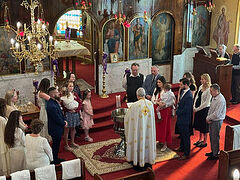
Every year since the mid-1970s, the Russian Orthodox Church Outside of Russia (ROCOR) has organized the annual St. Herman Youth Conferences for its young parishioners. This time, the conference took place at the Church of the Nativity of the Most Holy Mother of God in Albany, NY. We talked with it’s rector, Archpriest Alexis Duncan, about the gathering, and why young Americans choose Russian Orthodoxy.

—Dear Father Alexis, can you share how your parish hosted St. Herman’s Youth conference this year?
—Every year in late December, the ROCOR holds St. Herman’s conference in different parishes in the Eastern American Diocese or in the Canadian dioceses. This time, we hosted this gathering and welcomed about 225 participants, most of whom—around 200—were young people.
The conference lasted four days, and we had several main lectures. Archpriest Peter Perekrestov, dean of Our Lady “Joy of all who Sorrow” Cathedral in San Francisco, spoke on the history of the Russian Orthodox Church Abroad and presented a film with never-before-seen video of St. John of Shanghai and San Francisco. Bishop Luke of Syracuse delivered a lecture on the growing presence of AI in our lives.
 Archpriest Alexis Duncan We also organized spiritual workshops. One was devoted to marriage, and there were separate sessions for young women and young men on what it means, from a spiritual perspective, to be a healthy and normal human being.
In addition, we held several social workshops so young people could spend time together and build fellowship. These included learning how to prepare kutia,1 making gingerbread houses, playing board games, and similar activities.
On December 24, we celebrated the Vigil, and on the 25th, the Divine Liturgy on the Feast of St. Herman of Alaska and St. Spyridon. Our First Hierarch,
Metropolitan Nicholas served together with Archbishop Gabriel of Montreal and Canada and Bishop Luke of Syracuse. Altogether, we had nearly 20 priests and deacons. The church was completely filled with young people.
The Hawaiian Iveron Icon and the Kursk Root Icon of the Mother of God were presented during the services, and people came in great numbers to venerate them. We distributed about 500 small paper copies of the Hawaiian Myrrh-streaming icon. This means that at least 500 people attended the vigil service that evening.
We received a great deal of positive feedback, and many participants promised to return to the conference next year. It will take place at St. Nicholas Cathedral in Montreal.
—Was it a joy to see the church filled not only with parishioners, but with so many young people?
—Yes, absolutely. It is always very encouraging to see such a large gathering of people united by a common purpose. The services themselves were especially impressive because the choir was made up entirely of young people—about 35 to 40 singers, all with excellent voices. The result was truly remarkable.
Just recently, I met a young man who had never been in an Orthodox church before. He is from China and happened to attend the vigil on the evening of December 24 and the Divine Liturgy on December 25. It was the first Orthodox service he had ever experienced.
This man returned again the following Saturday and Sunday, and I had the chance to speak with him. He told me that he lives in our city and had read about the Orthodox Church online. He said he would continue coming, explaining that the services were so beautiful and impressive. Experiences like this show that these conferences also have a missionary dimension: People sometimes encounter faith for the first time.
Imagine coming into a church filled with 250 or 300 people, all gathered for the same purpose. It is very powerful. Our parishioners were very pleased, and Metropolitan Nicholas personally told me he was encouraged and fully supportive of youth work.

—What message did you, as clergy and adults, convey to the youth during this conference? And what message did you hear from them?
—I will begin with what I hear from them. Many young people feel that contemporary life is empty and lacking meaning. They see a world focused on selfishness, money, power, influence, and possessions—beautiful things, expensive cars, and constant excitement. Yet all of this leaves them feeling unfulfilled.
If someone buys a new iPhone, it brings excitement for a few days, but then that feeling disappears and something else is needed to fill the void. I believe this realization is one of the reasons they keep returning, even if they do not articulate it explicitly.
For our part, as clergy and organizers, we try to point them toward a path that brings deeper joy and lasting happiness. I tell them that the most important things in life are often the most difficult: fasting, prayer, attending church, and loving one another. Yet these are the only things that truly give life meaning and lead to happiness.
We place strong emphasis on preserving Orthodox culture. It is essential to safeguard the heritage we have received. In the Russian Church, this includes language, the use of Church Slavonic, the veneration of Russian saints, and respect for a culture formed over a thousand years.

I tell them that even small elements of culture, once lost, can never be recovered. If you lose them, you become impoverished, because they no longer fill your life. Therefore, preserving Orthodox culture and passing it on to one’s children is essential.
We live in American society, but we do not need to adopt its destructive elements. We must preserve our Russian Orthodox culture, allow it to grow, and never be ashamed of it.
—How is it possible to preserve Russian Orthodox culture in America and avoid temptations?
—Only within the Church. In our city, there are Russians who do not attend church. They even have a Russian cultural center, but it has nothing to do with Orthodoxy. As Dostoevsky said, without Orthodoxy, Russian culture is meaningless.
Without the Church, culture eventually becomes nothing more than a social club, lacking any real meaning. In the Church, however, all these elements are preserved and become part of daily life. The more deeply young people participate in church life, the more firmly they preserve their culture. Without the Church, there is no true center of life.
—How would you describe the outcome of this conference?
—From what I hear, young people leave with genuine enthusiasm. Friendships are strengthened, and we encourage everyone to confess, receive Holy Communion, and maintain a daily prayer life. During the conference, we prayed together every morning and prepared together for Holy Communion.
This creates not only friendships but also spiritual bonds. Many young people say they already look forward to the next year. Although the Church offers many activities—camps, dances, and other events—the more we interact, the stronger these bonds become.
—Do you see growing interest in Russian Orthodoxy and Russian culture among young Americans?
—Yes, very much so. This trend can be seen across America, as well as in Australia and parts of Europe. Young people, especially young men, are becoming increasingly interested in Orthodoxy.
In my parish alone, we baptized 30 adults last year. I currently teach a weekly class for those preparing for baptism, with about six people attending regularly.
Many young Americans are tired of political correctness and ideological pressure. I am not speaking about politics as party affiliation, but about being forced to accept ideas they know are not true. For many young men, this creates a desire to rebel and seek truth.
They are searching for guidance and sanity in an increasingly chaotic world. By God’s grace, they discover the Orthodox Church—a place that is not afraid to speak the truth. And they are drawn to it.
—So they choose the Russian Church because it is not afraid to speak the truth?
—Yes, that is a fair way to put it.
—What, then, can the Church offer them?
—The Church offers a foundation. Today, firm foundations are rare. The Church provides a way of life that supports spiritual formation and ultimately leads to the Kingdom of Heaven.
Without this foundation, a person is like a blind man walking in darkness. The Church becomes a guide toward a normal human life—building a family, raising children, centering life around the Church, and nurturing piety, intellectual freedom, and the ability simply to live rightly.