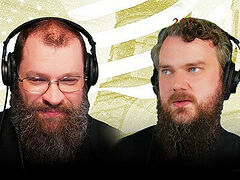
OrthoChristian.com had a visit from the Orthodox geopolitical blogger, Conrad Franz, from Austin, Texas—a graduate of Kings College, New York in media studies. Conrad was invited to Russia by the Moscow Patriarch Department for the Church’s Society and Mass Mediа Relations, to get firsthand experience of our Church life—in Moscow, Moldova, and the Donbas.
In this part of our interview, Conrad talks about his own path to Orthodoxy, Orthodox media, the demographics of the Church in the US, and the conversion blooming deep in the heart of Texas.
 Conrad Franz —Conrad, it’s good to have you here. Tell us a little bit about how you became Orthodox.
My favorite question! I was raised in a rather devout Protestant home, and we went to church every Sunday. Tired or not, we got up and went. We even planted churches, including in the Caribbean, we were lived for some years. It was a “low church”, Evangelical, Protestant reformed kind of vibe, with worship music and all that. Much of the local black population came to the church, with that cultural atmosphere. And, you know, it was great.
There was never a time in my life when I didn’t consider myself a Christian. When choosing a university, I decided on one in New York City. My parents told me that one of the first things I need to do is figure out where I’m going to go to church—now that they won’t be dragging me to church every Sunday.
—Which one did you choose in New York?
It was a non-denominational Bible church, with reformed Calvinist preaching. In fact, I always call the non-denominationals in the South simply reformed Baptists. That’s really what they are, even though they don’t openly identify that way.
So, I went to New York and I visited a few of these churches—some affiliated with Tim Keller, some affiliated with other mainstream Protestants. Generally reformed beliefs. Tim Keller is very well known in the Protestant world. He died recently. He wrote a lot of Christian books. He was on the more progressive side near the end of his life, so a lot of people stopped listening to him.
But eventually I thought, no, I hate all of these churches, I’m sorry. The low church worship, and the community felt so forged, with a non-liturgical nature of interactions. And I just realized, there’s no way I’m waking up every Sunday morning to take the subway to something like this, so I asked some of my more devout professors (this was a very conservative Christian University) where they go to church. Because I can’t be doing this low church rock band evangelical stuff. So, one of my favorite professors told me about this ACNA Church (the Anglican Church in North America). They’re the Anglicans who split away from Canterbury when they started ordaining women and lesbians, and all that kind of thing. So I started going to that church with my roommate for a while. We went there for about a year, and I really liked the liturgical aspect of it. I liked the reverence with which they approached communion. I thought the music and the hymns were more serious, the sitting in the standing was much more ordered. But I soon realized I couldn’t stay there, because there was a vested female pastor in the sanctuary. She never preached the homily and she wasn’t highly involved. I suppose she was more of a deacon. But even in my Protestantism I knew that wasn’t what we need to be doing, so I quickly started my discernment between Roman Catholicism and Orthodoxy.
At my university, study of the Old and New Testament and historical theology were mandatory to get a degree. Now, one of my Lutheran professors was weirdly pro-Orthodox. He really liked Orthodoxy. And he encouraged me to choose Orthodoxy over Catholicism. But that wasn’t the reason I decided; I started visiting churches. I went to a few Catholic churches, and to a few Orthodox churches. And I realized that I really loved Orthodox worship. When I was home in Austin for the summer I visited an English language service at the Church of St. John the Forerunner, which is near my home. When I returned to New York, I went to St. Mary’s Antiochian Church in Bay Ridge, Brooklyn.
I was catechized into the faith there, and received into the Church in January 2020 at my church in Austin, the parish of St. Elias in the Antiochian Archdiocese. At the time, my godfather was a deacon, and now he is a priest.
—So you were already Christian, but you were looking for the Church.
—I was basically making it my own. I had always been loyal to my parents, and because they’re my parents I did what they wanted. But finally, when I was out on my own, I had to make my own decision. I realized that I wanted the real thing.
Christian media
—Tell us about your studies at King’s College.
—My major is called Media, Culture, and the Arts. They had these very specialized degree programs, and I focused on journalism. My favorite class was on covering religion in journalism, which is basically what I do now. So unlike many students these days, I actually ended up doing what I studied after graduation. I also got a minor in theology; I even studied Islam. Studying theology in the midst of becoming Orthodox was very interesting. I am very grateful to my college experience for all of that. I graduated in 2021.
—When did you start working on your website, World War Now?
—I started it as a hobby when I was working for Dr. Steve Turley. People might be familiar with him. He has a popular YouTube channel called, “Turley Talks.” I used to run his website and his social media. It was my first job out of college.
And then about a year later, in September 2022, I started my show, and brought in my co-host, Dimitry. We were introduced through Jay Dyer and some other people. I reached out to him, because I knew he was a very well-informed Russian history and politics expert. I said to him, hey, I think we’re in the midst of a third world war. Would you like to do a podcast with me about it? And he said, absolutely. And that’s how we started. The catalyzing event was the destruction of the Nord Stream pipelines. That was when I realized that someone in America needs to be talking about all this through the perspective of what the saints have told us. I love St. Paisios, St. Porphyrios, as well as St. Lawrence of Chernigov, Elder Jonah of Odessa, and Elder Zosima of the Donbas.
I had heard about all of these people and their prophecies. But there was no website, let alone a podcast, bringing all of this analysis and the words of these saints together, applying them to the extremely unique and catalyzing times that we currently live in.
The whole brand I have is called “World War Now,” with a weekly free geopolitical analysis show. Our other weekly show is called Aether Hour—with more interviews. We talk a lot about Orthodox history, Russian history, Greek history—the Orthodox world in general. We’ve interviewed such people as Abbot Tryphon [(Parsons), of the All Merciful Savior Monastery, Washington], Fr. John Whiteford [Houston Texas, ROCOR], and Fr. Peter Heers. We’ve had all different Orthodox figures and other interesting people, like Cameron McGregor, the son of Colonel Douglas McGregor. It’s the alt-media sphere that really understands what’s going on in Russia, Ukraine, and the Middle East—a major focus of ours.
Part of the show is behind a paywall, part is free.
A Thousand Catechumens
—You mentioned before that there are currently a thousand Orthodox catechumens in Austin, Texas. I assume that is in all of the Orthodox churches together?
There is the well-known Fr. Moses McPherson in the Georgetown area, whose [ROCOR] parish is booming. But some of the ethnic Russians have started a rural core parish after he came—it was a little too American for them. There is also an Elder Ephraim monastery, about an hour west of Austin—the Monastery of the Holy Archangels. I’m very close with the monks there.
My parish, St. Elias, has about a hundred catechumens now. We usually receive people in groups around Pascha, and in the latter half of the year we receive people individually, so I don’t even know how many we have at a given time. In all the nine parishes of the city there may be about forty or fifty. So, at any given moment there are 800 to 1100 catechumens being received into the Orthodox Church in the Austin area.
Austin is an interesting scene. It is a university town with many students, and although it’s a very liberal city, there is a kind of underground conservative movement. In fact, the president of the University of Austin is Greek Orthodox—Pano Canelos. He’s a good guy. Fr. Maximus Constas works there. He’s the head of the humanities department. I see him at the monastery whenever I go on Sunday—he helps chant.
 The Church of St. Elias downtown Austin. Photo: maps.app.goo.gl
I’m on the fundraising committee at my parish, where we’re building a huge new temple in North Austin that will hold about 500 people. There is also an old Lebanese parish—the oldest in Austin—built it in the 1930s. So there is a real Orthodox heritage and roots, as well as new things happening. I view Austin as a center of Orthodoxy in Texas. The big conversation between all the priests right now is that we need a bishop down here.
I’m in the Antiochian Archdiocese. Our bishop is ostensibly up in Wichita, the ROCOR bishop is in Chicago, the Greek bishop is in Denver—but there are more Orthodox Christians in Texas now than in many of those places. So we really need a Texas bishop—which could be a catalyzing factor for more Orthodox unity across jurisdictions, and that is something I’m always happy about. But Father Moses is an institution in and of himself. His church raised $2 million for the new plot of land they have. And the Romanian church has almost completed work on their beautiful new church building.
The other Antiochian church is expanding its church hall. The Serbian church is helping them. Everything is booming and it’s extremely encouraging. Everyone has as if looked up from their own very heavy workload to grow the Kingdom.
 The new St. Elias Church, north of Austin. Photo: maps.app.goo.gl
—My experience of Orthodoxy in Texas is very positive. But I’ve often heard it said that Austin is a hotbed of wokeness and liberalism.
—In many ways, it is. So I wouldn’t undersell that it’s still a very liberal city. But even at the University of Texas, there’s a liberal faction. But because UT is a state university, Greg Abbot [the governor of Texas] has been able to exert some influence on the curriculum and tone down the wokeness a bit. I’m not telling anyone to send their children there without warning them about the dangers of getting indoctrinated, but it has been toned down a little bit.
And I’ve heard that Texas has the largest Orthodox Christian Fellowship (OCF) chapter in the country. The OCF is a student group for college campuses. And the OCF in Austin is growing, because besides UT, there is also St. Edward’s University1 in that city. Some of the teachers there go to my parish. But Texas A&M University—just a few hours from Austin—has apparently one of the largest OCF chapters in the country, and it makes sense. It’s a very conservative school. So in general, Texas is the place to be. If you want to be Orthodox, move to Austin!
A Real Man’s Religion. Demographics
—This brings me to my next question. Various videos and articles are going viral—not only in the States, but also in Russia—talking about a new view of Orthodoxy in the US as a masculine religion, the place for real men. Do you think that’s true?
—The demographics have certainly changed. When I was visiting the church in 2019, this was the beginning the wave of the “OrthoBros,” Jay Dyer videos, or listening to Father Spyridon. That’s what people call us. It’s become sort of a slur now, but I think it’s a funny term. I don’t mind it.
—What could be wrong with it? I’ve seen it described as a sort of zeal without knowledge. Fr. Seraphim (Rose) used to call it, “Crazy Convert Syndrome.” I personally think the “OrthoBros” of today is a healthier phenomenon than what Fr. Seraphim was describing.
—Yes, I’m Orthodox and I’ve got my bros. That’s great. It is what it is.
—In a cursory search on “OrthoBros”, I saw woman authors talking about it as if men converting to Orthodoxy was somehow unseemly—titles like, “Why Orthodoxy seduces young American men.” These authors don’t seem to be happy about it. Is there a disbalance between the number of male converts to female? And if so, does that make it hard for the young unmarried male convert to find a bride?
—Yes, there are many more males than females, and it is a problem for finding a wife. Ironically, we have found that the Evangelical (or Protestant in general) churches are disproportionately female. Which of course makes it hard for these girls to find husbands. I would encourage them to look into Orthodoxy!
But in fact, many young families are coming into the church—many people who are working in the conservative movement, pro-life activists and their families. My parish is right next to the Texas Capitol building, two blocks away. Every other year, the legislature meets, and people come from all over Texas. Many of those people who work for the legislature and work for Republican representatives come along, and while they’re there they go to my parish—and they bring their families. It’s a whole thing.
These are intelligent, precocious people that are involved in politics, in the conservative movement or something like this—such people are very often drawn towards Orthodoxy. And at my parish, the vast majority of catechumens at any given time are usually young men between the age of sixteen and thirty-five, generally speaking. And that’s at my parish, which, isn’t necessarily the most he-man one. Then there’s Father Moses in Georgetown, who has fifty or sixty young men at any given time in his catechism classes.
There are both single and married men. We get some Catholics, but generally speaking, mostly former Protestants. There are people from all walks of life. Because there’s no Eritrean or Ethiopian church here, many of those people come to our church. There are more and more Hispanics coming as well.
We’re seeing a good amount of Hispanic people because Protestantism is now ravaging Catholicism in the Hispanic community. And I think that many of those who went from Catholic to Evangelical—or maybe their parents did—have been finding their way to Orthodoxy.
There is also the Greek monastery, between Austin and Fredericksburg, which has a huge community. If you visit on Sunday, there will be hundreds of people there in the trapeza having a wonderful time.
 Holy Archangels Monastery, Kendalia, TX. Photo: holyarchangels.com
—How many monks are there now?
—Ten. They are both Greek and American. If you want to be a novice in Texas, Holy Archangels will take you; although not all remain as monks. As yet, monastic life seems to be too hard for American men.
—I have heard that Elder Ephraim’s vision was that for now the monasteries would use the Greek language, but that there will probably come a time when they will transition into English language.
—Yes, and there’s Fr. Menas, who left St. Anthony’s and started the Monastery of St. Paul in Wisconsin, which is basically just like the Ephraimite monasteries, but using English. So, it’s starting.
—How do your parents view your conversion to Orthodoxy, and even dedicating yourself to an Orthodox website?
—Thankfully, I am very blessed with an extremely supportive family. I think my parents were just grateful that though I went to New York City for college I came back more Christian than when I left. They were confident that I would maintain my faith, but they didn’t expect me to get even more serious about it. I am probably the most religious of my siblings, but they also think it’s great.
My dad is a young baby boomer and my mother is an older gen X lady. And the idea that young people are super religious is a bit alien to them. As for the website—my parents have always been extremely conservative. My parents met at the Heritage Foundation in Washington, DC. They were big political people. I was born in Arlington, Virginia, and my dad was always the most conservative person at his conservative office. He wrote firebrand things for think tanks and what not, getting hated on from the liberals in Washington. So I’ve always had that sort of boisterous conservatism, and my parents love it. They’re very proud of what I’m doing.
The Antiochian Archdiocese, and Russia
In our Antiochian community, generally speaking, there is a favorable view of Russia. After all, our Antiochian Archdiocese owes its entire existence to Russia, because it was Tsar Nicholas II who sent St. Raphael of Brooklyn over to the United States to preach to the Arab Orthodox Christians. St. Raphael started preaching, and he laid the groundwork for what became the Antiochian Archdiocese of North America, which is the largest diocese in the Antiochian Patriarchate.
So the Antiochians still have an awareness of that. And of course, we know that our church was not represented at all at the Council of Crete in 2016, for example. We have strongly stood with Metropolitan Onuphry in Ukraine. And Patriarch John X is very close with Patriarch Kirill and with the Russian Church, because he understands the Russian role in Syria and how that’s unfolded. Of course, everyone has their own opinions, right? And we have Russians at our parish, too.
Because our parish was so old, we used to have everybody. We had the Greeks, the Russians, the Serbs—all came to St. Elias. So that’s probably why there’s more of a pan-Orthodox attitude. The Serbian church, of course, likes Russia. The only place where you probably find a general opinion otherwise—and even then it would be very split—is the Greek church. I know a lot of very conservative Greek people that definitely love the Russian Church and hate what’s going on in Ukraine. But there’s a big Greek church in Austin; I remember one time I went there, and they had Ukrainian flags on their tablecloths or something like that. But that was a while ago, and I don’t think that would be as popular these days.
We have a Mediterranean food festival every year, but we also have a Russian stand, in front of which there was always a miniature scale model of St. Basil’s Cathedral. In the first years of the war, we thought it prudent not to use it, so that no one would come and kick it down. But in 2023 and 2024 we had St. Basil’s proudly on display.
So besides GOARCH, almost nobody in America has any desire to be associated with Dumenko2 and those with him.
—What about the so-called Slavic vicariate under Archbishop Elpidophorus?
—Thankfully, they are minuscule. No Slavs want to join that Slavic vicariate. There is, of course, also the Ukrainian church in the USA under the Ecumenical Patriarch in America. That’s probably where you’ll find the strongest pro-Ukrainian, anti-Russian feelings.
And as far as the general awareness of the situation in Ukraine, I give credit to people like Tucker Carlson and even JD Vance. And there has been talk that perhaps Patriarch Bartholomew is having second thoughts about how this [the OCU] is going. But Orthodox people in America are much more sympathetic with the canonical Ukrainian Orthodox Church. The Primate of the OCA, Metropolitan Tikhon, made a point of going to Ukraine and serving with Metropolitan Onuphry.
—Is there anything that you would like to say like to our readers at OrthoChristian.com?
Well first of all, I would just like to say thank you on behalf of the Orthodox Christians of Texas and of America for your website. It is basically the number one Orthodox website and resource for people. When I was becoming Orthodox as a catechumen, I was reading it all the time. It’s the home page on my laptop. It is very much an evangelizer, a shining light into the barbarian lands of the West.
I also think that it is important to pay attention to the prophecies of the saints—the Greek, Serbian, and Russian saints, and even some American saints, if you consider Elder Ephraim to be an American saint—which I do.
My show is a good guide to this. I think my friend Jonathan at the Eschaton Vigil, for example, does really good work in translating these prophecies. If you go into it with a prayerful mind, and you’re an Orthodox person that has read some patristic literature, you will get a very interesting and clear picture of where we’re headed. And while it is a bit scary and there are some scary things along the horizon, ultimately it is a message of hope. Because in the midst of all of this, all the saints agree that Orthodoxy will be preached and spread as these fateful days unfold. So, I suppose that would be my message.
—Thanks, Conrad. You also traveled to Moldova, and we would very much like to hear about the experience. But we will talk about that next time.