For 400 years now, the Holy Dormition-Vysha Monastery has been standing on the right bank of the Vysha River, not far from its confluence with the Tsna River, twenty miles from the city of Shatsk. Monasteries have always been a bastion of Russian statehood, its invisible shield of prayer, spiritual foundation, and defense. Many events took place as part of the anniversary celebrations in 2025, most importantly the transfer of the venerable relics of the monastery’s abbot, Archimandrite Arkady (Chestonov), to Vysha, which took place on August 20.
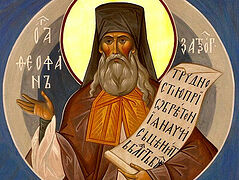
 St. Theophan the Recluse During the time of Archimandrite Arkady, the outstanding theologian St. Theophan the Recluse labored at the Vysha Hermitage. While occupying high Church positions, he always longed for solitude, peace, and quiet in order to devote himself to spiritual writing and thereby serve the holy Church and the salvation of others. But this was hindered by his extensive active ministry in service to the Church. St. Theophan first visited Vysha Hermitage when he headed the Tambov Diocese.
On July 17, 1866, he was relieved of the administration of the Vladimir Diocese and appointed abbot of the hermitage. On July 28, after a moleben, Vladyka left Vladimir and headed for the place of his final spiritual labor, arriving at Vysha on August 3.
St. Theophan wrote about his first impression of the monastery:
The monastic routine here is excellent. The brotherhood is good. The services are a bit long, but you can get used to it. Matins is at 3:00 AM, followed immediately by the early Liturgy, and the late liturgy at 8:00. Vespers is at 4:00 PM. At 7:00, they gather again for prayers before sleep. There are hard workers who stand through entire services and won’t sit down, even getting angry if someone asks to sit. The hermitage is in the forest. A fair number of people, both monastics and laypeople, gather on every Sunday and feast day. They stay in the guesthouses and are fed by the monastery. Not a single day has passed since I arrived without people receiving Communion. In every respect, Vysha is a most consoling and most blessed monastery! I am so peaceful in spirit here that I couldn’t ask for anything better!
However, the burden of the abbacy weighed heavily on the Holy Hierarch, and in September 1866, he retired. In many letters from this period, he repeated: “I’m doing well. Very well”; “I feel very good at Vysha.”
There, St. Theophan took up the asceticism of reclusion. Archimandrite George (Tertishnikov), a researcher of the spiritual heritage of St. Theophan, wrote about this: “The time of reclusion was the most important period—we might even say the very center of His Grace Bishop Theophan’s life—for it was then, above all, that his great labors and asceticism were manifest in their full strength.”
At Vysha, he prepared translations of Patristic writings and wrote theological works and hundreds of letters where he reflected on the Christian life, overcoming temptations and faintheartedness, and the final fate of mankind. In the saint’s letters, you can find the answer to practically any question that might arise on the Christian spiritual path.
The main theme of his works was salvation in Christ. This is seen in such major works as The Path to Salvation (1868–1869), The Rule of a God-Pleasing Life (1868–1869), Letters on the Christian Life (1870–1871), Thoughts for Each Day of the Year According to the Daily Church Readings from the Word of God (1871), The Spiritual Life and How to be Attuned to It (1878), Daily Reflections for the Year (1882), and Foundations of Christian Moral Teaching (1891).
He also prepared various translations for publication: Homilies of St. Symeon the New Theologian (1877–1881), Unseen Warfare by St. Nikodemos the Hagiorite (1885–1887), and The Ancient Monastic Rules of St. Pachomius, St. Basil the Great, St. John Cassian, and St. Benedict (1892). The crowning achievement of his theological work and life path was the Russian translation of the Philokalia. St. Theophan didn’t simply translate it from Greek, but adapted it for monastics and laypeople, so that all members of the Russian Church could use it in their spiritual life. The five volumes of St. Theophan’s translation of the Philokalia were published in 1877–1890.
After the revolution, Vysha Monastery, which had become a famous spiritual and educational center in the nineteenth century with numerous pilgrims flocking to it, was ruined.
 In 1938, a psychiatric hospital was established in the monastery buildings, remaining there until 2012. The patients were kept in the most difficult conditions; the residents of the surrounding area tried as much as possible to ease their lives, bringing them food and gifts. Many righteous people were to be found within the walls of the hospital. Living among the patients, many of these ascetics took upon themselves the exploit of holy foolishness and bore it until the end of their lives in obscurity far from the world. The righteous women of prayer of the Shatsk region, the Petrina sisters, said: “Previously, there was a monastery at Vysha, but now Vysha is higher than a monastery.”1
In the early 1970s, St. Theophan’s relics were secretly uncovered by Archpriest George Glazunov, rector of the Church of St. Sergius of Radonezh in the village of Emmanuilovka, Igumen Mark (Lozinsk), Archimandrite Elevthery (Didenko), and Archimandrite George (Tertishnikov). It was decided to transfer his remains to the Holy Trinity-St. Sergius Lavra, where they were kept in the basement of the Dormition Cathedral until 1988.
That same year, St. Theophan the Recluse of Vysha was canonized at the Jubilee Local Council of the Russian Orthodox Church as an “ascetic of faith and piety who had a profound influence on the spiritual rebirth of the society of his time.” His relics were also transferred to the church nearest the monastery—the Church of St. Sergius of Radonezh in the village of Emmanuilovka.
After many years of desecration, the monastery was revived in our time as a convent. On April 29, 1990, the Council for Religious Affairs under the Council of Ministers of the USSR decided to transfer part of the buildings of the former Holy Dormition-Vysha Hermitage to the Ryazan Diocesan administration. The very next day, in the Sts. Boris and Gleb Cathedral in Ryazan, with the blessing of His Holiness Patriarch Pimen, Archbishop Simon of Ryazan and Kasimov solemnly elevated Nun Nonna (Znamenskaya) to the rank of igumenia, followed by her appointment as abbess of the monastery. The Kazan and Nativity of Christ Churches were transferred to the monastery, as well as the small former fraternal building. The psychiatric hospital continued to occupy the monastery territory, so the first nuns settled a few miles from the monastery on Bykova Gora, which became a dependency of the Vysha Monastery in 2004, with a church consecrated in honor of St. Theophan.

At the request of Abbess Nonna, the Dormition Cathedral was transferred to the Ryazan Diocese on May 29, 1997. It was consecrated on June 21 the following year. In 1999, an important event took place when a pre-revolutionary copy of the wonderworking Kazan Icon of the Mother of God of Vysha was transferred to the monastery. It had been kept by Schemanun Cheruvima, who subsequently gave it to the nuns Ludmila and Yuliana.
In 2001, processions with the Vysha Kazan Icon to Tambov were resumed. Since 2011, the processions have been held with both the icon and the relics of St. Theophan the Recluse.
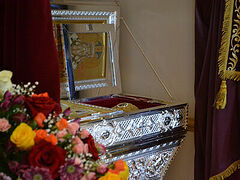
 On June 29, 2002, His Holiness Patriarch Alexei II headed the solemn transfer of St. Theophan’s relics from the village of Emmanuilovka to the Holy Dormition-Vysha Monastery. A feast was then established to celebrate the anniversary of this event on a Churchwide level. On March 14, 2009, Archbishop Pavel of Ryazan and Kasimov transferred St. Theophan’s holy relics to the monastery’s restored Kazan Church. He also served the minor consecration of the church that same day.
On June 28, 2010, the Theophany Church and the St. Theophan Museum were consecrated by Archbishop Pavel. The museum, set up in his monastic cells, officially opened the next day.
From 2011, the monastery was headed by Abbess Vera (Rovchan), who carried out large-scale restoration projects. Since 2024, the monastery has been headed by Abbess Dimitria (Lukianova).
In 2025, jubilee celebrations dedicated to the 400th anniversary of the monastery’s founding were held.
On August 20, the honorable remains of the monastery’s former abbot Archimandrite Arkady (Chestonov) were transferred to Vysha. Today, the relics of the ascetic co-struggler of St. Theophan, who is yet to be glorified, are located in the crypt of the Nativity of Christ Cathedral.
 The transfer of the holy remains of Archimandrite Arkady to Vysha
An exhibition dedicated to the 400th anniversary of the Holy Dormition-Vysha Monastery, “Keep Your Heart in the Higher Realms and You’ll Always Be in Vysha!”2 opened on August 21.
The children’s competition, “Holy Dormition-Vysha Monastery Through the Eyes of Children” was held that year.
The Theophan Readings have become a regular event, organized by the Publishing Council of the Russian Orthodox Church, which established a scientific-editorial council to oversee publication of the Complete Works of St. Theophan. During the summer months, Vysha hosts the “God’s Harvest” St. Theophan Missionary Patriotic Forum of Orthodox Youth.
The sisters of Vysha Monastery labor unceasingly for God and for people. Since December 2025, nighttime Liturgies have been held for the sisters in the Theophany House Church of St. Theophan.
A monastery, in the words of St. Theophan, is “the best place for working out your salvation,” “a society of those struggling with themselves for the sake of the Heavenly Kingdom.”
Many pilgrims come to venerate the wonderworking Kazan Icon of the Mother of God and the relics of St. Theophan the Recluse. As many years ago, prayer is offered daily at the monastery for the country, for the Russian Church, and for the souls of the people.