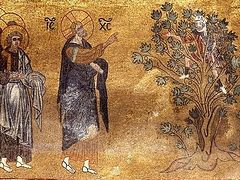
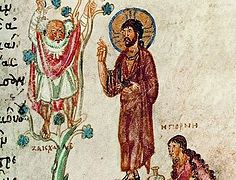
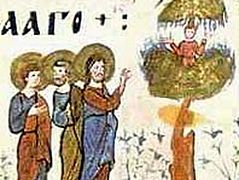
And Jesus entered and passed through Jericho. And, behold, there was a man named Zacchaeus, which was the chief among the publicans, and he was rich. And he sought to see Jesus who he was; and could not for the press, because he was little of stature. And he ran before, and climbed up into a sycomore tree to see him: for he was to pass that way. And when Jesus came to the place, he looked up, and saw him, and said unto him, Zacchaeus, make haste, and come down; for to day I must abide at thy house. And he made haste, and came down, and received him joyfully. And when they saw it, they all murmured, saying, That he was gone to be guest with a man that is a sinner. And Zacchaeus stood, and said unto the Lord; Behold, Lord, the half of my goods I give to the poor; and if I have taken any thing from any man by false accusation, I restore him fourfold. And Jesus said unto him, This day is salvation come to this house, forsomuch as he also is a son of Abraham. For the Son of man is come to seek and to save that which was lost (Luke 19:1–10).
I would like to single out three moments in the story of Zacchaeus, placing particular emphasis on one of them.
Zacchaeus passionately desired to see Christ. Such a longing on the part of a publican testifies that although according to God’s law his life is unworthy—unworthy of him as a human being—Zacchaeus preserved, in the depths of his soul, a sensitivity to truth, to beauty, to the human dimension of things; and therefore he was capable of meeting God, of encountering God’s dimension. In his ardent desire to see Christ face to face, he encountered two difficulties: He is small of stature, and therefore must find some way to attract the Lord’s gaze—and this may expose him to ridicule. He is small of stature, and so he will have to climb a tree.
Are we not all small people, lost in the crowd and deprived of the ability to see? Must not each of us from time to time climb to a height that is not natural to us—outgrowing ourselves, though remaining just as small and poor as before? And do we not risk becoming objects of surprise and mockery when we attempt to rise higher than we truly are, in order to stand face to face with God? Above all else in our search for God, we are hindered by the fear of being laughed at. Our pride, stubbornness, and desire for self-assertion can withstand harsh criticism and direct attacks; they can endure hostility and rejection. But to endure ridicule is extraordinarily difficult. It is precisely this chief problem that I wish to address.
But first, allow me to note the third moment in the story of Zacchaeus. When Christ enters the house of Zacchaeus, He is met there with reverence and joy. Awe before God, joy at His presence, are clearly manifested in Zacchaeus’s life by the authenticity of his conversion, by repentance in deed—metanoia, which means a completely new direction of life. Because he has met God, and this encounter has awakened life and joy within him; because his crippled soul has straightened itself to the full measure of his humanity and has been reconciled with God to the depths, Zacchaeus renounces his past. He is ready to set right every injustice. By an act of trust in God, by an act of faith, he seeks to begin a new life, free from the past. Christ acknowledges all this when He says: For he also is a son of Abraham—that is, he belongs to the lineage of those who are capable of believing, not with credulity, but with total self-surrender. That is why this day is salvation come to this house.
But the entire situation hinges on one circumstance that could have broken Zacchaeus’s resolve—the laughter of the crowd. The Fathers of the Church consistently tell us that very often what prevents us from beginning a new life is not the attraction of the evil to which we have grown accustomed, nor the opposition we may encounter, but the fear of being ridiculed. I want to develop this point.
I am a prison chaplain. I remember one inmate who said to me: “You cannot imagine what a stroke of luck it is to be caught and publicly shamed when you are about to start a new life. How many times I tried to give up stealing, and each time I retreated because of the mockery of my companions. ‘What,’ they would say, ‘have you decided to settle down? Ready to sell your freedom—the freedom of a man who stands alone against this rotten society?’” As soon as this man was caught and ended up in prison, he came out from under his friends’ influence and felt that he could begin life again. Before that, whenever he tried to change, honest people who did not know he was a thief would ask themselves, “What’s going on with him? He’s changing—and if so, that means there was something wrong with him before.” In constant fear of being exposed, afraid that his corrupt inner self would be discovered precisely because a good beginning had begun to dawn, he was glad that he had finally been unmasked. He felt that now nothing stood in the way of his change; there was nothing left to hide, and he could become a new man.
How often the fear of other people’s opinions prevents us from changing, even when we are fully ready for change, ready to take the first step—because that step will immediately betray our past. And it is ridicule that frightens us, far more than the sternest condemnation.
Imagine this scene. A wealthy man—something like a present-day bank manager—with a solid position in a small town, wants to see Christ. He squeezes through the crowd, and a little man like him already makes a rather comical sight. And he climbs a tree. Can you imagine the manager of the local bank scrambling up a tree in the town’s central square to see a wandering preacher? Of course, mockery, caustic remarks, and whistles would rain down on him. This was probably the greatest trial of Zacchaeus’s faith. To become a disciple of Christ and, for His sake, to be rejected by friends and family is undoubtedly an act of great courage; but for him—a local celebrity—to climb a tree like a street urchin is something altogether different and far more difficult. Is it not precisely the fear that the very first step will make us look ridiculous that so often prevents us from following Christ? “Where is your free thinking now that you have suddenly decided to bow before outdated ideas? You—the one who claimed the right to do whatever you pleased, who challenged God—and now look at you, suddenly become His slave? You were never afraid of human gossip. Why are you frightened now, and even ready to submit to His law?” Do we not hear our friends’ reaction to our conversion in these words?
There are only two ways to overcome vanity, the dependence on public opinion—either through pride, or through humility. There is no third way. Vanity made Zacchaeus a small man, and it makes us small before God and before people. Vanity has two negative features. On the one hand, the vain person falls completely into servile dependence on the judgments of others. His conscience falls silent before the voice of the crowd, and God’s judgment is excluded. God stands invisibly, unobtrusively at a distance, while the crowd, loud and self-assured, demands submission and conformity to commonly accepted standards. Dependence on public opinion stifles the conscience and God’s judgment.
On the other hand, the most humiliating thing about vanity is that the people on whose opinion we depend are people we do not even respect. The rabble whose approval we so eagerly seek, whom we so fear, whose judgment we dread, is far from being the council of God’s saints. There are not even people amongst them capable of pronouncing a just judgment or of upholding true values. We sometimes listen with contempt to their gossip about others, and yet we tremble before their verdict. Think how much we do in life while looking over our shoulder at “society,” worrying whether it will think well or ill of us. If only for a moment we were to reflect, we would see that the very people whose approval or condemnation so troubles us we do not consider sensible at all. And yet we quake under their scrutinizing gaze and seek an approval that is so superficial and petty. And thus, as it turns out, we all walk through life with outstretched hand, begging for a miserable coin—an approving smile or glance. I have just described the people from whom we expect alms. But what kind of alms are they, and how do we receive them? Is it not by agreeing to live as fakes in a distorted world, where illusion has replaced reality?
Vanity not only deprives what we possess of true content; it also takes away from us what we truly have. There is a story from the lives of the Desert Fathers about a monk who lived in a large monastery, and as his hagiographer says, through harsh ascetic labor and with God’s help he acquired nine virtues. Yet in his zeal for greater perfection he strove to acquire a tenth virtue, but despite all his efforts, he couldn’t do it. Instead of examining what was driving him to seek more, and whether there was not some weakness in him that stood as an obstacle in his path, he decided to leave his monastery, where, as it seemed to him, the conditions did not favor his aspirations. As soon as he left his cell with the intention never to return, the little humility he had acquired departed from him, and vanity seized his soul. He visited nine monasteries, but left each one, believing that remaining there did not help him become a saint. Yet each time he departed from another monastery, he left poorer than when he had entered it. First he lost patience, then vigilance, then self-restraint, then obedience, self-control, meekness, and so on. His vanity kept growing, pride increasingly took hold of him, and with it—irascibility, anger, laxity, self-will, presumption, and hardness of heart. And after he had gone through nine monasteries, nothing remained of his original virtues. What was at first a slight admixture of vanity and pride completely crowded out all the virtues.
Vanity is destructive also because it is prone to being deceived by a misleading appearance. Christ tests the human heart; He sometimes casts aside what seems entirely convincing evidence and penetrates into the depths, beneath what is visible. Two examples will help us understand this.
When, after His Resurrection, Christ met Peter on the shore of the Sea of Tiberias, He did not reproach him for his apostasy, nor did He demand a detailed confession. He asked Peter a direct question: Lovest thou Me more than these? Had Peter been more attentive, the last three words—more than these—would have troubled him. Perhaps he would have recalled Christ’s words: A certain creditor had two debtors: the one owed five hundred pence, and the other fifty. And when they had nothing to pay, he frankly forgave them both. Tell me therefore, which of them will love him most? And he himself had answered: I suppose that he, to whom he forgave most. If he had reflected a little, he might have come to himself like the prodigal son. But Peter is impatient, ardent, and direct; he acts before giving himself time to think. He answers with all his heart: Thou knowest that I love Thee. Lovest thou Me? Christ asks again. Yes, Lord, Peter replies. Lovest thou Me? the Lord asks a third time. And suddenly Peter understands. He has already heard such a threefold question—in the courtyard of the high priest, on the night when Christ was betrayed; he was questioned three times, and three times he denied Christ. Christ’s words more than these now sound threatening. Who will believe that Peter loves Him? They promise condemnation, not hope. And desperately realizing that all the evidence testifies against him, hoping against all hope, Peter cries out: Lord, Thou knowest all things; Thou knowest that I love Thee! And Christ, God, who indeed knows the human heart, knows that Peter loves Him. He sets aside all outward evidence and addresses the hidden depth of the man’s heart, saying, Follow Me.
In a similar way Christ believes the woman taken in adultery. He does not break the law, but He sees through the surface of what is evident. As an adulteress, she deserved to be stoned, but then this woman became capable of entering into eternal Life. She was no longer a sinner caught in the act. Now she knew what she did not know or understand before—that sin is the same as death. If only life is granted to her, she will never forget the terrible truth that sin kills. The woman who committed adultery died within her. The one who stood in terror awaiting stoning was someone else entirely. It is this other woman, free and resurrected, whom Christ sends forth into newness of life. He saw her heart, addressed her deepest self, and the obvious is overcome not by pity, but by a greater truth.
As I have already said, there are only two paths for overcoming the feeling of servile dependence on the opinions of others: either pride or humility. Humility can take the form of indifference both to slander and to praise from people—of standing only before the judgment of God and one’s own conscience. This is spoken of in the story of a monk who wished to learn how one should respond to praise and reproach. His spiritual father ordered him to go to the cemetery and revile the dead. He did so, and when he returned, the elder asked how the departed had behaved. “They did nothing,” replied the monk. “They kept silence.”
“Now go and praise them,” the elder commanded.
And when the disciple reported that the cemetery had remained just as silent as before, the elder said: “Act like the dead. Human judgment no longer touches them, because they now stand before the eyes of God.”
There is also a form of humility that is the fruit of ascetic labors ruined by vanity. It is illustrated by the conclusion of the story of the monk with the nine virtues. Having lost everything he possessed, he came to a monastery, broken in spirit and lamenting all that had happened. After carefully examining his soul, he resolved henceforth to place his hope only in the Lord. Having confessed to God in detail, he wrote down all the manifestations of vanity and pride that had brought him to such a pitiable state and hid the slip of paper in his belt. He remained in the monastery, and whenever temptations assailed him, he would take out the paper and, after reading it, would be strengthened against the devil. The brethren marveled at his peaceful disposition—no quarrels, disturbances, or troubles could disturb his composure. Then they noticed that every time external or internal temptations attacked him, he took a piece of paper from his belt and immediately found peace and steadfastness.
“He must be a sorcerer,” the brethren said, “and he carries some kind of charm in his belt.” They complained to the abbot and asked that he be expelled from the monastery. But the abbot decided to find out what the paper was. At night, while the monk was asleep, he took it out and read it. In the morning he told the brethren that he would now read it aloud. The monk, fearing that the brethren would take his awareness of former sins as a virtue, begged the abbot to keep silence. But the abbot, understanding how much this could teach the monks, ordered it to be read. When they heard what was written, the brethren bowed to the ground and said: “Forgive us, brother, for we have sinned against you.”
If we listen at all to the voices of those around us, it should be only in order to hear the voice of God. Humility is one of the most courageous evangelical virtues, yet we have managed to turn it into the pitiful trait of a slave. Few people wish to be humble, because humility is perceived as a renunciation of human dignity. The same applies to obedience—we praise a child for being obedient, whereas in reality he is merely submissive and deprived of his own will. We very rarely ask what is in his heart and far too easily take a bleating sheep for a sheep of Christ’s flock. To be thought humble, obedient, and meek is perceived almost as an insult. We no longer see the height and strength of this state.
The caricature of humility that we know from experience—or that we ourselves represent—consists in responding to praise by hypocritically asserting that we do not deserve it, while, when we are ignored, we draw attention to ourselves by insistently repeating that we are of no account and not worth troubling about. True humility is born from the vision of God’s holiness; yet we often try to force ourselves to feel humble by artificially belittling ourselves.
I remember, once in a church in Moscow I saw an icon. The Lord was depicted upon the throne full-length, while at His feet lay two tiny human figures, no bigger than mice. If you were brought up in Christian “piety,” you will see in this merely the difference in proportion between God and man. But if this language is unknown to you, if you come from outside and simply see this icon, you will say: “No, this is not for me. I am a human being, not a mouse, and I have no intention of crawling at the feet of this God seated on a throne. I want to stand upright before Him; I do not feel so insignificant—I am a free person.” If you have read Holy Scripture, it is clear that you are right, and that it is precisely Christ God who showed man his greatness and Himself affirmed his dignity by becoming the Son of Man. If we wish to know what a human being is, we must look at Christ as He appears in the Gospels—Christ in Gethsemane, on the Cross, Christ Risen, the Son of Man seated at the right hand of the Father’s glory. We have no need to diminish ourselves, to make ourselves insignificant, in order to exalt God. God forbids us to do this. And if we do so, we achieve not humility but humiliation, which does not allow us to live worthy of the Kingdom of God and of our human calling.
How can we at one and the same time fall prostrate at God’s feet and become partakers of the divine nature? How can we lie stretched out before the image of God—and yet say: “I am a living member of this Body, whose Head is God Himself in Christ”? How can we shrink at God’s feet when we know that we are the temple of the Holy Spirit, the place of His presence? Can we look upon ourselves as something small and insignificant before God and yet say together with Saint Irenaeus of Lyons that in the Only-begotten Son we are called by the Holy Spirit to be an only-begotten son, the “whole Christ,” totus Christus, and that the glory of God is man fully alive, fully realized?
Thus, humility does not at all consist in a constant effort to belittle ourselves and to reject the human dignity with which God has endowed us, and which He requires of us, because we are precious to Him, and not slaves. As can be seen in the examples of the saints, humility is born in them not solely from an awareness of sinfulness—for even a sinner can bring to God a contrite and repentant heart, and a single word of forgiveness is enough to wipe away all evil, past and present. The humility of the saints arises from a vision of God’s glory, majesty, and beauty. Humility is born not even by contrast, but from the awareness that God is so holy, from the revelation of such perfect beauty and such astonishing love, that the only thing left to do in His presence is to fall before Him in reverence, joy, and wonder.
Do we not experience a feeling of profound humility when someone loves us—a love that is always undeserved? We know that love cannot be earned, bought, or obtained by force; we receive it as a gift, as a miracle. Here lies the beginning of humility. “God loves us freely,” says St. Tikhon of Zadonsk.
Humility is a state in which a person stands before the face of God, who sees him, and before the face of another person who does not even notice him; humility naturally seeks the lowest place, just as water of itself flows down into the depths. Humility means complete openness to God, the surrender of oneself to His will, readiness to accept everything from Him—whether directly from His hand or through other people—without loud declarations of one’s own worthlessness. For humility is not self-degradation, but simply standing before God in wonder, joy, and gratitude.
This is the only way to free ourselves from the fear of public opinion, from that servile dependence which prevents us from finding the courage and the possibility to change, because we have chosen human values as the criterion of our behavior. As soon as we are freed from this, we remain alone with our conscience, where the voice of God sounds clearly, proclaiming God’s judgment and granting us the strength to begin living fully and freely. We know that this is accessible to us, because there are moments when each of us suddenly ceases to depend on public opinion—moments of the deepest experience, when we become authentic and grow to the full measure of our humanity. Pettiness then falls away from us like husks and is scattered. When great happiness seizes us, or when sorrow pierces our heart; when we are completely absorbed by some inner experience, we forget—even if only for a moment—what people might think of us. When we learn of the death of someone close to us and are seized by grief, it is of no importance to us whether those around us approve of us. When, after a long absence, we meet the one we love, we throw ourselves into his or her arms without a second thought, not in the least concerned that the crowd may consider our behavior ridiculous.
All this became possible for Zacchaeus because he cast aside every human consideration and resolved to see—and this resolve allowed him to draw near to God and to experience the revelation of the Living God. For thousands of years, every human soul has been seeking this God whom Zacchaeus encountered—the Living God, so different from the frozen images offered by the various religions that replace one another. In the fourth century, St. Gregory the Theologian said that if we were to gather from Holy Scripture, from Tradition, and from the experience of the Church everything that humanity has been able to know about God, and were to fashion from all this a coherent image—however beautiful that image might be—we would have created an idol. For as soon as we create an image of God and say, “Behold, here is God,” we immediately substitute our dynamic, Living, immeasurably deep God with something limited; we give Him a human scale. For all revealed knowledge must be according to the measure of man. In revelation there is nothing beyond measure—otherwise, whether infinitely great or infinitely small, it would elude our understanding. Everything that we knew about God yesterday does not correspond to today’s or tomorrow’s knowledge. What I mean is this: I cannot worship God within the limits of the knowledge I currently have of Him—that knowledge is a boundary. The God before whom I stand in prayerful worship is the God whose knowledge has led me to the point where I can meet Him beyond human images and mental representations. I stand before the Unknown God, whose mystery is eternally unveiled before us and who, nevertheless, remains infinitely unsearchable.
To help people see God, it is useless to invent new images of Him. If we insist, “Hundreds of years ago people discovered what God is like; I will tell you about it,” people are right to reply, “If you truly knew this, it would be evident.” But it is not evident! If any one of us were truly a revelation of Christ, people could say, “I have seen the face of Christ.” Recall the passage from the Epistle to the Corinthians where the Apostle Paul says that God has shone in our hearts, to give the light of the knowledge of the glory of God in the face of Jesus Christ. A similar statement is found in an Orthodox ascetic: “No one can renounce the world until he has seen the light of eternity, even if only on the face of a single person.” If we were such a revelation, we would not need to search for countless ways to describe God.
In the Sayings of the Fathers there is a story of a great ascetic who met three monks. Two of them began to ask him innumerable questions, while the third remained silent. At last the ascetic addressed him: “Do you not wish to ask me something?”
“No,” he replied, “it is enough for me to look at you.”
There is another story of an Alexandrian bishop who was to visit a monastery. The brethren asked one monk to deliver a word of greeting, but he refused.
“Why?” the monks asked in surprise.
“If he does not understand my silence,” the monk replied, “he will understand nothing from my words.”
Thus did Zacchaeus come to know Christ; thus the Lord spoke with him, just as He spoke silently with Peter on the night when He was taken: And the Lord turned, and looked upon Peter. And Peter went out, and wept bitterly (Luke 22:61). God, Whose gaze penetrates the depths, shall not judge after the sight of his eyes (Isaiah 11:3).
He searcheth the heart, and trieth the reins (cf. Jeremiah 17:10,), and He also opens our eyes, delivers us from Pharisaism and self-deception, and saves us from bondage to the fear of man.