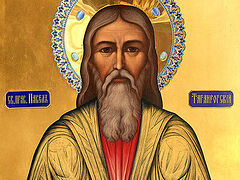
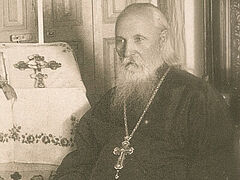
This February 3, 2026 marks ten years since the universal canonization of Elder Pavel of Taganrog by the Russian Orthodox Church. Despite his great witness of asceticism and holiness in the Don region, he still remains mostly obscure in the Orthodox Christian world and virtually unknown among the English-speaking faithful.
The translator of his Life into English, Fr. Michael Moibenko, hopes to release his book on Elder Pavel of Taganrog in early 2027.
 Elder Pavel’s grave in the original wood chapel
On the easternmost corner of the sea of Azov stands Taganrog. In this unassuming, albeit once great, city is a cemetery with a chapel built around the grave of one of the greatest Russian saints of the nineteenth century—Elder Pavel. Pavel Pavlovich Stozhkov (1792- 1879) despite the many miracles attributed to his intercessions and his great renown as an ascetic and clairvoyant, was not a monk or a clergyman—he was a simple layman. By the elder’s prayers, many were cured of countless diseases: epilepsy, drunkenness, and illnesses that no medical doctors at the time could diagnose. His holy way of life was a light that drew to it many people from across the Don, so much so that a community formed around him. The community that was formed in his cell, known as his Kelia, lived by the elder’s strict rule and teachings.
The elder taught that the ascetic life is not something reserved for monks in faraway monasteries but is something that all Orthodox Christians must participate in regardless of who they were or where they lived. The Christian life was a spiritual life, a life of fasting, prayer, regular church attendance, piety, and pilgrimage. First and foremost, the elder’s life was a witness of faith, hope, and love in a time and place full of great pain and woe. As the elder was approaching death he told his visitors, “Though I will die, don’t ever forget my place,” and after his death many continued to visit his grave for healing and consolation. With the collaboration of chief members of the committee on the canonization of Elder Pavel, St. Innocent Press is currently working on publishing a tome dedicated to the elder’s life. The Elder: The Life and Ascetic Labor’s of St. Pavel of Taganrog is the first ever book published on Elder Pavel in the English language. Unlike any existing vita, it will set out to provide the historical and cultural context within which the elder’s life took place, as well as a history of the elder’s canonization and the repression of his veneration by the Bolsheviks.
 Elder Pavel’s “novices” after his death, building his chapel brick by brick.
The below segment is taken from the book, a story originally published in the Journal Prizyv, in 1910.
Nikolai was a man of faith and virtue. A fisherman, he set out to Taganrog on a steamboat by reason of his trade. When the steamboat approached the Elizavetovskaya stanitsa on the Don a church appeared. Seeing it, the passengers took their hats off and began to make the sign of the cross. When everyone was putting their hats back on, he continued to cross himself and bow to the retreating church. “Does God really need you to make crosses on yourself with your hand?” A gloomy old man remarked. “One must have the cross on their heart.” Nikolai was embarrassed and taken aback. He didn’t think that anyone was paying attention to him. “Is there anything bad in this?” he asked the old man timidly. “Nothing bad—it is just of no use,” the old man continued grimly. “When I pray and start to think about something else, I cross myself and my soul quickly returns back to prayer,” Nikolai responded, defending himself. “That is because priests taught you those prayers, and you grind them like a mill,” grumbled the old man “Stop bothering the boy,” one woman interjected, “He was praying to God. And he surely did not bother you. His soul requires both prayer and the sign of the cross. You, apparently, are a Molokan,1 you don’t recognize priests—so buzz off!” The old man riposted, “You think that priests will lead you into heaven by a string? You must strive on your own!” “Thank you, for interceding,” Nikolai said turning to the woman, “but don’t offend the kind man, he might be speaking the truth. I work at the fisheries, know my trade well, and make good money—but what I want most is God’s truth. I have been praying to my patron St. Nicholas the Wonderworker to guide me.”
A Cossack lying on the deck was listening attentively to the conversation and evidently wanted to intervene. “Listen, Nikolai,” the old Cossack spoke up in his booming voice, “if you are looking for God, you should not turn to those who have lost him, but to those who have preserved Him. After all, this Molokan used to be Orthodox, but he lost his faith and now wanders—looking for another one. Why are you asking a tramp about the road?” Whether the gloomy old man was a Molokan or not is unknown, but he protested the Cossack’s characterization.
The Cossack gestured his hand to Nikolai saying, “Where are you going, son?” “To Taganrog, to the Croatian’s fisheries,” Nikolai responded. “Well, here’s my advice, in Taganrog near the fish market look for the pious elder Pavel Pavlovich, people there will show you where he lives, go talk to him. He is strong—strong in the faith of our fathers and grandfathers. After all, our faith wasn’t built yesterday, it has stood for ages. It is a fool’s errand to change it—know that there were people before us, and they believed. Do not listen to these Molokans!” The old Cossack waved his hand contemptuously at the old man, turned on his side and fell silent. The steamboat entered the sea at dusk. The evening was wonderfully quiet, and the air was crisp. Stars began to light up in the sky. The people on deck wrapped up warmly and fell asleep. The steamboat, churning foam with its wheels, cut across the sea heading for Taganrog. Nikolai, leaning against the side of the boat, looked at the sky and then at the sea in which the heavenly dome with its stars reflected its secrets. The lights of Taganrog flickered off in the distance. “What will the pious old man tell me? I’ll find him, it’s not for nothing that they talk about him all over the district.” Nikolai’s gaze expressed religious awe. “God! God!” He whispered, “all this sea, all this sky, and all the brilliant stars, all of it was made by You by the wave of Your hand!”
 Elder Pavel’s cell
The steamboat arrived in Taganrog at night and in the morning, upon the ringing of the bells, Nikolai headed for the Church of the Holy Trinity which was near the harbor. A venerable old priest served. Nikolai liked the way he served—his prayer was fervent. From church he went to the old bazaar, drank tea in the “Hellas” tavern, and leaving his things there went to look for the pious elder Pavel Pavlovich. The search was short-lived. Nikolai was soon shown the modest dwelling of Pavel Pavlovich and with great embarrassment and excitement he bowed down deeply to the elder. The face of the elder was stern, his eyes expressed his knowledge and perception of the hearts of men. At the same time, some kind of attractive force emanated from him and predisposed a person to him. “What do you want from me, good man?” he asked Nikolai, pointing to a chair. “I heard of you Pavel Pavlovich, that you strengthen wavering people, so here I have come to you.” “Have you been in Taganrog long?” asked the elder. “Yes, I just got off the steamer, went to the church that overlooks the sea, prayed, left my things at the hotel, and came to you—forgive me for Christ’s sake for disturbing you.” “What disturbance? I am glad to speak with you, but if I help, then believe me—it won’t be by my own feeble strength. Well, what did you see in the church, who served there and how?” “The venerable old priest served marvelously, the service passed by without me even noticing.” said Nikolai. The elder paused Nikolai, “Hear that ringing? It comes from a different church. Go pray there, then get your things and come back, stay with me for a few days, we will understand each other better.”
Nikolai thanked Pavel Pavlovich and went to the church. An hour and a half later he returned with his belongings. It was a weekday, and Pavel Pavlovich had some people over. “Well, sit down Nikolai, tell us what you saw—how was the service at the church?” Nikolai hesitated, tried to say something but did not dare. “Bare your soul truthfully, if you leave anything out it will be a lie.” “I saw things unseen,” said Nikolai, “and I do not understand what it all means. The liturgy went as it should in an Orthodox church, decorously and reverently—and how could it be otherwise? However, it was not people who served, but heavenly angels, and the clergy were tied with ropes—they were there but did not do anything.”

Pavel Pavlovich listened to the young man with attention, his face shone with joy, and his eyes looked affectionately at him. “But what is surprising,” Nikolai continued, “is that no one was surprised by this, as if they did not notice it.” The elder took Nikolai by the hand and said, “You have a good heart and sincere faith in God, therefore you do not only see with your physical eyes—which is what everyone calls eyes—but you also see with your inner spiritual eye, which others do not have and do not understand. Orthodoxy will exist and her Liturgy will be celebrated from Christ till the ages of ages. But will there always be priests worthy for this great, albeit everyday work? Unfortunately, not always and not everywhere, but God cannot be put to shame, and an unworthy priest should not celebrate the Eucharist. Therefore, in such cases the heavenly angels serve the Liturgy and the priests do nothing. To not humiliate the dignity of the priesthood the Lord is pleased to make it so that not all laity see this secret, but only those whose spiritual eyes have been opened because of their faith. In the chapel of St. Michael (at the church of the Holy Trinity), which overlooks the sea, you saw the venerable priest Father Vasily Bandakov, whose sermons put faith and the fear of God into the heart of a person. Oh! If educated people only read his sermons, they would have found much instruction in them.
“But alas! This is not for us they say—this is for the common people. They reject what they do not know and do not want to know it. This righteous pastor approaches the Liturgy with reverence, and the Lord permits him. What you told me shows that your soul is bright and pure. Do not stain it with evil deeds and doubts. When doubt begins to sneak up on you, pray! Pray firmly and persistently. A bad feeling will prompt you to think that this prayer is not sincere, that it is full of doubts, but you must continue to pray. If you do something wrong, do not be discouraged but pray to not do it anymore. If you still do it, pray again, because who can help you with this? What kind of person? Nobody but God, pray to Him—pray, always pray. He truly has eternal and insurmountable strength!”
I have come to love you”, the elder continued, putting his left hand on the young man’s shoulder. “I would never have chosen to part ways with you, but you must go and do your honest work. Never enter into disputes with anyone about religion, for this there are teachers of faith, do not make yourselves teachers, says the Gospel.” The young man fell on the elder’s chest and cried. Pavel Pavlovich kissed Nikolai on the forehead, blessed him and said, “Go, be zealous in your faith! Our Church stands from the days of the Apostles to this very day, and, despite the weaknesses of both the shepherds and the flock, she is holy—outside of her there is no truth.”
From the forthcoming book, The Elder: The Life and Ascetic Labor’s of St. Pavel of Taganrog
St. Innocent Press