Recently, a whirlwind of wandering brought me to Taganrog (the second largest city of the Rostov region in southern Russia). That trip became possible after one event. Last spring, at the International Literary Competition called “Prayer,” I was awarded a special prize by the Diocese of Taganrog for an article on a pilgrimage to the Holy Land—an icon of St. Paul of Taganrog. This saint’s relics are kept in the church of St. Nicholas the Wonderworker in Taganrog, where I first went upon my arrival there.
The foundation of the church was laid in 1777, when Rear Admiral Fyodor Alexeyevich Klachev, commander-in-chief of the Azov Flotilla and the port of Taganrog, petitioned Archbishop Eugene of Slavyansk for permission to build a church in honor of St. Nicholas in the “marine quarter” of Taganrog. A special place was chosen for the church, where Emperor Peter the Great’s tent had once been set up when he had first arrived at Tagany Rog1 and took soundings at sea.
A year later, the church was consecrated. The edifice was magnificent and fine; it was built in the classical traditions of Russian church architecture of the late eighteenth century. At first it was called the “Church of St. Nicholas of the Sea” and was attached to the Maritime Department. Shortly after its completion, the church was designated as a cathedral and remained so until the construction of the Holy Dormition Cathedral.
In 1778, a bell was cast specially for the church from Turkish cannon taken as trophies. It depicts the patron saints of sailors—Sts. Nicholas and Phocas. However, in 1803, by decree of Emperor Alexander I, after the final transfer of the flotilla base, the bell was sent to Sevastopol, where church utensils and part of the iconostasis for St. Nicholas Church under construction were given as well. After the Crimean War of 1853–1856, the allied forces of the UK and France took the bell from Sevastopol to Paris among their trophies. It was returned on November 23, 1913, with a large concourse of people and accompanied by a solemn cross procession. And in 2016, through the efforts of benefactors, a replica of this bell was transferred to St. Nicholas Church in Taganrog.
During the Crimean War, the St. Nicholas Church was also damaged. In May 1855, an enemy squadron entered Taganrog Bay and bombarded the city. There were seven holes made in the St. Nicholas Church. A cannonball that had been stuck in the bell tower wall was left after its reconstruction. The church had been built by sailors, and its parishioners were mostly fishermen. St. Paul of Taganrog was a parishioner of St. Nicholas Church as well, and he gathered around himself a religious brotherhood that took care for the beautification of churches.
With the advent of the Soviet authorities in 1922, icons with friezes, some gilded church utensils, diamonds and gold were confiscated from St. Nicholas Church. In 1941, during the Great Patriotic War, the wooden parts of the church burned down completely. In 1957, the upper tiers of the bell tower were blown up, and in the late 1950s the church was closed altogether, with its crosses being removed and its furnishings taken out. At first, a table tennis club was organized in the church, then it was given over to a motor transport service, and the central part accommodated the warehouse of a fish co-op. The church grounds were littered with garbage.
The restoration of the ancient church commenced in 1988 and was combined with preparations for the 300th anniversary of Taganrog. The restoration had to start with the cleaning of the territory—as many as ninety-six trucks of garbage were removed in the first stage alone. In the early 1990s, the bell tower and the new brick church building were restored. It was taken under state protection as a historical and cultural monument of the eighteenth century. Thanks to the self-sacrificing labors of the rector of the parish, Archpriest Alexander Klyunkov (1950–2021), the restoration work was completed quickly. Local authorities, the seaport, factories and other enterprises of the city contributed to the resurrection the St. Nicholas Church. Soon, theological courses and a Sunday school opened there, as well as a library of spiritual literature.
 Canonization of St. Paul of Taganrog, 1999. Transfer of relics
A great event for Taganrog took place on June 20, 1999, when St. Nicholas Church celebrated the canonization of St. Paul of Taganrog, beloved by the whole city, as a locally venerated saint of the Rostov-on-Don Diocese. Over 10,000 believers from the Rostov region and the south of Russia came to pray to Righteous Paul on the day of his canonization. The shrine with his holy relics, carried in turn by all the diocesan clergy, was solemnly transferred from All Saints’ Church in the old cemetery to St. Nicholas Church, where Archbishop Panteleimon of Rostov and Novocherkassk (1995–2014; now retired) read out the episcopal decree on the canonization of St. Paul of Taganrog and the Divine Liturgy was celebrated, after which many believers venerated the saint’s relics. The ceremony was marked by numerous miracles. Thus, in the middle of the Liturgy, a round rainbow appeared above St. Nicholas Church around the sun, which was at its zenith in the cloudless sky. Remarkably, the solemn translation of his relics was predicted by the saint himself shortly before his repose, when the elder was singing: “Paul was carried to the grave, and from the grave to the cathedral” (back then, St. Nicholas Church had the status of a cathedral).
In 2016, the church celebrated the Churchwide canonization of St. Paul of Taganrog.
Meanwhile, I approached the church, which had a warm, light ochre color. A small bell tower towered above it, behind which a golden cupola crowned with a blue dome shone forth over the altar. There was no one on the porch, but the church doors kindly beckoned entry, which we did.
Inside, the church turned out to be spacious and bright, filled with an air of grace. The church had neither the usual division into chapels nor large columns, and this made it feel homely. After all, a church is a house of God—it cannot be otherwise. The painted walls shone with a golden joyful warmth. From above, not very high up, in wondrous and beautiful icons, such close and dear faces of our saints looked at people. At St. Nicholas Church we prayed in front of icons of the holy Royal Martyrs, St. Nicholas of Myra and his companion St. Spyridon of Tremithus, Blessed Matrona of Moscow and St. Luke of the Crimea... They all prayed here for the Russian Orthodox people. I also remember the “Queen of All” (Pantanassa) and “Inexhaustible Cup” Icons of the Mother of God.
The lives of some outstanding people of our fatherland are inextricably linked with the history of St. Nicholas Church. Thus, during his service in Taganrog, St. Theodore Ushakov—an officer of the Azov Flotilla and later the legendary unvanquished admiral—was its parishioner. Now the church has an icon of the Righteous Theodore Ushakov with a particle of his relics. The writer Anton Chekhov together with his father and brothers sang in the choir of St. Nicholas Church in childhood. But its most amazing parishioner was St. Paul of Taganrog.
 Shrine with the relics of St. Paul of Taganrog For a long time, with great gratitude for being vouchsafed to come, I prayed at his holy relics in a splendid gilded shrine. After asking St. Paul for help in the salvation of my restless soul and sharing other needs and sorrows with him, I was filled with quiet joy and headed for the cell of the ascetic of Taganrog.
Now let me tell you about his amazing holy life. Righteous Paul of Taganrog was born on November 8, 1792 into the family of Paul Stozhkov, a nobleman from the Chernigov province. He was baptized in honor of St. Paul the Confessor, Archbishop of Constantinople. His parents hoped that their son would obtain a good education and have a high position in society, but the young man aspired to a godly life of prayer and visiting holy sites as a wanderer.
At the age of twenty-five, Blessed Paul distributed the share of the estate that he had inherited, set his peasants free, and taking his father’s blessing, set off on a long-awaited pilgrimage to the holy monasteries in order to find peace for his soul. He visited the Kiev-Caves and Pochaev Lavras, the Solovki Monastery, St. Artemy’s Monastery in Verkola (in the Arkhangelsk region), the Kozheozersky Monastery of the Theophany (on Kozha Lake in the north-west of the Arkhangelsk region, reputedly the remotest monastery in Russia) and many other monasteries. The young man donated funds he had inherited to each monastery or church. During his pilgrimage, Paul met many spiritual mentors who became models of righteous life for him, and taught him continuous prayerful communion with God.
His wanderings lasted for about ten years, and then Blessed Paul made the seaside city of Taganrog his home. There, as if forgetting his noble origin, he wore simple peasant clothes, spoke the vernacular Little Russian dialect and lived in a dugout. Through hard work at the port, humility and tireless prayer, the ascetic cleansed his soul and body of all that was passionate and sinful, and the grace of God rested on him. The Righteous Paul became a beacon for many people who unwittingly, impressed by his words and good works, thought more deeply about the meaning of life and remembered the Heavenly Fatherland.
Having reached an advanced age, the holy toiler gave up his hard work at the port and began to live in a small house, unceasingly praying to God and serving people. Paul Pavlovich loved churches and often donated icons, icon lamps, candles, oil, etc. to them. Every day, at the first stroke of the church bell, he went to the St. Nicholas Church, prayed at the Liturgy and checked the icon lamps, for which he carried a small bench with him, and on his shoulders a white towel with which he wiped holy icons. There is evidence that as an old man St. Paul of Taganrog carried bricks, helping add chapels to the cathedral. As before, he spent nights in fervent prayer and prostrations. The Jesus Prayer never left him; he taught all those who came to him to perform this prayer, and he never let anyone into his cell without it.
Common people found in the Righteous Paul a holy elder great in virtue, who received from the Lord the gifts of healing and clairvoyance. People flocked to him with their sorrows, troubles, and questions, for guidance and comfort, and they always received help. Gradually, a community began to form around the elder. Some members of the community lived in the cell with him. St. Paul of Taganrog blessed married people to live with their families. The members of the community lived according to a strict monastic rule.
The Righteous Paul distributed the food received from donors to those in need. He was especially favorably disposed to prisoners. Every week he sent numerous provisions to the prison and took care of the sick. Whenever a prisoner died, Righteous Paul would buy a coffin and clothes for his burial and make sure that the prisoners were buried in a Christian way.
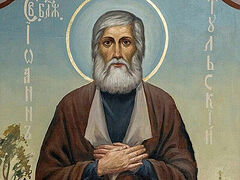
 Righteous Paul of Taganrog. A portrait, late nineteenth century Possessing the gift of clairvoyance, St. Paul of Taganrog always foresaw who should be received kindly and who should be humbled sternly. Whenever a visitor with unrepentant sins happened to come to the Righteous Paul, the saint, so as not to embarrass him with a rude revelation of his secrets, pretended to pounce on one of his novices: scolding him, severely reprimanding him, and threatening him with a stick, while naming the visitor’s sins in order to encourage him to repent. The novice meekly endured that and only repeated: “I’m sorry, Father, it’s my fault.”
By the power of the grace of God, the saint clearly saw both a person’s soul and his future. He predicted to his father-confessor, Hieromonk Damian (Kassatos; 1848–1931): “You will be a great man—no one could be higher.” And these prophetic words were fulfilled in the life of Fr. Damian: in 1897, he was appointed Patriarch of Jerusalem.
It is known that St. John of Kronstadt visited the saint shortly before his (St. Paul’s) death. Tradition has it that Fr. John greeted the righteous Paul with the words: “Rejoice, a pillar from earth to Heaven!”, to which the elder replied: “Rejoice, the sun from west to east!”
Approaching the end of his earthly life, the Righteous Paul was increasingly weakened physically, but his holy soul still burned with love for God and his neighbor. As was the case with many other great saints of God, the Lord revealed to him the day and hour of his repose. The day before, the blessed elder ordered a letter to be written to his close ones asking them to attend his funeral.
St. Paul of Taganrog fell asleep in the Lord on March 10, 1879. In the evening, he became very weak, and having received the Holy Body and Blood of Christ from his father-confessor, Fr. Damian, he commended his righteous soul to God. At the moment of his death, all those present saw that the saint’s face shone with great joy and his body turned white like snow. All who saw this sign of grace over Righteous Paul were touched and glorified God for His mercy.
Now let’s return to the story about my pilgrimage. Turning into Turgenevsky Lane and walking a little, I suddenly saw an old, tall wooden gate with the sign, “St. Paul of Taganrog’s Cell.” which struck me. We entered a courtyard paved with large stones. We saw a wooden two-storied house before us, which did not look at all like a cell. It was explained to me that it was a new model. But it seemed to me that it was a good stylization of old buildings that had once adorned the streets of Taganrog. In the courtyard, my soul felt peace again, as in the church.
In front of this house we saw a marble-framed bronze bas-relief icon of St. Paul (sculpted by Irina Shtod).
 Bas-relief icon of St. Paul of Taganrog
To our right was another low house, where St. Paul lived and received the suffering. Maria Tsuryutina (†1914), the elder’s novice, left a description of life in the cell: “Elder Paul occupied the entire house for an apartment, consisting of several rooms, one of which was called his cell. This cell was fully covered with holy icons, in front of which stood a wooden bench, and on it stood jugs filled with sand, into which large candles were set, burning day and night. Icon lamps burned in front of the icons as well. Beside the other walls of the cell were tubs, pots, baskets and sacks filled with bread, bagels, olives, prunes, lemons, honey, etc.; bags of prosphora hung on the walls. By one of the walls there was an uncovered bench, which served the elder as a bed.”
From the outside, the light-colored house, with humble windows that lowered their glass eyes towards the ground, seemed small, but there were four rooms whitewashed like snow inside it.
According to the established tradition, in the hallway you are expected to take off your shoes or put on shoe covers. We took off our shoes and went inside barefoot. Now, as in the Righteous Paul’s lifetime, visitors are treated to holy water and breadrolls, kept in a basket on the table at the entrance to the cell.
Having entered the cell, I felt a wave of warmth from the bright flames of candles, icon lamps, and the brilliance of the wonderful holy icons that covered all the walls. As during the saint’s lifetime, there are jugs filled with sand in front of the numerous icons, and candles burn in them day and night. As I read later, “The call interior has been partially preserved and partially reproduced from the time when Eldress Maria Velichko2 and other disciples of St. Paul lived there. Icons belonging to Elder Paul have been preserved and restored. Many relics that were kept in All Saints Church of Taganrog and by private individuals in the Soviet era have been returned to the cell.”
In one bright room there was an analogion with a huge Psalter on it. Anyone could read this holy book aloud, and with excitement I became absorbed into the God-inspired texts of the holy King and Psalmist.
 The Cell of St. Paul of Taganrog
There was also the elder’s narrow bench, covered with a colorful homespun rug. Coming to this cell, many believers try to lie down on it, believing in healing through the saint’s prayers. I must say that their faith is justified; there are testimonies of cures of disease. After lying down on this miraculous bench, I can say that it would be very hard for a mere mortal to sleep at night on this bed designed for saints.
In another room there were large full-length icons and a portrait of Blessed Paul made while he was alive. I sat in front of it for a long time, staring at the holy man. The candle burning on the table illuminated his face. It was seen that the elder had renounced all earthly things, mentally immersed in the Jesus Prayer, which was a second breath for him, and unhurriedly with his overworked hands he fingered the knots of the prayer rope: “Lord Jesus Christ, have mercy on me, a sinner.” From this righteous man’s prayerful struggle, peace radiated into the soul of one contemplating the portrait.
In the third room, photographs of Righteous Paul’s spiritual children hung on the walls—the ones whom he taught fasting, prayer, abstinence and every virtue by his own example.
After the elder’s death, the cell and the surrounding area were bought by his follower, Baroness Elizabeth von Taube, and transferred to the ownership of the saint’s disciples. For a long time, the house belonged to various members of the community. In the 1990s, the process of transferring the cell to the ownership of the Russian Orthodox Church began.
In 2014, the house and the whole complex were purchased and registered as the property of St. Nicholas Church. Its painstaking restoration and reconstruction began under the guidance of the chairman of the Commission for the Canonization of Saints of the Don Metropolia, Head of the Taganrog Deanery Archpriest Alexei Lysikov.
In 2019, after Blessed Paul’s Churchwide canonization, Metropolitan Mercurius (Ivanov) of Rostov and Novocherkassk consecrated the renovated complex on the site of the saint’s cell.
 Courtyard and icon shop by the cell of St. Paul of Taganrog
After leaving the cell, I went into an icon shop where I bought some relics related to St. Paul’s memory. There was a well very close to the shop, which has survived since the time of the elder. It is said that he would pour holy water there, brought from various holy sites.
The southern sun warmed the ground agreeably. The courtyard of the complex was framed by a wooden covered arcade, which looked quite picturesque.
I sat down on a bench in front of the icon shop, gladly turned my face towards the warm rays of the southern Taganrog sun, and felt the fullness of being. Perhaps when you receive the breath of the Holy Spirit, you don’t need anything else in this life. You only feel this moment, and that everything else is vanity of vanities…