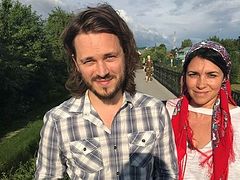
Robert C. Casad Jr, a biochemistry scientist, lawyer, musician, author of songs and editor of atlasstumble.com blog, who was born in the US and lived for twenty years in Denmark, has been living for the last year in Russia as a “spiritual refugee.” Robert, baptized in Orthodoxy with the name of Theophan, has recently celebrated his sixty-fifth birthday. Speaking about his experience of spiritual life in the USA, Denmark and Russia, he uses the Gospel image of “leavening” and talks about St. John of Shanghai and his path to Orthodoxy.
“Will you become Orthodox?”
 Theophan Casad with Protopresbyter Gennady Belovolov —How long have you been living in Russia and why did you choose to attend the Church of All Saints of the Russian Lands in, Park Pobedy, in St. Petersburg?
—I came to St. Petersburg in December, 2024, but I have long been connected with Russia. As for the Church of All Saints of Russia, I go there because it’s where I was able to find Archimandrite Jerome (Testin).
We first met in 2013. At the time, there were still direct flights between St. Petersburg and Copenhagen, which was where I worked. I would stay there for two weeks and then fly to St. Petersburg for two weeks to spend time with my godson. I got interested in Father Jerome’s doctoral dissertation about the economy of the Russian Orthodox Church in relation to the economy of Russia up until the Church Council of 1917. With the help of Google Translate, I translated it into English and hope that I can publish it soon on my blog in Danish, Russian, English, Greek and Serbian.
—But how did you end up living in St. Petersburg?
—During the twenty years I’d been living in Denmark, I used to travel to St. Petersburg three or four times a year thanks to my old Russian friend. At the University of Kansas, I befriended Kirill Kozlov, an exchange student of law from St. Petersburg. He invited me to visit him and in the summer of 1991. I came to his tiny apartment near the Ozerki metro station. I stayed there with him, his young wife and his parents. In July of 1992, Kirill and his wife had a son, Daniel. They weren’t believers at the time, but they asked me to become a godfather, since it was trendy to baptize children then.
I was standing there, at the service, holding my godson in my arms and making nothing of the meaning of this sacrament. Before the service began, the priest, who knew I wasn’t Orthodox, stared at me, looking into my eyes, and asked something in Russian, which I couldn’t understand. Kirill then asked me: “Just answer ‘Da!’” and I just did that. Years later, I found out what the priest actually asked me: “Will you become Orthodox?”
On the way to Orthodoxy
—How and when did you become Orthodox? Where were you baptized?
—The story of my baptism is quite long. I was baptized in the Orthodox Church twenty years ago, even though I grew up as a Baptist. My parents were religious people. At the age of sixteen, I was supposed to be baptized in Protestantism, but it so happened that I had a teenage angst against the “white” Baptist church, which I considered hypocritical. I switched to services at a “black” Baptist church with the congregation fully consisting of African Americans. While I was still studying at college, I took interest in Eastern spirituality and, in fact, having embraced Taoism, I remained a Taoist for many years. Chinese traditional teaching about Tao contains the elements of religion and philosophy.
 Ann Arbor. Michigan, USA. Photo: wikipedia.org
So, at the age of seventeen, I opted out of the Baptist church and left Kansas for Ann Arbor, Michigan, where I lived for almost twelve years. This was where I graduated from the university with a Ph.D. in Biological Chemistry. I became disillusioned about biomedical research and rejected it as corrupt, since it was headed by “robbers” claiming to be scientists.
In 1990, I briefly returned to Lawrence, Kansas, where I worked as a postdoctoral research fellow. I graduated from law school after two years there to become a patent lawyer, got my barrister’s license and returned to Michigan, where I met a spiritual group of “esoteric Christians.” They do not believe in a “church organization,” but they do believe in the Mystical Body of Christ, and spiritual labor as it is described in the New Testament. They consider such labor as a revelatory mystical teaching. By extending an invitation to visit an Orthodox church, the leader of this group drove me there himself for a Greek Orthodox service in Iron Mountain.
Having attended the Liturgy for the first time, I became acutely aware of the reality of the “sacrament of the assembly”
Having attended the Liturgy for the first time, I became acutely aware of the reality of the “sacrament of the assembly,” in other words, Liturgy, and I have never since missed attending the service. While working as a patent lawyer in Lansing, I used to travel weekly to the small town of Williamston nearby for the vespers and liturgy services at the St. James’s Antioch Orthodox Church. When I first came to the service led by Fr. Richard Peters, who had only recently converted from Protestantism, he asked, “Are you Orthodox?” I said, “No.” He poked me in the chest with his finger and said, “But actually you are, I see it.” A year later, he asked, “Why aren’t you getting baptized?” I replied, “There is no need to convince me of anything. I see and feel it’s real.” He retorted, “What you had was only an appetizer. You will never learn what it’s like to be at the banquet without accepting baptism.” After this explanation, I went through a catechism class and got baptized on September 25, 2005. I saw for myself that Father Richard was absolutely right. He gave me the name of Theophan.
 Venerable Theophanes the Merciful of Gaza —In honor of St. Theophan the Recluse?
—No, I was named after Venerable Theophanes the Merciful of Gaza. But I certainly try to be the disciple and the “follower” of St. Theophan the Recluse. Every day, as I appeal to him in prayer, I pray with him and feel spiritual closeness. I’ve only recently begun using his writings as textbook to improve my Russian reading skills, which are currently far from the level of my spoken language.
I should note that several weeks before the baptism, I had lost my first job as a patent lawyer (due to my client transferring to another company). On the day when my contract with the company was terminated, a former Greek colleague of mine asked me if I would like to join him and go to Denmark to finish a certain project we had started together in Europe. So, not long before my baptism, I was at the crossroads—either to look for a new job in the United States or to go to Denmark, thus leaping into the unknown. As I was flying from Michigan to Kansas, I felt someone invisibly grab me by the collar, and without uttering anything, said: “Go to Denmark, by all means.” I went there with only two suitcases immediately after my baptism. As I was looking for work there, I lived in a guest house at the Technical University of Denmark. I soon got a high-paying job as a U.S. patent attorney in Copenhagen.
—What is it like to be an Orthodox in the USA, Denmark and Russia?
—I became certain that it is truly very difficult for an Orthodox person to reside in the USA and Denmark. It’s basically the same as if you swim against the tide of society. Only in Russia can an Orthodox Christian live and work by making prayer a way of life. Whereas there, you just keep up with the Joneses.
About Russia
 Theophan Casad playing the ukulele —What does Russia mean to you?
—While working in Moscow in 1991–1993, I became fascinated by Russia, as it was much more interesting to live than to do biomedical research in the USA. I found researchers who worked at the major center of physio-chemical biology and biotechnology in Russia. They worked in the same research field (“special neuroreceptor system”) that I was working at back in Kansas. I agreed to work as a junior research associate in Moscow at the Russian Academy of Sciences’ Research Institute of Biochemistry named after academicians M.M. Shemyakin and Yu.A. Ovchinnikov. Essentially, it’s been my postdoctoral work. I became a PhD postdoctoral research fellow who received his PhD. As far as I know, I was the first American who has ever gotten a job at the Russian Academy of Sciences. After me, there were many there.
—Was it easy for you study Russian?
—The Academy provided a personal Russian tutor for me. I remember distinctly that after approximately half a year of staying in Moscow, I suddenly stopped translating my thoughts from English into Russian, but would simply listen and reply in Russian. I remember the euphoric mood of the people when Gorbachev resigned, I also remember the onset signs of hyperinflation, the shooting on the streets, and Yeltsin firing from tanks at the White House. When everything crashed, it was really hard to continue working.
“A guy comes to the store and asks: ‘No milk?’ A saleswoman replies: ‘No, we have no fish. The shop that has no milk is next door.’ “
I still share an anecdote of those days:
We used to wash dropper ends to use them more than once. Eventually, I gave up and returned to Lawrence, Kansas. I worked for a few more years as a professor of biochemistry at a medical school in the Caribbean. Between academic terms, I’d go to Europe for a month to conduct my experiments and to publish the results of work I’d started back in Moscow.
On the “leavening effect” and comparison of Orthodox spiritual practice in Russia, Denmark and the USA
 Jan Luyken engraving to illustrate the Parable of the Leavening
—At the conference dedicated to St. John of Shanghai, you talked about the “leavening effect.” It is derived from the Gospel, isn’t it?
—Yes. In the Gospel of Matthew, my attention was drawn in particular to the famous Parable of the Leaven: The kingdom of heaven is like unto leavening, which a woman took, and hid in three measures of meal, till the whole was leavened (Matthew 13:33). The image of the Kingdom of Heaven is widely used in the Scripture. In the Gospel of Luke, the Lord teaches that the kingdom of God is within you (Luke 17:21) surely meaning the Kingdom that we have access from here, through Him and by our connection through the Mystical Body of Christ.
The Lord’s Prayer says, “Thy kingdom come, Thy will be done, on earth as it is in heaven.” In my view, the “leavening effect” is possible when a small group of spiritually active Christians consciously works to BE a living prayer in the society. I think that Protestants will never really understand this parable. They don’t understand that it is impossible to constantly maintain a lifestyle of prayer without first having to “love thy neighbor as thyself” in society. As for the Orthodox, they understand this, and, by bringing to the society the love of the Creator they have received through prayer, they display the “leavening measure effect” by acting as leavening that leaveneth the whole lump of dough.
—Is it true that the “leavening effect” is better manifested if a man prays more in order to BE present with his prayer in the “social fabric” of society?
—Yes. But what matters here is not the effort of just one person, but of at least a group of people. It is that small flock, whose “spiritual unity” and a prayerful attitude within the “social fabric” of society is capable of actually producing a sufficiently powerful “leavening effect.” Spiritually, modern society in the USA is still in its “adolescent” state. It represents consumerism, or, literally, a cult of individualism that actively glorifies the ego of individuals, or even worships this ego. The “flow” of this society is contextually “unified” only if a person becomes an impersonal unit of the consumer-technological system. Such a society is strictly materialistic, which is especially dangerous when the majority of consumers are Protestants who live according to the lightweight principle, “I believe—it means I am saved.” My experience is that it takes a grueling effort to BE a living prayer and “swim against the tide” in the society in the USA. Even if all Orthodox Christian Americans were diligently living in prayer, the “leavening effect” would have been quite small at best. That is, a materialistic society doesn’t provide traction for the “leavening effect” to happen.
Spiritually, modern American society is in its “adolescent” state and it represents consumerism culture
The amazing thing is that, even though twenty-three percent of the US population regularly attend Protestant services, this has never affected the people’s spiritual disconnection and “cult of individualism.” On the contrary, in my opinion, this gives rise to a dangerous misconception that one can only find the “peace of Christ,” which is not of this world, by going with the flow in this society. Some Orthodox Americans have created isolated spiritual enclaves where parishioners live from Sunday to Sunday. Such are, for example, the parishes of the Russian Orthodox Church Outside Russia, and some of them still remember St. John of Shanghai. They gather “in Christ” inside their enclave and then “swim against the tide” in society. Unfortunately, the vast majority of Orthodox Americans have embraced a predominantly Protestant society and try to navigate its course. This gives rise to a kind of “Orthodox individualism,” which, in its essence, is “diluted” and devoid of any “leavening.”
—Does consumerism in Russia and Denmark proceed in the same direction as in the USA?
—Sad to say it but yes. It is quite logical to predict that if no active steps are taken to prevent this, it will eventually have similar impact on the “social fabric” in Russia. The long history of Danes living under the state Christian church has left behind a lasting cultural legacy of Trinitarian communion on a social level.
—What is “Trinitarian communion”?
—By Trinitarian communion I mean the collective spiritual unity within the framework of the physically united and mutual presence of souls and bodies. Currently, the Danes continue living in the society in such a way that they “love thy DANISH neighbor as thyself.” The “flow” of that society is indeed spiritually united by the collective “love of the Danish people.” That said, foreigners would inevitably feel alienated in the society where the spiritual tendency that brings Danes together actually “expels” those who aren’t Danish. Compared to the American “cult of individualism,” we see a significant progress in Denmark, but we can’t say it has some conscious connection with Christ. Only fifteen percent of Danes continue to believe in “divine power.” Therefore, the Trinitarian communication of the Danes is in what I call the “Mystical Body of the Danes,” which, without doubt, isn’t the same as the Mystical Body of Christ. This collective love isn’t nourished by prayer, but the mundane, material aspirations of openly atheistic people.
—What do your friends think of it?
—A good Danish friend of mine says that he is actively trying to stay OUT of all that “Trinitarian communion” because of its atheistic nature. These days, in order to BE a living prayer in this context, the Orthodox faithful in Denmark must also “swim against the tide” in society, practically imitating the “Orthodox isolationism” of ROCOR parishes in the USA. As such, you can’t observe any noticeable “leavening effect.” However, having lived in Denmark for twenty years, I can declare with certainty that “swimming against the tide” with your prayer in that society is a lot easier than in the USA. Had the Danes returned to their Christian roots and deliberately strove to be united “in Christ,” they would have essentially become a great Orthodox society, despite their Lutheran past. But the only country where this is still possible is Russia. Even in Greece, where I also lived, this is impossible, as it is impossible in Denmark, and absolutely impossible in America.
About Russian “leavening”
 Theophan Casad at the monument to the Holy Righteous John of Kronstadt in Kronstadt —You’re right. Neither the collapse of the Russian Empire, nor the breakdown of the Soviet Union, founded on its wreckage, were able to destroy the historical tendency towards “conciliarity” in society.
—Even when a small group (say, seven percent) of Russians regularly pray at services, then even those seven percent would be enough, because collegiality in Russia continues to exist in the social fabric of society. In other words, the “leavening effect,” which neither the USA nor Denmark possesses, is really great in your country. Even if this is not truly an obvious manifestation of the principle “love thy neighbor as thyself” in the Danish terms, it is deeply rooted in Trinitarian communion in Christ. They achieve this unity in the “sacrament of the assembly”—the Liturgy.
Thus, even if individual men and women may not even realize this, they draw from the inexhaustible source of love of the Creator, from the nourishing source of “conciliarity,” which is inextricably connected with Christ. Thirty-four years after the fall of the Communism, seventy two percent of Russians consider themselves Orthodox Christians, have icons at home and pray, in one way or another. But only seven percent of them (if not less) regularly participate in the “sacrament of the assembly.” This way, as long as the “conciliarity” continues to exist in the “social fabric,” even seven percent of regular participants in the “sacrament of the assembly” can have an extremely powerful effect by simply continuing the work of the liturgy “out in the world.”
Speaking of the “leavening effect,” what I mean is a small group of active Christians who, in their attempt to live and pray in society, are playing the role of the leavening, without which the dough won’t rise. To live in constant prayer means to be this “leavening,” to lead the lifestyle when you love your neighbors as yourself. “Leavening effect” means that man, upon receiving from the Lord His Divine Love, delivers his prayer-filled Love to everyone around him. But it’s that classical context (when, out of a great number of Orthodox believers, only a small cohort regularly attends worship) where the “leavening” effect may be quite great.
About the life of a “spiritual refugee”
—What life is like for you, far from your native country?
I came to Russia from Denmark and the USA as a “spiritual refugee,” to live here in peace and repentance
—I came to Russia from Denmark and the USA as a “spiritual refugee,” to live here in peace and repentance. This is the only country where I can work on myself, cleansing my soul by repentance, so that I could go with the flow of society with my prayer. I regularly take a “prayer walk” among the crowds of pedestrians on Nevsky Prospect, trying to “love my neighbor as myself.” It is as if I stay present where the spirit, soul and body are one. I feel this unity in the Mystical Body of Christ, in the Liturgy. I surely have to keep working on this, actively fighting my ego and passions of the flesh in order to “love my neighbor as myself.” We do just about the same during Liturgy.