On January 21/February 3 the Church celebrated the Icon of the Mother of God called “Joy and Consolation.” This icon became the protectress of a unique convent created by a Russian countess, the amazing Abbess Magdalena envisioned a community where the nuns would serve God by serving their neighbor, in simplicity and humility.
 The icon of the Joy and Consolation Mother of God in Dobrynikha
In 1883, Countess Maria Vladimirovna Orlova-Davydova, a lady-in-waiting to Empress Maria Feodorovna and daughter of V. P. Orlova-Davydova,1 inherited lands near the village of Shcheglyatovo in the Moscow region. Near Shchelyatovo village was the Dobrynikha hermitage, where the countess dreamed of building a Christian community. Her intention for this community was to “serve the needs of the people in the surrounding area, to care for the sick, and to educate the girl children.”
In 1893, Maria Vladimirovna built the sister’s quarters with a house church dedicated to the “Joy and Consolation” icon of the Mother of God, which had been brought to her from Mt. Athos. In June of 1894 she wrote a letter to the Metropolitan of Moscow expressing her wish that the “Dobrynikha community not have any outward signs of monasticism, but that the sisters would continue to wear simple peasant dress and freely serve their neighbor,” and that they would be “ready at any time of day or night to serve the many and various needs of the sick, the poor, and the orphaned among the surrounding peasant population.”
 Children’s home at the community, early 20th c. From her vast inheritance, Maria Vladimirovna donated 103 desyatins (about 279 acres) of land and 200,000 rubles (USD value today: about 6.5 million). Having founded the community, she became its superior, with the new monastic name, Abbess Magdalena. In 1899, she began the construction of a cathedral, according to an architectural plan by professor of architecture S. U. Soloviev. In December 1900, the countess gave all the lands in her possession (over 1071 desyatins/2891 acres) to the community.
The Church
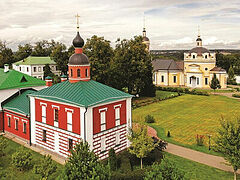
Architect Soloviev created a unique plan for a four-columned, five-domed church of the cross- cupola type with three tall aspida and a lowered west narthex. The church harmoniously combined the styles of different Russian architectural periods, and the walls were painted in the ancient Russian manner. Most of the paintings have survived to this day. The church was consecrated in August, 1904, by Metropolitan Vladimir (Bogoyavlensky) of Moscow and Kolomna—now canonized as a New Martyr.
 The Dormition Church in Dobrynikha today, under restoration. Photo: dobrynixa.cerkov.ru
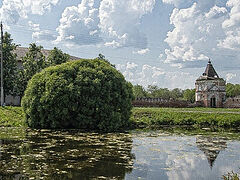
The monastery complex was built over the course of a few years, and a high wall with corner towers was built around it. It was to become an innovative monastic community, with emphasis on spiritual and practical works of mercy for the people living around it.
It contained an excellent rehabilitation center having no comparison anywhere else in the world. It was founded in accordance with patristic teaching, having as its aim the spiritual rehabilitation and renewal of the human soul. In order to bring her ideal to life, Mother Magdalena built a parish school, a refuge for poor children, a hospital, a two-storied building to house the sisters, a house church, and an almshouse. The community also had its own workshops and various storage facilities.
 The “Joy and Consolation” Monastery, early 1900s
Mother Magdalena’s contribution became a good seed sown in the grace-filled soil of women’s monasticism. Similar women’s communities with the same name began springing up in all corners of Russia. Even in our own time, one of Mother’s relatives heads a community in Bulgaria bearing the same name.
By 1913, 130 nuns and sisters lived in the community, fifty people lived in the almshouse, and thirty orphans up to age fourteen where being brought up in the children’s home. A private clinic was supported at Abbess Magdalena’s expense.
 Abbess Magdalena (right) at tea with sisters of the community, 1900s. Photo: is-tok.ru
Mother Magdalena left a legacy of good stewardship for similar communities of mercy. Its financial foundation consisted of interest-bearing investments and credit vouchers totaling around 411,000 rubles, most of which was inherited from Count Sergei Vladimirovich Orlova-Davydov. In his will signed April 15, 1903, he asked that his executors “sell at a free-market price… all valuable items… and for the sum received, acquire Russian government or mortgage bonds, to be consigned as unremittable capital for the community dedicated to the Mother of God “Joy and Consolation,” founded by my sister, Nun Magdalena, secular name Maria Vladimirovna Orlova-Davydova, who resides in Moscow governate, Serpukhov region, Shcheglyatev village.”
Before the revolution, in 1916, the community received 41.5 thousand rubles income, with expenditures of just over nine thousand rubles. Significant income (over six thousand rubles) was received from the sale of livestock, fruits, vegetables, and honey.
In 1916 the “Consolation” community donated 2000 rubles for the care of psychiatric patients in the Pokrovsk psychiatric hospital, to the active army, and to the families of mobilized and wounded soldiers. By 1917, the community’s net worth was 412 thousand rubles.
This capital was lost during the revolution and civil war, but the community survived thanks to its industriousness. By 1920 there were 113 residents, consisting of peasant women aged eighteen to fifty-nine. After the revolution the community changed its name, at first being called an artel (labor community) then a “sovkhoz”(collective farm).
The local soviets took over the community, and a “commissar” was assigned its supervisor, who informed the new regime of its activity. The good land was confiscated, and the sisters were left with a small amount of inconvenient and overgrown land.
Despite the hardships, Mother Magdalena found ways to help people who had lost their homes and livelihood. The community also gave refuge to Princess Ekaterina Petrovna Vasilchikova, Princess P. A. Shirinskaya-Shakhmatova, and the daughters of the engineer, Major-General D. Yazykov, Anna and Natalia.
After the bylaws of the new agricultural commune were written, the work group was designated as being formed “to raise breeding livestock, create an apiary, grow vegetables and cultivate seeds.” Abbess Magdalena was the first to sign the bylaws. However, in October 1921 the group was ordered to give itself over to a state collective farm. The new arrangement put it under the control of a local soviet headed by the secular Xenia Efimovna Afinogenova. Abbess Magdalena and Priest N. K. Sokolov were added to the list of members among others, including the Yazykova sisters, who were numbered among the agricultural workers.
All in all, the collective numbered 106 people, only two of whom were men: Fr. Nikolai Sokolov and the communist Sysenkov. The latter did not like the collective farm’s religious component, and complained to the Serpukhov authorities. As a result, he and his family were released from the collective farm.
The “artelshchiki” (members of the “artel” or work group) labored to the best of their skills and strength. All proceeds went to a common cash account. Their only personal property was their clothing and a few household items. They had a common table. Leather and felt boots, coats, and everything needed for labor was provided from a common storeroom. The work day was eight hours long.
 A preserved part of the altar cupola in the Dormition Cathedral today After 1925, the collective farm worked six fields. It was an example to all of order and efficiency, and all the peasants in the surrounding area emulated it. Formally the collective was directed by a soviet, but in fact, Mother Magdalena’s influence remained as strong as it was before.
Finally in May, 1925, the communist authorities took Abbess Magdalena off the list of artel members, along with the priest and thirteen nuns, but left them as workers. In September, 1925, the Serpukhov authorities resolved to expel the Abbess, the Yazykova sisters, P. A. Shirinskaya, and E. P. Vasilchikova from the Dobynikha collective farm. However, the local governate committee ruled that since they were living on their former property, the March decree was not applicable. Nevertheless, fourteen members of the community, including Abbess Magdalena and Fr. Nikolai, were deprived of their right to vote.
In September, 1927, the Serpukhov authorities liquidated the Dobrynikha collective farm, and another one called “Vesna” was put in its place. In early 1929 the authorities decided to close the church, saying it had no “historical or artistic significance.”
After the artel was closed, Mother Magdalena settled in the village of Stepygino and lived there for a few years. In the final years of her life, she was unable to get around by herself due to a hip injury.
Abbess Magdalena departed to the Lord in 1931 and was buried in an oak grove near the monastery, opposite her home. Marking her grave was a simple wooden cross with the inscription: “Orlova-Davydova Maria Vladimirovna, Abbess Magdalena. 1849–1931."
 Mother Magdalena’s grave. Photo: is-tok.ru
Mother Magdalena’s great-nephews warmly called her, “Grandma-Matushka,” and the locals called her “Dobrynikha,” which in Russian means “the kind one”—because she was so loving and kind to the simple folk. With God’s help and with her ascetic labors of love and humility she gave new meaning to what was once an empty field called Dobrynikha.
After the artel was closed the monastery building was used for various agricultural needs. In 1934 a psychiatric hospital was opened there.
The great Dormition Cathedral suffered significant damage during soviet times, but has been given to back to the Russian Orthodox Church as a parish. It is currently being renovated by the rector and its zealous parishioners.
In the spirit of Mother Magdalena’s love and care for people living in the area, events are held to delight the local children. It is famous in the area for its New Years and Christmastime festivities, with a traditional Russian play, games, and food.
 The rector, Priest Alexiy Zveroboyev
 The play Morozko, cast
 Costuming the trees for the play
 The abandoned stepdaughter of the play meets the hero, Morozko

 The “Russian wood stove on wheels,” created by the local factory, “Zabava”


From the website of the “Joy and Consolation” Church, Dobrynikha
Compiled and translated by OrthoChristian.com