Photo: xpam-xpicta.ru
In the name of the Father, and of the Son, and of the Holy Spirit!
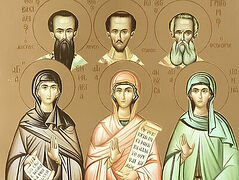
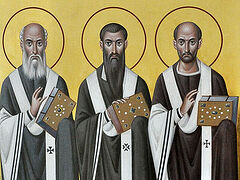
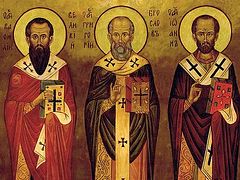
Dear brothers and sisters in the Lord, greetings to all of you on the great feast! Today we commemorate the Three Holy Hierarchs: Sts. Basil the Great, Gregory the Theologian and John Chrysostom.
Over the 2,000-year history of the Church, there have been a host of bishops glorified as saints. But over these two millennia, only three of them have been honored with the title of “Ecumenical Teachers.” These are the three men whose memory we celebrate today.
These men were similar in many ways—they all came from noble families, they were very talented by nature, and they obtained a brilliant education. Each of them had a truly brilliant intellect. And they were very courageous as they carried out their ascetic labor of confession of the faith, because the time they lived in was marked by the spread of various heresies.
The heretics were very aggressive. For example, once St. Gregory the Theologian was almost killed during a church service—heretics stoned the bishop who was concelebrating with him and killed him. St. Gregory barely survived; some people managed to bring him out of church.
The work of archpastoral ministry required immense courage at that time. In addition, they personally led a life of total self-denial—they fasted, prayed, and lived extremely modestly in their everyday lives.
But that’s not the main point. The main point is that they were men of like spirit; they were driven by the same spirit. And the only “theme” of their lives, the only One to Whom all their thoughts, all their feelings and all their talents were directed, was the Triune God and the Incarnate Word—Jesus Christ. They used all their talents for His sake and devoted their whole lives to Him.
The Three Holy Hierarchs examined very thoroughly the theme of the will of God, which is revealed in the Holy Scriptures—something that many, especially in our time, take very lightly, People hardly ever read them and do not know them—but the Three Holy Hierarchs read them throughout all their lives.
These incredibly talented men came to the following conclusions… St. Gregory the Theologian said, “The only wisdom I have learned is that one must fear God in his life.” He taught that the only wisdom is the fear of God.
St. John Chrysostom said that “everything is in vain, and all knowledge is ultimately futile if one does not know Divine Revelation.”
Brothers and sisters, let’s take a look at our lives. Everyone standing here has completed nine or eleven grades of school. That is, nine to eleven years of study. Plus five years of university or institute education, or three years of college education. Plus, to get a job, we also studied some other applications. In between studies we are all interested in politics, various news, arts, and so on.
And imagine that the only thing we know for sure about ourselves is that we’re all going to die sooner or later. And when we stand before the Judgment Seat of the Messiah the most important question addressed to us will be the same one that the Lord Jesus Christ asked the Apostle Peter in the Gospel, Simon, son of Jonas, lovest thou Me? (Jn. 21:15). It will be the most important question.
It will be very bitter and sad to realize at that moment, when our lives are being summed up, when the “final exam” is at hand, that after living for twenty, thirty, forty, fifty, sixty, seventy or eighty years, after living for whole decades we have failed to understand the purpose and meaning of our lives. We haven’t even understood it!
And the worst thing is if we understood it but did nothing to fulfill the purpose and meaning of our lives. We are standing before God, the Heavenly Kingdom is in front of us, and those who in their lives have striven to fulfill the two most important commandments (as testified by the whole Gospel, all the Epistles, and all the Patristic works)—Thou shalt love the Lord thy God with all thy heart, and with all thy soul, and with all thy mind, and with all thy strength… Thou shalt love thy neighbor as thyself (Mk. 12:30–31)—can enter Paradise.
When we try to fulfill these two commandments in our lives, we see such a beautiful picture, described by Hieromartyr Peter of Damascus. He said that “the right fruit of spiritual life is when a Christian sees his sins like the sand of the sea.”
This is such a beautiful picture: You live, get an education, and think that you are smart, maybe talented, and some think they are handsome or pretty. When you begin to serve God, you see that there is simply not a single place that has not been affected by sin—your whole soul is damaged and disfigured.
We start trying to do something, to practice some acts of love and virtue, but we are like invalids with broken arms who cannot even lift anything. And what should we do? There was a famous Russian ascetic of the twentieth century, Igumen Nikon (Vorobiev; 1894–1963). Many of his books are sold in Russia, and there are such wonderful words right on the cover, especially for all of our contemporaries: All That Is Left for Us Is Repentance. We are left with repentance alone!
St. Macarius the Great of Egypt—one of the founding fathers of Orthodox monasticism, a man of a very high spiritual life who was referred to as a “god upon earth”—listed the blessed states that he had experienced.
He listed the heights to which each person is called, and then summed everything up as follows. He taught, “You must at least acquire the gift of weeping for lack of any virtues.” At least weep, regret, and grieve that you have nothing. This alone is the greatest gain for a Christian. Therefore, it would be good if the motto of our lives were the words of Igumen Nikon (Vorobiev): “All that is left for us is repentance.”
The life of A Christian is one of repentance, when he forces himself to do good works. Repentance is attainable solely by forcing yourself to perform good works and by forcing yourself to fulfil the commandment given by the Lord: Be ye therefore perfect, even as your Father which is in Heaven is perfect (Mt. 5:48)—it requires great exertion. Otherwise, you will not see yourself.
Thus, dear brothers and sisters, may the Lord Jesus Christ our God help us all, through the prayers of the Great Holy Hierarchs Basil, Gregory and John Chrysostom. Amen.