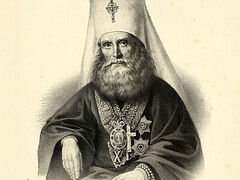
St. Theodore of Sanaxar Today, on March 4 according to the new calendar, the Holy Church honors the memory of St. Theodore (Ushakov) of Sanaxar. The future saint was born in 1718 into a pious noble family and was named John. Having received his education at home and upbringing in the faith, at the age of seventeen he went to St. Petersburg. His military service began in the Preobrazhensky regiment. He was soon promoted to corporal. The young man had extensive social prospects. But one day he became a witness of the sudden death of a young guardsman at an entertainment. Deeply struck by that incident, John decided to give up his secular career and devote his life to God.
The future saint left St. Petersburg secretly with only one servant. Letting the servant go, he put on beggar’s clothes, which he had prepared in advance, and retreated to the northern Pomor forests on the banks of the Northern Dvina River (in what is now the Arkhangelsk region). He struggled there in extreme poverty for three years, eating whatever local pious inhabitants brought him. But he had to move to one of the monasteries of the Orel province in the south of Russia. The local abbot settled him in a remote cell of the monastery forest. However, John, who desired special monastic labors, did not find peace there either. People from Empress Elizabeth Petrovna (1741–1761) came to those parts. Having discovered that he had no passport, they took him to the royal court in St. Petersburg. Elizabeth Petrovna met him with the question, “Why did you leave my regiment?” he replied, “For favorable conditions for the salvation of my soul, Your Imperial Majesty.” The Empress wanted him to return to the regiment, but the future saint replied: “I wish to remain in the life I have begun for God and my soul, Your Imperial Majesty, but I do not want my former life and rank.” With the Empress’ permission, John was admitted to St. Alexander Nevsky Lavra.
Three years later, he was tonsured a monk with the name Theodore in honor of the holy Right-Believing Prince Theodore of Smolensk and Yaroslavl (feast: September 19/October 2). He lived at the lavra for about ten years. The ascetic was distinguished by his elevated spiritual life and fasting. And people began to come to him seeking spiritual guidance for salvation. A spiritual brotherhood in the spirit of Christian love was formed around Fr. Theodore. This caused envy among other Lavra monks, so much so that he seriously feared for his life. In the end, the saint asked for permission from the monastery administration, received letters of leave and left the Lavra, arriving in Sarov. His spiritual children followed him, desiring the monastic life.
Monk Theodore did not stay long at the Sarov Monastery. He had his spiritual daughters admitted to a convent nearby, while himself and his disciples moved to the Sanaxar Monastery (in what is now the autonomous Republic of Mordovia). His strict and fruitful labors at the Sanaxar Monastery commenced.
 The Sanaxar Monastery
By the time Fr. Theodore and his brethren came, this monastery, situated in a bend of the Moksha River, was in decline. With the help of benefactors who had known Monk Theodore from St. Alexander Nevsky Lavra, he managed to restore the monastery. A stone church was built, and the cells were restored. In 1762, he was ordained hieromonk and appointed abbot.
The monastery rule was very strict. They read and sang slowly, and Vigil could last twelve hours. The meal was very modest, and they never ate white bread. The brethren’s prayer rule was voluminous. The abbot shared the obediences with the brethren, engaging in fishing and hay harvesting with them, while being a kind but strict mentor to them. Gradually, believers seeking spiritual instructions began to flock to the monastery. St. Theodore was merciful and affectionate to everyone.
But here, too, the enemy of mankind strove to destroy God’s work. The holy elder was slandered and had to leave the monastery he had revived. The Solovetsky Monastery became Fr. Theodore’s place of exile and new place of service. Before leaving for the harsh lands, he had a long conversation with St. Tikhon of Zadonsk, Bishop of Voronezh (commemorated August 13/26). The latter greeted the ascetic of Sanaxar with respect and love. After that, for nine long years St. Theodore struggled in poverty and the cold on the Solovki Islands. But his spiritual children, with God’s help, finally managed to secure his return from exile. And the elder came back to the Sanaxar Monastery, where he was welcomed with great joy. The saint continued his ascetic labors there until his repose on February 19, 1791.
 Solovetsky Monastery
The elder’s relics remained incorrupt. At his burial place, by the wall of the monastery church, a plaque was set up with the following inscription: “Here is buried the seventy-three-year-old Elder and Hieromonk Theodore, surnamed Ushakov, the reviver of the Sanaxar Monastery, who was tonsured at St. Alexander Nevsky Lavra and led monastic life for forty-five years; he passed away as a true Christian and a good monk on February 19, 1791.”
Soon after his death, St. Theodore appeared to one of his disciples, comforting him and showing him the wondrous Heavenly abode in which he dwelt. In 2004, the Bishops’ Council of the Russian Orthodox Church canonized St. Theodore of Sanaxar for Churchwide veneration.
Let us turn to the elder of Sanaxar’s spiritual instructions, which have survived for the edification of the faithful. He taught: “God created man, who lives on earth for eternal and everlasting life, to become children of God and inherit His Divine Kingdom.” But in order to inherit this Divine Kingdom, a struggle is needed. The elder wrote about this: “The three main passions that are most pleasing to the devil are love of glory (vainglory), love of money, and love of pleasure. By these three means the enemy seduces people into violating all the commandments of God, stirs up much enmity, provokes bloodshed, and plunges people into other sinful passions... the warfare against the adversary is intended to overthrow the devil—that is, to mortify the passions inside us, inserted by the fiend, and not to listen to his pernicious suggestions; We must remain not only in abstinence from tempting passions, but also in patience, even to death, for the sake of God’s truth: for this is our struggle and perfect victory against the enemy.”
The elder also taught: “If a person loves the Lord—that is, if he keeps His commandments while living on earth and fighting his evil enemy, the devil, and all the passions, then God, seeing his labors, will love him as a son more and more… In order to fulfill God’s commandments and overcome the devil and his pernicious passions, we need to have the constant remembrance of God and unceasing prayer... in order to receive the Lord’s help, with which we will be able to stand firm against all the devil’s crafty schemes.”
When asked what is pleasing to God, the elder replied: “Whoever wants to receive Divine mercy must keep the Lord’s commandments, which enjoin us to perform virtues and stay away from evil deeds. In order to please God we must pray to Him with contrite hearts that He will forgive our sins and arrange our lives mercifully (for salvation), and thank Him for all His mercies to us: go to church of God on the feasts of the Lord, fulfil everything that the Holy Church commands us to, and on other days do our work without laziness, giving alms to the poor and offerings to the church of God from the fruits of our labors; help each other in our needs; forgive without anger those towards whom we had enmity; endure all undeserved troubles, misfortunes and other trials peacefully without sorrow, with gratitude to God. Always keep the fear of God in our minds in order to avoid eternal torment and ask God to vouchsafe us the Heavenly Kingdom. All these things are pleasing to God!”
 Cosimo Rosselli. The Sermon on the Mount
The elder spoke of the things that are repulsive to God as well: “So as to avoid evil deeds we should: not offend each other, not steal anything that is someone else’s or seize it by deception, not lie, not quarrel, not be angry, not be rancorous, not be lecherous, not be drunkards, not laugh frivolously, not be foul-mouthed and idle talkers; not be buffoons and dancers, not practice magic and other impious things, and not resort to quack doctors and charmers in illnesses. These are the things that God abhors.”
When asked what true humility is like, the saint taught: “Humility consists of not thinking of yourself as anything great and lofty both before God and before men: before God, because you are always a sinner, even if you have done something good, you must know that you have not done it by yourself, but solely with the help of the Lord… Put yourself last before people, and while living in the brotherhood, choose the last: love the last place among them… When being rebuked or treated unfairly by others, do not be irritated, but only think that you are the very last and the slave of all. This is what perfect humility is like.”
The elder would say about purity of soul: “Spiritual purity, or purity of soul, is in keeping your soul from lustful sins, for the soul that remains in sin is impure and unclean… To be pure from sin means not only to keep yourself from sinful actions, but not even to incline to these things in thought, according to the words of the Lord: Blessed are the pure in heart: for they shall see God (Mt. 5:8).”

He taught about patience: “Patience consists of not being discouraged or saddened in any sorrowful and difficult circumstances, both in bodily labors and in thoughts, but in bearing all suffering courageously and benignly, even to death, in the hope of God’s mercy, in accordance with Christ’s words: Come unto Me, all ye that labor and are heavy laden, and I will give you rest (Mt. 11:28); and also, He that endureth to the end shall be saved (Mt. 10:22).”
The saint taught about abstinence, which is vital not only for monastics, but also for laypeople: “Abstinence is moderation in everything except what is necessary, and restraint from excessive desires, according to the Apostle Paul’s words: Make not provision for the flesh, to fulfil the lusts thereof (Rom. 13:14). Abstinence is needed in various ways: regarding the stomach, the tongue, sight, hearing, and every lust of the flesh and spirit… And any excessive desire, other than an essential one, should not be allowed to be fulfilled in practice. That’s what abstinence is about.”
The saint also asked himself this important question for all children of the Orthodox Church: “Why is it that we may not get bored standing in front of some person all day long, but don’t want to stand before God even for a minute?”
The troparion to St. Theodore of Sanaxar, tone 4:
From thy youth up thou didst love Christ with filial love, and desiring to serve the Lord alone, thou didst choose the good part, which shall not be taken away by death. Devoting thyself to the one thing needful and the Giver of Life, from Him thou wast vouchsafed to receive the gifts of divine teaching and spiritual discernment, nourishing all who had recourse to thee, seeking the salvation of their souls, O divinely-wise Elder Theodore of Sanaxar.”
Let us also pray to the holy elder in the words of the kontakion to him:
“Forsaking the vanity of the world and all the fleeting things in it, thou didst enter Sanaxar Monastery, O venerable one. Living there like an angel, thou wast a path to salvation for many; and so Christ enriched thee with the gifts of discernment and teaching. Therefore we cry out to thee: save us, O Theodore, by thy holy prayers.”