Two of the epistles of the Holy Apostle Paul contained in the New Testament are addressed to Christians living in the Lycus River valley of Anatolia: the Epistle to the Colossians and the Epistle to Philemon. There was actually a third one as well, an epistle to the Christians of Laodicea; but this epistle has not survived and is known only because Paul himself refers to it briefly in his letter to the Colossians. These epistles make mention of certain figures associated with the nascent Christian communities of that region, figures now venerated as saints of the Church and who had a lasting impact on the churches there. This article proposes to examine these figures and situate them in their geographical and historical context.
Colossae and the Lycus Valley
 Map of Phrygia, Lycus Valley. Photo: Bible mapper
The Lycus River Valley is located in the historic region of Phrygia, in the western part of Anatolia—present day Turkey. The principal cities of this region were Colossae, Laodicea, and Hierapolis. All three cities were clustered within approximately twelve miles of each other. In addition, all three are mentioned by the Apostle Paul who, though he seems never to have visited them, nevertheless had passed not far from them in his travels and was well aware of the goings on in their communities, which he followed with keen solicitude. All these cities had Christian communities from the very earliest days of the Church. Important Roman roads connected the cities to major urban centers such as Ephesus, located roughly 100 miles to the west, as well as to other important cities to the east.
 Present day view of Honaz, Turkey, near the site of ancient Colossae. Photo: Wikipedia.
Colossae was the southernmost of the three, located to the southeast of Hierapolis and Laodicea. It was located in the region of present day Honaz, Turkey, and was situated at the base of Mt. Cadmus, the region’s tallest mountain. In medieval times its population had shifted to the more or less adjacent city of Chonae. Chonae is associated with a famous miracle of the Archangel Michael in which local pagans had re-routed the river to submerge and destroy the church there; however, the archangel thwarted their plans by opening a fissure in the earth into which the raging and rapidly approaching waters plunged, leaving the church unscathed. In ancient times Colossae was particularly renowned for its springs of cold water which were believed to have healing properties. It was also well known for its production of dyed wool. Even in New Testament times the city was already quite ancient, and although it had considerably declined in prominence it remained a significant city in the region. Archaeological excavation of ancient Colossae has only gotten underway in the last few years, since previous work in that field had been mostly focused on the other ancient sites in the Lycus Valley.
 Ruins of Hierapolis. Photo: Wikipedia
Hierapolis was the northernmost of the three cities of the region. In contrast to Colossae’s cold springs, Hierapolis boasted of renowned hot springs. These springs served as the basis for spas that drew cure seekers in large numbers. Hierapolis had once served as a pagan cult center. It was of significance to Christians as the site of the martyrdom of Philip the Apostle; his tomb is located there.
Laodicea was the westernmost of the three cities and was situated somewhat between the other two. It also had springs, but its water sources were of medium temperature. Interestingly, this fact ties in with the mention of the city in the Book of Revelation, in which the Church of Laodicea is upbraided for its insipid lukewarmness. Like Colossae, the city was known for its wool products, in particular its distinctive black wool. There was a Christian community there and, as mentioned above, they received an epistle from St. Paul which has not come down to us.
The Christians of Colossae
 Ruins of Colossae. Photo: Wikipedia
The principal figures associated with the early Christian community of the Lycus Valley are referenced in St. Paul’s epistles to Philemon and the Colossians. They established vibrant and lasting churches in the region and are venerated as saints of the Church. Some details of their lives and subsequent histories are preserved in holy tradition. These main figures will be briefly discussed here.
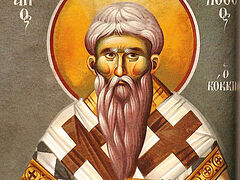
 St. Epaphras Epaphras: St. Epaphras was arguably the most important figure associated with the churches of the Lycus Valley. Epaphras served as the educator of the Christians in the area, communicating Paul’s teachings to them while also keeping Paul informed of the happenings within those Christian communities. He was probably a native of Colossae and is believed to have played a leading role in founding the churches of Colossae, Hierapolis, and Laodicea. He seems to have been the one who first brought the Gospel to the region. Indeed, Paul himself seems to confirm this when he says to the Colossians, “You learned it [i.e., the Gospel] from Epaphras.” (Col. 1:7) That he was especially close to the Apostle Paul as a trusted and invaluable helper can be gleaned from the mentions of St. Epaphras in the letters to the Colossians and to Philemon. In the concluding greetings from the letter to the Colossians, the Apostle Paul says of him: “Epaphras, who is one of you, a bondservant of Christ, greets you, always laboring fervently for you in prayers, that you may stand perfect and complete in all the will of God. For I bear him witness that he has a great zeal for you, and those who are in Laodicea, and those in Hierapolis.” (Col. 4:12-13) Some traditions credit Epaphras with being the first bishop of Colossae.
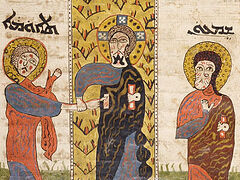
Philemon (and Apphia): St. Philemon and his wife St. Apphia seem to have been people of means in Colossae who had a church in their home. Philemon, of course, was a recipient of a letter from Paul written on behalf of the runaway slave Onesimus. This brief epistle, the third shortest book in the New Testament, commends Onesimus, newly converted to Christ by Paul, to his former master with exhortations full of warmth and deep love. Tradition relates that Philemon was made a bishop and did much to spread the Gospel in Phrygia before eventually becoming bishop of Gaza in Palestine. St. Apphia, his wife, was distinguished by her great hospitality, ministering to the ill and destitute and sheltering them in her home. Sts. Philemon and Apphia were martyred during the persecutions under Nero by stoning.
 St. Onesimus. Photo: johnsanidopoulos.com Onesimus: St. Onesimus, as mentioned above, was at first a slave of Philemon’s. He had run away, possibly following some infraction against his master, and ended up encountering Paul during the latter’s Roman imprisonment. Paul brought him to Christ and baptized him. St. Onesimus faithfully ministered to St. Paul in his bonds, rendering him great assistance and relief—a fact gratefully acknowledged in the epistle to Philemon. After Paul’s martyrdom, St. Onesimus preached the Gospel in many lands including Spain. He later became bishop of Ephesus, succeeding St. Timothy. He was martyred during the persecutions under Trajan.
 St. Archippus Archippus: St. Archippus is mentioned in both the epistle to the Colossians and the Epistle to Philemon. At the end of Colossians, Paul instructs the faithful there to “Tell Archippus: ‘See to it that you complete the ministry you have received in the Lord.’” (Col 4:17) Archippus, too, would later go on to serve as bishop of Colossae. He suffered martyrdom alongside Sts. Philemon and Apphia under Nero.
The Epistles
Both Colossians and the letter to Philemon likely date to the period of the Apostle Paul’s imprisonment in Rome, c. AD 62. Both documents give insight into the circumstances of the Christian communities of the Lycus Valley in those early days of the Christian faith. This section will briefly examine them but not intend to do so in any depth; for that the best possible reference point would be the invaluable, divinely inspired commentaries by St. John Chrysostom. Significant commentaries on these epistles have also been written by Archbishop Averky (Taushev) of Syracuse.
 Epistle to Philemon, fragment. Photo: Wikipedia
Colossians: The epistle to the Colossians opens with a customary greeting, after which the Apostle assures the community there of his ongoing fervent prayers for them. He further assures them that he is laboring strenuously on their behalf, as well as for the Christians of Laodicea. He then exhorts them to be united in love and rooted in Christ. Of particular concern to the Apostle is the threat of vain speculative reasoning leading people in the community astray: “See to it that no one takes you captive through hollow and deceptive philosophy.” (Col 2:8) Further instructions are given, particularly as concerns relations between spouses and children. Final greetings are conveyed from Paul and his companions to the believers.
 St. Philemon. Photo: Historica Philemon: “I beseech thee for my son Onesimus, whom I have begotten in my bonds.” (Phlm. 1:10) Thus does Paul write on behalf of the runaway Onesimus to the latter’s erstwhile master, Philemon. The epistle to Philemon is a plea on behalf of Onesimus, who had been converted in the Roman prison by Paul and had become the Apostle’s faithful helper. Indeed, Paul, who in his bonds had great need of a helper, was reluctant to part company with Onesimus—but he wished to effect a reconciliation between Philemon and Onesimus. To this end he sent this epistle, using powerful and moving exhortations. “If thou count me therefore a partner, receive him [Onesimus] as myself.” (Phlm. 1:17) One can easily imagine how effective such a plea must have been. The brief epistle ends with Paul stating his hope to someday visit Philemon and his companions.
 Ruins of Laodicea. Photo: Wikipedia
Conclusion
The early Christian community of the Lycus Valley in Phrygian Asia Minor, centered on the cities of Colossae, Hierapolis, and Laodicea, was closely connected to the holy Apostle Paul’s missionary labors. Particularly through Epaphras, St. Paul had regular contact with the believers of the region and had solid information about their respective churches’ circumstances and situation. Holy figures like Sts. Philemon, Apphia, Onesimus, and Archippus, provided a solid and enduring Christian foundation for the whole region and even spread the Gospel to other areas, too. It is hoped that this brief sketch has given a little more insight into the historical situation of this vibrant community of the early Church.