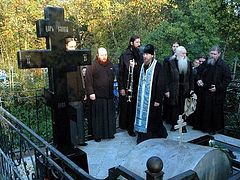
Beloved brothers and sisters, you have done well to come together to church today, to raise your fervent prayers to the Throne of God for our departed brothers, sisters, and all our relatives, and for all departed Orthodox Christians. The debt of love to our close one obliges us to pray for the dead, who have departed to eternity. We do not know what is their lot, but we must pray without fail for them, because it is very good for them and brings us great benefit as well. In praying for the reposed, we thereby witness our love for them, express our compassion and mercy. And the Lord said that blessed are the merciful, for they shall find mercy (Matt. 5:7). Moreover, if our close one for whom we pray has pleased the Lord, then he himself will have boldness before the Lord, and can raise his own prayers for us to Him.
The Church received the custom of praying for the reposed from the Apostles themselves, and throughout all ages it has prayed and will pray for them, till the end of time. St. John Chrysostom writes: “It is not in vain that the Apostles have made it a law to commemorate the dead during the Awsome Mysteries. They knew that there is great benefit in this, and for the reposed it is a great benefaction.” The Holy Fathers and teachers of the Church of all times preached aloud to all that change is possible to the lot of the reposed until the Last Judgment.
St. John Chrysostom says, “It is possible to ease the punishment of a departed sinner. If we pray often for the reposed and give alms, then although he may not have been worthy himself, God will hear us.” And from Blessed Augustine we read, “Do not reject the notion that the souls of the reposed receive relief from the pious, when the Sacrifice of Intercession is offered for them, or alms are dispersed for their benefit. But such acts of piety bring benefit only when the reposed had deserved this benefit… Truly, there is no life so pure that it does not require help after death, and none so evil that such help after death would not benefit.”
There are many examples when fervent prayer for the reposed has delivered them from a state of torment. We will cite one true example, described by a holy martyr of the third century, Perpetua. “One day,” writes the martyr, “in the prison during common prayer I unexpectedly pronounced the name of my dead brother Dinocratus. Stunned by this sudden remembrance, I started praying and sighing for him before God. The next night, I had a vision.
I saw Dinocratus coming out of a dark place in a great heat and tormented by thirst, unclean in appearance and pale, he had the wound on his cheek with which he had died. There was a great abyss between him and me, so that we could not come near each other. Near the place where Dinocratus stood there was a full vessel of water, but its rim was much higher than my brother’s height, and Dinocratus stretched upwards trying to reach the water. I felt so sorry that the height of the rim prevented my brother from drinking.
“Immediately after this I awoke and knew that my brother was in torments. Believing that my prayer could help him in his suffering, I prayed day and night in prison with cries and tears that he might be granted to me. On the day when we remained bound in chains, I had another vision: the place which I had previously seen dark had become bright, and Dinocrates, with a radiant face and clothed in beautiful garments, was enjoying the coolness there. Where he once had a wound, I now saw only its scar, and the edge of the pool was now no higher than the waist of the boy, so that he could easily draw water from it. At the edge stood a golden vessel full of water. Dinocrates came near and began to drink from it, and the water did not diminish. Then the vision ended. At that moment I understood that he had been delivered from his punishment.
Blessed Augustine says in explanation of this story that Dinocratus was enlightened by Holy Baptism, but he had gotten led astray by the example of his pagan father and was not firm in the faith. He died after certain falls into sin that are typical of his age. For such unfaithfulness to the Christian faith he endured suffering, but by the prayers of his holy sister he was delivered from them.
Therefore, my dear ones, as long as the Church militant remains on earth, the lot of departed sinners can still change for the better. What great consolation for the grieving heart, what great light for the perplexed mind there is in Christianity! Rays of light beam from it into the murky kingdom of the dead.
Dear brothers and sisters, the Savior’s goodness has given us a means to ease the lot of our reposed brothers. Let’s not be inattentive to our close ones. Let us do whatever we can for them, let’s pray for the reposed according to the prayers of the Church, let’s give alms for them. If not for them, let’s at least be merciful for ourselves. After all, will the Lord be merciful to us if we have not been merciful to those whom He has redeemed by His Blood? Will we remain true Christians if we don’t perform works of love?
In completing our commemoration of the dead, we should always remember that we also—if not today, then tomorrow—will definitely follow in their footsteps to another, Eternal Life, because man does not disappear without a trace, for he has an immortal soul, which does not die. What we see dying is the visible, coarse body; but what lives in it is the invisible, subtle force, which is usually called the soul.
The body itself testifies to its own mortality, for it is destructible and divisible; but the soul, to the contrary, has an unconfused spiritual, indestructible essence, and it can’t decompose into different parts like the body and die. The soul is immortal. The soul has an indivisible, unconfused unity; throughout its life it feels its single, continuous existence. Our body participates in life as if involuntarily, being brought into motion by the power of the soul, and always burdens the latter with its laziness. The soul, to the contrary, ever continues its independent life and activity, even when the activity of the body ceases through sleep, sickness, or death. Belief in the immortality of the soul has existed in all peoples and all times, even among pagan and wild tribes.
What serves as proof of our soul’s immortality? First of all, the word of God convinces us that the human soul is immortal. Even in Old Testament times, Ecclesiasts said: Then shall the dust return to the earth as it was: and the spirit shall return unto God who gave it (Eccles. 12:7). And in another place the Wise Solomon says: For God created man to be immortal, and made him to be an image of his own eternity (Wisdom of Solomon 2:23). God allowed temptation to come only upon Job’s body and possessions, but He did not permit the evil one to touch his soul.
The entire New Testament is a confirmation of our faith in the immortality of the soul and our hope in the future resurrection. The Lord Jesus Christ confirmed this faith and hope by His teaching and by His works when He said that He came into the world, that whosoever believeth in him should not perish, but have eternal life (John 3:15); and again: Verily, verily, I say unto you, If a man keep my saying, he shall never see death (John 8:51).
Moreover, the Lord commands all Christians, especially those who preach the word of God Fear not them which kill the body, but are not able to kill the soul: but rather fear him which is able to destroy both soul and body in hell (Matt.10:28). By these words He also clearly teaches that the soul is immortal.
And common sense has to recognize the truth of the immortality of the soul. Look carefully at man: What does his heart seek, toward what does it strive? Why is his soul never satiated or satisfied by anything in this world? One man may have every possible pleasure on earth, and yet he goes on seeking and not finding. Another desires to quench the soul’s thirst with worldly pleasures and fun, but it all leaves nothing but emptiness in his soul, languishing of spirit, and so he seeks ever new delights but again finds no joy in them.
All of this proves the truth that the human soul cannot satisfy its inner thirst for blessedness by anything in this world. This is precisely why God aroused this insatiable thirst in the soul of man—in order to direct him through it to another, better life; so that man would not get stuck in temporary pleasures but rather strive toward the honor of a higher divine calling.
And what if we turn our attention to our soul’s capacity for knowledge? How broad is the circle of human knowledge, what vast reserve of subjects the memory contains, what a limitless space the imagination can traverse, what lofty concepts the reason accepts and explains! And the vaster man’s circle of knowledge, the greater this thirst is aroused in his soul to acquire it. What does this unquenchable thirst for knowledge mean if not that the soul will only be completely satiated with knowledge there, beyond the grave?
If we pay attention to man’s life itself, then we can find important proof of the immortality of the human soul. In what does a great part of our lives pass? Isn’t it in sorrows and calamities? One person struggles with sicknesses, other with various misfortunes, another suffers from poverty and depravation, another endures the wrath of enemies or sorrows from their envy and slander. It’s hard to find a man who has never known troubles, who could say, “I’m happy, I’m blessed!” And how many are the sufferers who met sorrows and sicknesses in their cradles and did not part with them till their very graves! How could we explain the goal of human existence, if we were to take away the soul’s immortality? Could it really be that the lot of man and of irrational beasts is the one and the same? How then does man surpass them? Only by the fact that he endures more sorrows and misfortunes than irrational animals…
But the word of God resolves this perplexity, saying, For we know that if our earthly house of this tabernacle were dissolved, we have a building of God, an house not made with hands, eternal in the heavens (2 Cor. 5:1).
Amen.
From: Readings For Every Day of Great Lent, Ed. N. Shaposhnikova (Moscow: Danilov Monastery, 2025).