In the name of the Father, and of the Son, and of the Holy Spirit!
Dear brothers and sisters in Christ, greetings on today’s feast, the fourth Sunday of Lent! We have already celebrated Mid-Lent, reaching the half way mark, and the Church dedicates this Sunday to the memory of St. John Climacus.
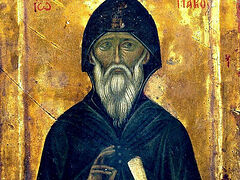
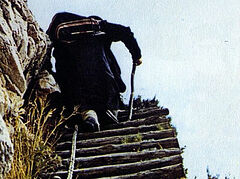
St. John Climacus left behind the work entitled, The Ladder of Divine Ascent, which is why he is called “St. John of the Ladder”. His Ladder is from earth to Heaven, and he expounded it in thirty steps.
If you ask yourselves what this book is about, then those who have read it and even those who have not read it will probably answer very simply. This book aims to answer the question: “How can we be saved?” And that is true. But there is one moment, an integral point of our salvation, and it is as follows…
In our lives we often hear the expression, “a successful person”, “a person who has achieved self-fulfillment”. And when we start wondering what he has done in order to succeed, we often hear the answer: “He is a family man”, “He has children”, “He has become a professional in some sphere”, “He has a successful career”, “He has lived to great old age”, and “He is highly accomplished.”
But first of all, of course, it is known to priests (who speak with a huge number of people), or just to people he is in touch with all the time. The following secret is revealed here: Very often people who have all these things are still inwardly unhappy. If a person is unhappy, this begs the question: is he really fulfilled?
How can we attain happiness? One day some young students came to the Optina Monastery. It was the heyday of Optina eldership; there were several elders at the monastery at the same time. The students were asked, “Would you like to go to the skete and talk to its superior, Igumen Barsanuphius?” They reluctantly agreed.
On their way to the skete they thought to themselves, “We are well educated people and scholars, we know a lot of things, we read very much—what can an old man, a monk who lives somewhere in a dense forest tell us?”
They came to him in this mood, but the holy Elder Barsanuphius shocked them with a question to which they could find no answer. The question was so simple and so relevant to everyone that anyone should have the answer to it at his fingertips.
The saint asked them: “What is life?” They could not answer, and there was an awkward pause, after which Fr. Barsanuphius himself answered his own question in such a way that they were even more shocked. He said, “Life is blessedness” (that is, it is happiness).
Naturally, they were put out immediately and said: “Father, how can life be happiness when there is so much sorrow in it?” The saint replied, “Yes, that is true. But we must enter into this happiness, and the Gospel shows us the doors by which we enter into it.”
Today the Gospel reading was dedicated to St. John Climacus. This reading is familiar to many. “Blessed” means “happy”: Blessed are the poor in spirit... Blessed are the merciful... Blessed are the pure in heart… (Matt. 5:3, 7, 8), and so on. That is, those who are merciful, pure-hearted and poor in spirit are self-fulfilled and have attained this inner happiness.
How? What’s the explanation? Maybe this is just some purely human morality? No. If you take the whole Gospel, put its essence into a small parable, and imagine that you have an opportunity to write a letter to God and ask Him the following question there: “Lord, where can we find You?” And if the Lord were to answer based on the Gospel, He would use these words: “Let us meet where there is love.”
The foundation of mercy, the pure heart of those who are poor in spirit, peacemakers, and so forth—everything that we have heard in today’s excerpt from the Gospel—is all the bricks that build love. Once you embrace love if only a little bit, with even one brick, that’s where a meeting with God takes place.
Who is God? God is the Creator of this whole world. God is the One Who upholds this world by His Providence. God Himself is Love. He is omnipotent and omnipresent, and He knows each one of us better than we know ourselves: He knows what is useful to us, He knows what we need to be happy, to be fulfilled, and to blossom.
That is why Alexei Stepanovich Khomyakov (1804–1860), a well-known Orthodox theologian, a man of holy life, an amazing and deep personality, said this very interesting phrase: “You can blossom fully only in the Church.”
Why only in the Church? Because the Church is the place where God unites us and where the Holy Spirit works. And only the Lord and the Holy Spirit know what talents we have and the place where these talents can be revealed in our lives. Why? Because God gave us these talents. Everything we have is a gift from God.
Every person in the world, observing himself and others, knows that everyone possesses some talent. One has an insightful and analytical mind; another is witty; yet another is very physically strong. They didn’t choose it—it was just given to them. It is a gift that God has endowed upon of them with to be of service. Everyone needs to find his place in this life, and the Lord knows that place. And people can only find it in the Church—there is no other way.
It’s Lent now—a special time. We say: repentance, mourning for our sins, and performing good works… The attention of Lent is focused on this. We will ask ourselves: “Is it not necessary to do all this the rest of the time?” It’s necessary, it’s just that we can’t strain ourselves so fully all year round and throughout our lives. Therefore, the Lord has set aside a special time for us.
And what else is special about it? Is it just that we voluntarily force ourselves to do something? No. Since God works in the Church, it is at this time that the Lord manifests Himself in a special way. That’s what our liturgical books say: “Most blessed is the grace of the holy fast.” Therefore, we must take advantage of this time for as long as it is still going on this year, trying to pay attention to our inner state, and first of all—especially at this time—to the quality of our prayer.
Because Lent is a period of special, long prayer. So it is very important to try not to make it formal. Many people complain that their mind wanders, or they don’t feel like praying, or it’s hard for them to pray. Here is advice from the Holy Fathers: Take a very short prayer rule (preferably individual) and perform it very, very carefully at home.
Forget that we “read through” the rule. That is, “we read from here to there, and that’s it—we’ve done everything.” No, devote this short time to prayer with awareness that you are now communicating with God, saying from the bottom of your heart: “Holy God, Holy Mighty, Holy Immortal, have mercy on me.” You can make a bow or even a prostration. Let it be from the Trisagion Hymn to “Our Father”, but it should be real prayer.
And real prayer is the flame that ignites our hearts. We receive inspiration from the Lord for this life, which constantly requires inspiration from us. Because this life is fraught, among other things, with various difficulties that must be overcome.
So, dear brothers and sisters, may God help all of you! I hope that we may all participate in this spiritual flame during this Lent, that we may burn, grow in love, and meet with God. Amen.