In Medieval Rus’, it was considered normal for Christians to read the entire cycle of services every day, so they would read the Midnight Office as morning prayers. The morning rule we’re familiar with now hadn’t been formulated yet. Many Midnight Office prayers are associated with the morning (although some say more about nighttime), so as you read it, you’ll notice several parallels with the morning rule from your prayer book.
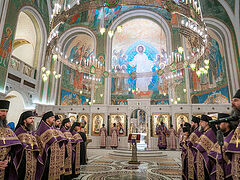
 Photo: standrewsgreekorthodoxcathedral.co.uk
It may sound unrealistic to some, but I do know some laymen who read the Midnight Office as their morning prayers—perhaps not every day, but it still happens sometimes. I also have friends who sometimes read the Hours at at the appointed times throughout the day. And there are even some laymen I know who sometimes read the full daily cycle at home as a pious exercise, with each service at its appointed time according to the Typikon. So, figuring that there likely are such enthusiasts of lengthy services according to the Typikon among the readers here (or simply early birds for whom reading the Midnight Office early in the morning would be physically easier than managing Compline with a canon after work), I decided to write about the Midnight Office and the Hours.
Prayers Upon Rising from Sleep
In general, the Horologion begins with prayers “upon rising from sleep.” These prayers are identical to the beginning of the morning rule in our prayer books: the usual beginning (O Heavenly King through the Lord’s Prayer), the troparia to the Holy Trinity: “Having risen from sleep....” the prayer to the Holy Trinity: “As I rise from sleep I thank Thee…” Then is added (in contrast to the usual morning prayers) “Glory to Thee, O King, God Almighty.” This beginning of the morning prayers is the same any day of the week or year. But then the service depends on the day of the week—there are Midnight Office services for weekdays, for Saturday, and for Sunday.
Weekday Midnight Office
Let’s begin with the weekday Midnight Office.
—The usual beginning.1
—O Come, let us worship… (3x)
—Psalm 50 (Have mercy on me, O God…)
—Psalm 118 (Blessed are the blameless…)
—Nicene Creed
—Trisagion prayers
—The troparion, “Behold, the Bridegroom comes at midnight”
—Lord, have mercy (40x)
—The prayer, “Thou Who at all times…”
—Lord, have mercy (3x). Glory, both now. More honorable than the Cherubim
—[The exclamation, “In the name of the Lord, Father bless,” is omitted, since we’re reading the lay service]
—“Through the prayers of our Holy Fathers” is a common blessing that doesn’t have to be said by a priest, so we read it calmly.
—Amen. The prayer, “O Master God, the Father Almighty”
—[The next two prayers are read only from September 22/October 5, that is, the day after the Leavetaking of the Elevation of the Cross, until Palm Sunday]: The prayers, “O Lord Almighty…” and “We bless Thee, O Most High God…”
—O come let us worship (3x)
—Psalm 120 (I have lifted up mine eyes to the mountains…)
—Psalm 133 (Behold now, bless ye the Lord…)
—Glory, both now. Trisagion Prayers
—Memorial troparia: “Remember, O Lord, for Thou art good,” “ O Thou Who by the depth of Thy wisdom.” Glory: “With the saints give rest.” Both now: “In all generations we call thee blessed”
—Lord, have mercy (12x)
—Memorial prayer: “Remember, O Lord, our fathers and brethren who fell asleep in the hope of resurrection…”
—“My hope is the Father…”
—Glory, both now. Lord, have mercy (3x). Dismissal: “Through the prayers of our Holy Fathers…”
Saturday Midnight Office
The Saturday Midnight Office differs little from the weekday service.
—The 9th kathisma is read instead of the 17th.
—Instead of “Behold, the Bridegroom,” the troparion, “O Thou Who art by nature Uncreated” is read or sung.
—After the prayer, “O Master God, the Father Almighty,” instead of the two prayers of St. Basil the Great, a special prayer of the Martyr Eustratius, characteristic only of the Saturday Midnight Office, is read: “Most highly do I magnify Thee, O Lord…”
Otherwise, the Saturday Midnight Office is served the same as on weekdays.
Sunday Midnight Office
The Sunday Midnight Office, in turn, bears little in common with the weekday and Saturday service. Only the very beginning aligns:
—The usual beginning
—O come let us worship (3x)
—Psalm 50 (Have mercy on me, O God…)
—Glory, both now. Alleluia, alleluia, alleluia, glory to Thee, O Lord (3x)
Then the Sunday Midnight Office has a very special structure. After Psalm 50, a canon to the Most Holy Trinity in the tone of the week is read. This canon can be found in the Octoechos, in the section for the relevant tone, between the canon at Compline on Saturday evening and the texts for Matins. Since there are eight tones, there are eight canons to the Trinity, and they’re read sequentially, depending on the tone of the week. These canons are incredibly beautiful and of stunning dogmatic, exegetical, and ascetic depth. Regardless of whether you have the opportunity to get up early on Sunday, on a day off, and read them, I strongly urge you to familiarize yourself with them when you can.
Thus, at the Sunday Midnight Office, after Psalm 50 comes the canon to the Most Holy Trinity.
—After the canon, special Trinity hymns written by St. Gregory of Sinai are sung (in the tone of the week or in a special melody) or at least read.
—Then the Trisagion prayers up through the Lord’s Prayer
—Hypakoe in the tone of the week—a short Sunday prayer, found in the Octoechos at Matins after the polyeleos or at the end of the Horologion in the appendix for the Sunday dismissal hymns for the eight tones.2
—Lord, have mercy (40x)
—Glory, both now. More honorable than the Cherubim…
—Through the prayers of our Holy Fathers…
—And the prayer to the Most Holy Trinity: “O Almighty and Life-giving Holy Trinity…”
—Glory, both now. Lord, have mercy (3x)
—Through the prayers of our Holy Fathers…
 Photo: pemptousia.com
It should be noted that the order of the Sunday Midnight Office is given in the Horologion only in outline form, and even the prayer to the Holy Trinity isn’t given in full. But besides the Horologion, it’s included in the Octoechos itself, in a special appendix at the end of the book, which is logical, since the Sunday Midnight Office can’t be served without reading the Trinity canon of the current tone, and in practice it’s much easier to read everything from one book than to use the Horologion, where the order for the Sunday Midnight Office is given in an abbreviated form.
But if you don’t intend to purchase an Octoechos, you can put together a booklet for the Sunday Midnight Office. It should include the opening of the service (which can be copied from the Horologion—from the weekday Midnight Office, where it’s given without abbreviations), followed by the canons and hypakoi for each tone copied from the Octoechos, and at the end, the conclusion of the Midnight Office. If copying the ending from the Horologion, be sure to find and separately insert the prayer “O Almighty and Life-giving Holy Trinity,” since it’s not included in the Horologion.
General Notes on the Midnight Office
In general, the Midnight Office doesn’t really change throughout the liturgical year—it depends only on the day of the week. Only on certain Great Feasts and other special days (such as the Synaxis of the Most Holy Theotokos and Holy Saturday), instead of the troparion, “Behold, the Bridegroom comes at midnight,” the troparion for the feast is read, and instead of the memorial troparia, the kontakion of the feast is read, and the memorial prayer is left out.
The Midnight Office is completely omitted by the Typikon only on those days when an All-Night Vigil is celebrated. Though I would suggest that our modern Saturday All-Night Vigil, especially in its parish form, isn’t quite the “laborious vigil” that would keep someone from reading the Midnight Office with the Trinitarian canon as morning prayers on Sunday morning if they want to.
Can the Midnight Office Be Shortened Somehow?
This might sound like “harmful advice,” but I can’t help but mention that in Greece, in a number of monasteries with a special focus on the Jesus Prayer in the Typikon, the Midnight Office on weekdays and Saturdays is read without a kathisma (which significantly shortens it, so it takes about as long to read as the usual morning prayers). This is done largely for practical reasons, to increase the time allocated for the Jesus Prayer in their cells. At the same time, if the ninth kathisma at the Saturday Midnight Office isn’t directly connected in meaning to early morning prayer and was included in this service somewhat incidentally, then of course the weekday Midnight Office, when read without a kathisma, loses a truly essential element—Psalm 118, which speaks of love for following God’s Law—something we all need to remind ourselves of and pray about. So yes, this is a significant change.
But my series of articles isn’t about lamenting the exact observance of the Typikon, but about practical advice on how modern man, with his constant shortage of time and information overload, can connect his home prayer with the Church’s prayer, and that’s why I feel it is appropriate to offer such a suggestion. And then, objectively, not everyone has the zeal to get up even earlier than usual on weekday mornings to read the Midnight Office, which lasts about thirty to forty minutes at a calm pace—after all, many often lack the zeal even for the usual morning prayers! So I think that with the approach that something is better than nothing, it makes sense to try reading the Midnight Office periodically, even in this significantly abbreviated form.
The Lay Order for the Hours
In general, the Hours are probably the easiest service for a layman to read. There may be a problem only with not having enough time to read them (if you read each at its appointed time). In addition to being easy to learn, the Hours are interesting in that being able to put them together may often come in handy in practice in church. People who can read the Hours are needed not only in faraway parishes in missionary dioceses (where many may never find themselves in their entire lives), but also in newly built churches in large cities, where there are perhaps not enough altar servers to read the Hours before Liturgy—it happens! So we definitely should get acquainted with the Hours.
 A Slavonic Horologion, called Chasoslov All the Hours have basically the same structure, which looks like this3:
—The usual beginning4
—O come let us worship (x3)
—Three psalms (each Hour has its own three)5
—Glory, both now. Alleluia, alleluia, alleluia, glory to Thee, O God (x3)
—Troparion of the feast/saint6
—Glory, both now. Theotokion (each Hour has its own)7
—Trisagion prayers through the Our Father
—Kontakion of the feast/saint8
—Lord, have mercy (x40)
—The prayer, “Thou Who at all times and at every hour…”
—Lord, have mercy (x3). Glory. Both now. “More honorable than the Cherubim…”
—[“In the name of the Lord, Father bless,” is omitted since we’re reading without a priest]
—Through the prayers of our Holy Fathers, O Lord Jesus Christ our God, have mercy on us.
—Amen. And the prayer of the Hour (each Hour has its own)
The troparia and kontakia aren’t found in the Horologion. As was mentioned in the first part, the troparion and kontakion, like other liturgical texts dedicated to a feast or saint of a specific day, can be found in the Menaion. The troparion is at the end of Vespers, and the kontakion is in Matins after the sixth ode of the canon. But since we’re just beginning to study the Typikon and since we only need a troparion and kontakion for the Hours, we can simply take them from a Church calendar or website.
In the next, final part of our series, I’ll try to do the impossible—to talk in as simple language as possible about how to read the lay order of Vespers.
To be continued…