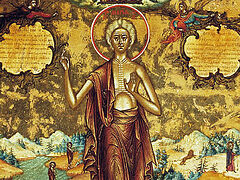
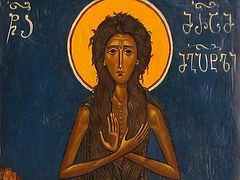
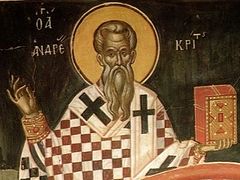
On Wednesday evening, a special service is celebrated in Orthodox churches—known as the “Standing of Mary” (the Service of St. Mary of Egypt).
At this service, for the only time in the year, the Great Canon of St. Andrew of Crete is read in its entirety—the same canon that was previously read in parts from Monday through Thursday of the first week of Great Lent—along with the canon dedicated to St. Mary of Egypt.
Because of this, the Matins service on Thursday is called the “Andrew’s Standing” and the “Standing of Mary of Egypt.” In the Canon are gathered and set forth all the exhortations to fasting and repentance, and the Holy Church now repeats it in full in order to breathe new strength into us for the successful completion of the Fast.
For the same purpose—arousing both strength and attentiveness in those who repent—the Life of St. Mary of Egypt is also read.
Troparia of St. Mary of Egypt from the Great Canon
With all zeal and love thou didst hasten to Christ, turning away from thy former path of sin, and in the impassable deserts thou wast nourished, and didst purely fulfill His divine commandments.
That thou ightiest quench the flame of the passions, thou didst ever pour forth streams of tears, O Mary, thy soul aflame; grant me also, thy servant, the grace of these tears.
The Life of Saint Mary of Egypt
St. Mary was an Egyptian ascetic. Here is how she herself recounted her life to St. Zosimas, who met her in the desert shortly before her death:
“At the age of twelve, I left my parents’ home and went to Alexandria, where I began to live a life of debauchery. Once, together with a crowd of people, I traveled to Jerusalem for the Feast of the Exaltation of the Cross. During the voyage, I led many of my fellow travelers into temptation.
“When I arrived in Jerusalem, I wanted to enter the church with the others, but some invisible force prevented me. I began to wonder why I could not enter while others could. Then the light of God illumined my heart, and I understood that it was my sins that barred me from the house of God.
“For a long time I wept, and suddenly, lifting my eyes upward, I saw an icon of the Most Holy Theotokos on the wall. I began to pray to her, asking her to forgive me and to allow me to enter the church so that I might venerate the Cross of Christ.
“And what happened? After my prayer, I was able to enter the church freely. I venerated the Holy Cross, and then, returning to the icon, I asked the Mother of God to guide me on the path of salvation. Then I heard a voice: ‘Go beyond the Jordan, and there you will find rest for your soul!’
“I obeyed the voice and, after three days, reached the monastery of St. John the Baptist near the Jordan River. After bathing in the holy river, I entered the church, partook of the Holy Mysteries, and then, crossing the river, settled in the desert beyond.
“There I lived for forty years, feeding on roots and enduring terrible hunger. At times I suffered, remembering the rich foods I had once enjoyed in Egypt. Sometimes I had not even water, yet I longed for the fine wines I had once drunk without restraint. My tongue would begin to repeat against my will the foolish songs that once delighted me. I struggled terribly with my former sinful habits. At times I fell to the ground from exhaustion. My clothing decayed with time; my body suffered from cold and burned from the heat. But after seventeen years, a time of peace came.”
Having recounted her life, St. Mary asked Zosimas to return the following year, on Great and Holy Thursday, bringing the Holy Gifts from the monastery so that she might receive Communion on the very day when the Lord communed His disciples.
When St. Zosimas came into the desert, he prayed for a long time and waited for the holy ascetic. At last he saw her approach the river. Making the sign of the Cross over it, she walked across the water. The elder was astonished and wished to bow down at her feet, but she said: “What are you doing? You are a priest, and you bear the Holy Gifts!”
After receiving Communion, the saint asked Zosimas to come to her again in the desert. When he returned a year later, he found her already departed. Near her, on the sand, were written the words:
“Father Zosimas, bury here the body of the humble Mary, who died on April 1.”
This occurred on April 1, 524—the very day of her Communion.
The memory of St. Mary is commemorated not only on April 1/14, but also on the Sunday and Thursday of the fifth week of Great Lent. She is honored at this time in order to present to repentant sinners a lofty example of repentance.
Particles of the relics of St. Mary of Egypt are preserved in various cities of Europe.
From: Readings For Every Day of Great Lent, Ed. N. Shaposhnikova (Moscow: Danilov Monastery, 2025).