For, behold, from henceforth all generations shall call me blessed (Luke 1:48).
 These words of the Mother of God are read at Matins on the feasts dedicated to her, and they are also heard in our evening services. They contain a deep prophetic meaning.
And it came to pass, that, when Elisabeth heard the salutation of Mary, the babe leaped in her womb; and Elisabeth was filled with the Holy Ghost: And she spake out with a loud voice, and said, Blessed art thou among women, and blessed is the fruit of thy womb. And whence is this to me, that the mother of my Lord should come to me? (Luke 1:41–43)
Filled with the same prophetic Spirit, the Most Holy Virgin also said of herself: “For, behold, from henceforth all generations shall call me blessed.”
Nothing natural could have given her reason to hope that not only would she be known, but that all generations would glorify her. Nothing earthly could have moved her to such a prophecy. The Spirit of God Himself—Whose action she blessed in prayer—enlightened her mind, opened her heart, and moved her lips to utter what had been foreordained for her in heaven, and what, according to that divine decree, the Holy Church joyfully received.
During her earthly life, the Most Holy Virgin herself avoided glory and shunned it. Even when she glorified God for choosing her to be the Mother of the Lord, she regarded herself as a humble handmaid. Later, when the people marveled at the divine words of her Son, when they glorified Him for His miracles, when they solemnly received Him, the Mother of God stood as if apart in those days of glory. She did not come forward to share in the glory of her Divine Son. But when He was mocked, when He was crucified and dishonored, then the Mother of God stood near Him.
The glory of the Lady of the world was revealed by divine grace itself.
The Holy Gospel recounts to us a striking event. The Savior, surrounded by a crowd, was teaching about the Kingdom of God. Those who listened eagerly absorbed His words of life, as parched earth drinks in life-giving rain. And suddenly, like lightning from a cloud, from the lips of an unknown woman came the cry: Blessed is the womb that bare thee, and the paps which thou hast sucked (Luke 11:27).
This unknown woman, of course, knew nothing of what the Most Holy Virgin had said more than thirty years earlier to Elisabeth: All generations shall call me blessed. Yet how precisely she expressed and confirmed the fulfillment of that prophecy—not only in thought, but even in word: Blessed is the womb.”She blessed the Mother of God, the womb that bore the Divine Teacher, and the breasts that nourished Him.
And see what followed. The Lord did not reject this praise of His Mother; rather, in His words that followed, He confirmed the rightness of such a heartfelt response. He only pointed out that all may attain blessedness if they hear the word of God and keep it: Yea rather, blessed are they that hear the word of God, and keep it (Luke 11:28).
This was the first open blessing of the Mother of God before the people—the first praise of her in the presence of many, she who became the Mother in the flesh of the extraordinary Teacher and Wonderworker.
After the glorious Ascension of the Lord into heaven, the Mother of God appears like a chosen sun among the holy apostles. These all continued with one accord in prayer and supplication, with the women, and Mary the mother of Jesus (Acts 1:14).
As we see, the writer of Acts singles out Mary, naming only her among the women. The Mother of God became the center to which the holy apostles came both before going out to preach and after returning from their missionary labors. From her they received a blessing for their apostolic work, and with her they shared their joys and sorrows. From her, who carefully kept and pondered in her heart all that took place in the earthly life of the Savior (Luke 2:19), the preachers of the Gospel received both the remembrance of divine commandments, strength for their labors, and consolation in sorrow.
As a vessel that once contained fragrant myrrh continues to emit fragrance afterward, so even more does she who became the vessel of the Godhead, anointed with the fragrance of divine grace, by her presence and prayer bring near to people the grace-filled and saving presence and action of Him who once dwelt in her bodily, and now and always dwells in her, abides in her, and is with her in the Spirit.
Already in the earliest days of the history of the Christian Church, the faithful came to understand the Most Holy Virgin’s nearness to God. They saw and experienced the power of her intercession in heaven, and therefore from the very beginning glorified her all-honorable name, called upon her in prayer, and sought her help. Since that time, her God-pleasing glory has shone, shines, and will continue to shine. No heretical reasoning has been able to obscure her glory, nor will it ever be able to do so, because the glory of the Mother of God is the work of God—it is established by Divine Providence itself.
Today we will not find a single Orthodox church, nor encounter a single Orthodox soul, for whom the Mother of God is not dear and close. She is our faith, our hope, and our joy—our Intercessor and our Advocate.
But, dear fathers, brothers, and sisters, as we bless the Mother of God and ask for her mercy, we must carefully reflect and ask ourselves: are we worthy to glorify her? Are we worthy of her love? As we praise the Ever-Virgin, do we preserve virginity, chastity, and purity? As we glorify her profound humility, do we remain in pride? Does the worm of self-conceit, vanity, and envy gnaw at us? Though we honor the Mother of God, our Heavenly Mother, in this holy temple, do we live differently at home?
Do children offend the sacred names of their parents by disrespect, inattention, or—God forbid—boldness and rudeness? Do parents themselves properly fulfill their duties toward their children and toward others? Does the wave of passions in our hearts drown out the praise of our lips?
According to the great Father of the Church of the sixth century, St. Gregory the Theologian, just as a cloud hides the rays of the sun, so a sinner who does not wish to acknowledge and renounce his sins hides from himself the rays of God’s love and the mercy of the Mother of God.
Let us therefore strive always to be true Orthodox Christians, worthy children of our Heavenly Mother—and the Mother of God will always be our faithful helper and fervent intercessor.
—Professor K. E. Skurat
On the Most Holy Theotokos
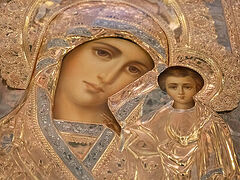
When you behold an icon of the Most Holy Theotokos, turn your heart to her, the Queen of Heaven, and give thanks to her for her ready obedience to the will of God, that she bore, nourished, and raised the Redeemer of the world, and that in our unseen spiritual warfare her intercession on our behalf never fails.
—St. Nicodemus of the Holy Mountain
She was a Virgin not only in body, but also in soul: humble in heart, measured in speech, prudent, sparing in words, a lover of reading… diligent in labor, chaste in speech, regarding not man but God as the judge of her thoughts. Her rule was to offend no one, to wish good to all, to honor her elders, to envy none of her equals, to avoid boasting, to be of sound mind, and to love virtue. Did she ever, even by her expression, offend her parents, or disagree with her kindred, or show pride before the humble, or mock the weak, or turn away from the poor? There was nothing harsh in her gaze, nothing careless in her words, nothing improper in her actions; her bearing was modest, her step quiet, her voice gentle—so that her appearance was a reflection of her soul, the embodiment of purity.
The Virgin-Mother is, as it were, the sole boundary between the created and the uncreated Divine nature. All who behold God come to know her also, as the place the Uncontainable was contained. And all who praise God will praise her after God. She is the cause of the blessings and gifts bestowed upon the human race before her time, the giver of present blessings, and the intercessor of eternal ones. She is the foundation of the prophets, the beginning of the apostles, the support of the martyrs, the firm foundation of the teachers. She is the glory of those on earth, the joy of those in heaven, the adornment of all creation. She is the beginning, the source, and the root of the hope prepared for us in heaven—of which may we all be deemed worthy through her prayers for us.
On the third day after her blessed Dormition, the Mother of God was raised and now lives in heaven in both soul and body. Not only does she dwell in heaven—she reigns in heaven. The Holy Church, when offering petitions to the greatest saints of God, to all the angels and archangels, says to them: “Pray to God for us”; but to the Mother of God alone she says: “Save us.”
From: Readings For Every Day of Great Lent, Ed. N. Shaposhnikova (Moscow: Danilov Monastery, 2025).