In the name of the Father, and of the Son, and of the Holy Spirit!
 Dear brothers and sisters, in today’s Gospel we heard how Christ took His twelve disciples and revealed to them what was to come and what was inevitable. He said He was going to Jerusalem where He would be condemned and killed.
With its hymns, the Holy Church brings us closer to Holy Week, to the remembrance of the Passion and death of the God-Man, inviting us to follow Him to Jerusalem—to suffer with Him in order to be glorified with Him. After all, the path of the Cross of Christ is our path as well.
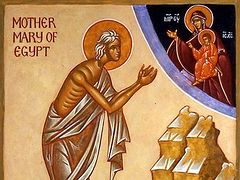
Everyone has their own Golgotha. On this day, the Holy Church commemorates St. Mary of Egypt, and this is because in this period of repentance and fasting, her life and feats can especially serve for the edification and consolation of all of us sinners. In fact, what is especially confusing for anyone who wants to give up a sinful life and start a new, Christian life? First and foremost, we are confused by the severity of our previous sins, then by the habit of sinning, which is so difficult to overcome. But here we see a woman with a corrupted heart, so immersed in sinful pleasures that for their sake she forgot both shame and conscience, trampling on everything sacred and apparently being close to the complete death of the soul. People had turned away from her with contempt.
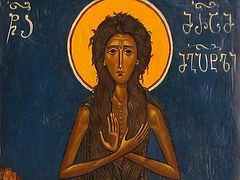
Through inner work on herself, having struggled with her vices and conquered her passions, with God’s gracious help, she became a great ascetic of the grace of God and thenceforth appears as an earthly angel to people. Hundreds of years have since passed, but the great image of the holy hermitess still shines with the light of Christ’s purity and encourages all people who are wallowing in sin but desiring to reform. And in our time, when many people are so frivolous and lenient regarding bodily sins, it is especially useful to remember the Life of St. Mary of Egypt. They will see from it that sin cannot bring true happiness to us, and that for a brief moment of pleasure we pay a high price—mental anguish, humiliation, and disappointment. They will also see how strong is the habit of evil, and how hard it is to uproot impure, sinful thoughts and feelings—often compared to weeds—from the soul, and that therefore they must be on the alert, wary allowing the habit of evil in themselves to strengthen. Lastly, they will see that only goodness harmonizes with human soul, which created in the image of God; that the grace of God enters a human soul that is enlightened and cleansed from sin. And where grace dwells, there is true happiness. Therefore, the Life of St. Mary of Egypt always makes a strong impression on everyone who cares about themselves and their eternal fate.
St. Mary lived in the second half of the fifth and in the early sixth centuries, and was originally from Egypt. She had the misfortune of losing her bodily purity at a very young age, and since her parents forbade her to lead a sinful life, she ran away to the city of Alexandria, notorious for its inhabitants’ sinful lifestyle. Being very beautiful and possessing a passionate temperament, living without any guidance or positive influence, she fell lower and lower until she found herself in the lowest depths of depravity. She indulged in debauchery for seventeen years.
One day, she saw that a multitude of people were going by ship to Palestine for the feast of the Exaltation of the Cross. Since there were many young men among them, she ran aboard, having only one aim: to seduce them and satisfy her passions. And so, with songs, wine, and carnal pleasures, she sailed to the holy city of Jerusalem. But even when she arrived, she did not give up her sinful way of life. Neither the holy city, nor the sight of Golgotha, nor the Holy Sepulcher touched her heart; in the mad intoxication of sin, she blasphemously laughed at everything dear to Christians; she responded with cheeky and defiant laughter to all the denunciations and reproaches of pious people.
But the One Who came down to earth for the purpose of saving us sinners, Who taught us to love each other, Who leaves ninety-nine sheep and goes after one lost sheep until He finds it, did not leave this poor sinner without His help and used for her conversion what, it would seem, could have destroyed her. The time came to venerate the Precious and Life-Giving Cross of Christ. Crowds of people rushed to the church. St. Mary went with everyone else, and together with the others she wanted to enter the church. But an invisible force held her back three times. “What is it, O Lord?” she exclaimed in trembling perplexity, and suddenly her gaze fixed on an icon of the Mother of God, as if she were alive, and saw that Her eyes were turned to her as if with sorrow and reproach. Agonizing shame, the awareness of her sinfulness, and the consciousness that God’s terrible chastisement for her impurity had come, flashed like lightning through her entire spiritual being in an instant. With bitter tears she fell to the ground and cried out to the Theotokos: “Mother of God, I know my sinful impurity, and I know that my place is not in the church, but in hell!” Abundant tears were flowing down her face, sobs were shaking her whole body, she was weeping and praying, and her tears of awakened conscience were sweet. From now on, St. Mary belonged to God.
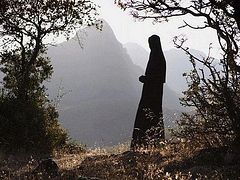
Freely entering the church and venerating the Precious and Life-Giving cross, she once again made a promise to belong to the Lord alone and retreated into the Transjordan desert, abandoning forever not only the world with its human whims, but even the basic needs of life. She spent forty-seven years in the desert—in cold, heat, and hunger—enduring terrible temptations from the Devil, who attacked her and reminded her of her former life of luxury in Egypt. Prayer, the sign of the cross, tears, and great patience saved her.
From her life, each one of us can see that by faith and repentance even the most sinful and dissipated person can, with the help of God, attain great perfection. Why did the event in the church of Jerusalem turn out to be a decisive step towards complete spiritual rebirth for St. Mary of Egypt? Because her conscience started speaking in her with an inexplicable power! And if each one of us had listened to the voice of our conscience more often, we would have seen incomparably stronger cases when the grace of God clearly called on us to reform, but, alas, ignoring them, we took them as “coincidences”. But, dear brothers and sisters, know that whenever and wherever the thought of giving up an empty and dissipated life comes to you, know that this thought comes from God. And if you accept this thought into your heart, the grace of God will come and show you the way to improvement. Not everyone can walk the path of St. Mary of Egypt—this is the path of angels; but let us not follow the opposite path—that of demons, imitating them in their pride and malevolence. There is the “middle way”—that of a humble and repentant sinner who, with God’s help, cleanses his soul from sin; so that having been cleansed from it, he may enter, even as the last one, into the Heavenly Kingdom—which may the Lord grant us through the prayers of St. Mary of Egypt. Amen.