In the name of the Father, and of the Son, and of the Holy Spirit!
Dear brothers and sisters, on this day, the fifth Saturday of Lent, called the “Saturday of the Akathist”, or the “Laudation of the Most Holy Theotokos”, our Holy Church commemorates the miraculous deliverance of Constantinople from a danger that threatened it.
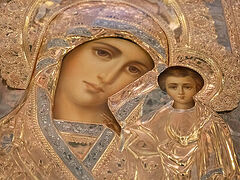
It happened in 626 A.D., during the reign of Emperor Heraclius (610-641), when the Byzantine Empire was going through tough times. Constantinople was surrounded by enemies from all sides. The Sassanid Persians were approaching it from the east, and the Avars from the west. The situation of the Greeks was very difficult. The fall of the capital, the deaths of its defenders and civilians seemed inevitable. Then Patriarch Sergius I of Constantinople (610–638) gave his blessing to hold a cross procession around the besieged city. He himself carried the wonder-working “Hodegetria” Icon of the Mother of God. A great relic, the robe of the Theotokos, which was kept at the Church of Blachernae, was taken as well. And once these relics were carried along the city walls and the robe was immersed in the waters of the Bosphorus, a miracle occurred—joyful for the Greeks and horrible for the assaulting enemies. A terrible gale broke out on the hitherto calm sea, and the enemy ships were sunk. The people spent the whole night at the Church of Blachernae, singing thanksgiving prayers to the Queen of Heaven.
Constantinople was miraculously delivered from its besieging enemies three more times—under the Byzantine Emperors Constantine IV Pogonatos in the seventh century, Leo III the Isaurian in the eighth century, and Michael III in the ninth century. So this feast was established in memory of this mercy of the Most Holy Virgin Mary to Her city and the entire Christendom.
Today all Orthodox churches sing the hymn of praise to the Most Holy Theotokos, called the “Akathist”, which means “not sitting”, because since the day of the salvation of Constantinople up to the present the faithful stand while reading it as a token of gratitude to the Mother of God. In terms of content, the Akathist to the Most Holy Theotokos is a hymn of the Annunciation, a song about the Incarnation of God the Word. When the Akathist began to be sung in memory of the historical events we have mentioned above, a special introduction was added to it, full of praise and supplication, “To Thee, the Champion Leader.” This hymn, as it sounds in the original Greek, says that Constantinople—the city of the Mother of God, which through Her intercessions was freed from misfortunes—dedicates a song of victory to Her and begs Her Who possesses invincible power to deliver it from numerous perils so that the city can glorify Her, exclaiming: “Rejoice, O Bride unwedded.” In the Russian translation, instead of the words “Thy city” it says: “Thy servants.” Just like the Greek people, the Russian people sing of the glory of the Mother of God with tender emotion, reading the Akathist to Her and thanking Her for the many mercies She has shown us.
At the Holy Trinity-St. Sergius Lavra, the Akathist to the Most Holy Theotokos is read not only on the feast of the Laudation of the Mother of God, but also by all the brethren on Fridays throughout the year in memory of Her miraculous appearance.
The Queen of Heaven appeared to our Venerable Father Sergius of Radonezh when he was reading the Akathist in his cell and praying for his disciples. Suddenly a voice was heard: “Behold, the Most Pure One is coming!” The saint hurriedly went out into the inner porch of his cell. A light brighter than the sun started shining around him, and in that light he saw the Most Pure Sovereign Lady, accompanied by the holy Apostles Peter and John the Evangelist. The Most Holy Theotokos said to him: “Do not be afraid, My chosen one! I have come to visit you because I have heard your prayers for your disciples. Be sorrowful no longer about your monastery; from now on it will have everything in abundance—not only in your lifetime, but also after your repose. I will never forsake this place.” And the Most Holy Theotokos became invisible.
Dear brothers and sisters, now that we are joyfully celebrating the feast of the Laudation of the Mother of God, the Lenten season is already coming to an end and the days of Holy Week are approaching. And we are becoming more and more convinced that, whether we want it or not, the Cross of Christ stands in the middle of the universe, from which we can neither hide nor turn away. “Rejoice, O Cross, the shield of the great King, beneath whose shadow every victory is prepared!” St. Sophronius of Jerusalem exclaims. And the Mother of God always stands humbly by the Cross. Therefore, during Lent the Holy Church established the reading of the Akathist to the Queen of Heaven. The Laudation of the Mother of God is, as it were, an addition to the great feast of the Annunciation of the Mother of God, which is celebrated every year on March 25/April 7. “Glorify, Russia, and glorify, every faithful son of the Heavenly Church, your Intercessor the Mother of God for Her never-ending maternal mercy to Russia and to you. Only through Her intercessions is Russia still intact, powerful, and glorious!” says St. John of Kronstadt. Amen.