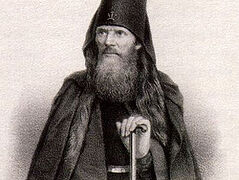
Igumen Cyprian (Parts)
Igumen Cyprian (Parts), the father-confessor of the Moscow Sretensky Monastery, answers some questions about spiritual life.
—Father Cyprian, your blessing. What should we do if in the course of our Christian life we become lukewarm in our prayer and attendance of services, falling into a state of relaxation?
—When the Lord calls us to Himself, He gives us such grace that everything is easy to do: to pray and attend church. But deep in our hearts we attribute it to ourselves. What will develop in us from this? Self-importance and pride. This can destroy us, right? So the Lord conceals our grace: He does not take it away, but hides it so that we may know our weakness. And what is required from us in this state if we remember the visitations of God? To live according to the rules that the Lord has revealed to us. It requires effort: The Kingdom of Heaven suffereth violence, and the violent take it by force (Mt. 11:12), said the Lord.
No spiritual gifts are assimilated by human nature without sorrows. The Holy Fathers taught: “Give blood and receive the Spirit.” How do we want to live? Piously, but calmly, flying on our wings for free, right? Where will we get to on the wings of self-conceit? And what can the Lord do with us then?... The Lord has revealed everything to us in the Gospel. He told us, And he that taketh not his cross, and followeth after Me, is not worthy of Me (Matt. 10:38); and also, Strait is the gate, and narrow is the way, which leadeth unto life, and few there be that find it (Matt. 7:14). The narrow path is that of self–denial and self-reproach, and the broad one is that of self–justification and self-pity. The Lord has not hidden anything from us—everything has been revealed to us. Another matter is that as you sow you shall reap.
Grace cannot be kept on its own—it is impossible. It’s a gift from God. And gifts are not granted for labors, but for humility. If a Christian thinks: “Now I will constantly read the Psalter, sleep four hours a day, eat once a day after sunset, and this will bring me spiritual gifts,” he is mistaken. He’s building this on himself. And at first the enemy may even help him. He will labor and struggle, hoping to receive God’s gifts. But the time will come when he will get tired and will receive no gifts. And his endeavor will be a complete flop. “Why so? I worked hard, but I got nothing!” But what was he doing it for?
—How can we acquire humility?
—Through obedience.
—And who should we obey in the world?
—If you aren’t obedient at work, will they keep you there? Obedience is everywhere. Archimandrite Nathanael (Pospelov; 1920–2002), an elder of the Pskov-Caves Monastery and a famous treasurer, said that “Divine Providence works equally through both spiritual and civil authorities.” Humility is impossible without obedience—obedience to God’s commandments. Humility before whom? Before what? Not before thoughts suggested by the fallen spirits, nor their implementation. There is no humility in this. Before what then? Before Divine Providence for yourself. St. John Climacus said that if we try to describe lowliness of mind in words, we will not succeed.
—What are the ways to acquire humility?
—It is revealed to us in the Gospel. And the Holy Fathers tell us a lot about this. It’s another matter if we read their instructions on how to live according to the Gospel, how to live the Church life, but do nothing. It is as if we had been told that a tree with medicinal fruit grows somewhere, but we ask how we can taste its fruit. We receive the answer, “You have to come to this tree.” But we ask, “How far is it?” The road is conquered by the one who walks, as the saying goes. What does the Lord say about the road? In the Gospel the road is not “what”, but “Who”: I am the way, the truth, and the life (Jn. 14:6). The Lord Himself said that He is the way. This is the way—in following the Lord and bearing your cross.
Some people follow the Lord selflessly and with great determination. A prince’s son entered a monastery when he was not even twenty, and died at twenty-five. I am talking about St. Joasaph of Kubenskoye Lake.1 How did he became a saint so quickly? A prince’s son, who had previously lived a life of ease, in five years not only reached the Heavenly Kingdom, but also became sanctified and is venerated as a saint. It took only five years! What is the reason? He obeyed! “Obedience is life,” said Elder Ambrose of Optina. We are told what to do, but we avoid it. We agree, we talk about it, but we don’t obey.
—What should we do if our desire to receive Communion has become deadened or faded away?
—Imagine that someone suddenly loses any desire to eat food. Is this a normal condition? No—he is ill. The soul of him who no longer wants to take Communion is sick. Note what St. Ephraim the Syrian says: “If you notice that you do not want to read the Holy Scriptures and the Holy Fathers anymore, then your soul has fallen into a serious illness.” He wrote only about reading, but what can we say if someone does not want Communion? Prayer and efforts are needed.

—How can laypeople love God with all their hearts and put Him first in their lives? Perhaps monks have this love a priori?
—This concerns everybody! Do we have one Gospel for the laity and another one for monastics? Does a monk no longer need labors? He has just been tonsured, and he is ready for the Heavenly Kingdom? No—he obeys. It depends on his efforts to obey or not. He has freedom, the same as everyone else.
Can there be love without faithfulness? No. Can there be fidelity without obedience? No. It’s all about whom we obey and whom we put first. Everyone has the same task (whether you are a layman, a monk, a man, or a woman)—to put the Lord first in our minds and hearts. Then it’s life—when all the powers of the soul are directed to the Lord. This is the life of man with God and in God. And this is the task of human beings. Otherwise, why live in a monastery if you’re already ready for the Heavenly Kingdom right after tonsure?
The monastery is a hospital. In his book, An Offering to Contemporary Monasticism, St. Ignatius (Brianchaninov) instructs: “Why did you come to the monastery? To get rid of your bad habits and passions and replace them with virtues.” Here he writes what temptations monks have. In Patericons we see that monks also have freedom to act, how they were overcome by temptations and why. And how, conversely, with God’s help, they overcame these temptations.
As for the real spiritual life, St. Ephraim the Syrian asserts: “He [God] forgives thousands of sins, and heals thousands of our wounds, and, having healed them, He rewards us for our tears. For this is typical of His grace: After healing, He lavishes rewards” (Ascetical Homilies). That is, even if you fall and are injured a thousand times a day on the path of God, nevertheless do not abandon this path.
—How can we live with the unceasing memory of God? Especially in the world, when our minds are constantly distracted by chores and problems?
—There was the following case. A monk who was walking somewhere entered a village and saw a pillar of light above one of the houses. He marveled, “I have never seen that in our monastery! Who lives there?” He knocked on the door, and a woman opened. Seeing a traveler, she gave him something to eat and drink. The monk asked her, “How do you live? How do you pray?” She replied, “How do I live? I get up in the morning, but I only start reading the morning prayers when my cow begins mooing. I have to run to the cow. Besides, I have chickens and a vegetable garden to look after. So I read the morning prayers all day long. And the same with the evening prayers.” The monk said, “No, that’s wrong. You should get up earlier to read your morning prayers in front of the icons calmly. And only then do everything else. The same with the evening rule. Do you get it?” She replied, yes.
After a while, the monk was coming back. He was walking happily: after all, he had instructed an ascetic on how to live properly! He reached the same village only to find that there was no more pillar of light above that house. He knocked, the woman opened, was delighted to see him and started feeding him. He asked her, “Well, how do you live?” She answered, “Oh, I live just as you told me. I read my morning prayers and go to do my housework. And the same with the evening prayers.” Before that, she had lived with the memory of God all day long, walking in the presence of God continually. But it’s hard work.
Schema-Archimandrite John (Maslov; 1932–1991), a Glinsk elder, wrote to St. Andronik (Lukash), an elder of the Glinsk Monastery, in Tbilisi: “It’s hard to walk in the presence of God all the time.” If it was a hard job for such an ascetic, then what can be said about us? Elder John (Krestiankin) advised people to turn to God as often as possible with short prayers. If you love someone, and your loved one is in the same room with you, can you forget about his presence? No. And we have to force ourselves to do it. There is not a single moment when the Lord does not see us. But we forget... Are we going to make efforts or not?
Ideally, our whole lives should be directed towards this—walking in the presence of God. We must necessarily force ourselves to fulfill the Gospel commandments in relation to our neighbor. First of all, a personal turning to God is needed. If we only try to “read through” our prayer rule in the morning and in the evening, we won’t succeed. Because if we were only preoccupied with worldly cares during the day, then our minds, accustomed to this, will run away to these things during prayer. In other words, we won’t be able to pray in the morning and evening either. We will be standing with a prayer book, but what are our minds used to?
—Does the mind of someone standing in church during the Divine Liturgy wander for the same reason?
—That’s what I’m speaking about. What is the mind used to? Only angels can pray without ever being distracted. Fr. John (Krestiankin) said that the “wandering” mind is a common illness. What is needed? If your mind is gone, bring it back. This is the labor of personal turning to God, standing before Him.

—How can we learn to trust God as a loving Father and believe in His good Providence? People may not have enough faith in it.
—“Faith is humility,” said St. Barsanuphius the Great. He said it bluntly. It’s not just for monastics—it’s for everyone. I was brought low, and He helped me (Ps. 114:6). That’s the point: the whole struggle is for humility. Humility before whom? Before the Lord and Savior. Love is impossible without humility. Look at what the Lord tells us in the Gospel: Take My yoke upon you, and learn of Me; for I am meek and lowly in heart: and ye shall find rest unto your souls (Mt. 11:29). The Lord did not say this only to monks or priests. No, He said it to everyone. Moreover, He said: Learn of Me—literally “from My dwelling in you.”
St. John Climacus writes about this very thing. Of course, The Ladder was written for monastics, but the spiritual laws the soul lives and can only live by are the same for everyone. I’m not talking about external circumstances, but the life of the soul is the same for everyone, just as for everyone the healthy body temperature is 36.6 degrees c. (regardless of your age or profession). It’s the same here—all these spiritual laws are for everyone. They go together—meekness and humility.
—But these are different things, aren’t they?
—If it were one thing, would the Lord have said it in two words? A coin has two sides; which one is more valuable? But He says, “Meekness and humility.” The fact is that there is such a spiritual law: he who drinks the milk of obedience eventually turns from being obstinate into meek. But the Lord guides the meek in judgment—that is, to judging about how to act. The Psalter says, The meek will He guide in judgment: and the meek will He teach His way (Ps. 24:9). They go together, they are inseparable. You can’t separate one from the other. But it is no coincidence that the Lord first mentioned meekness in the Gospel. The Lord Himself told us so. St. John Climacus gives this recipe: “The beginning of meekness is stillness of the mouth when the heart is troubled.” Meekness is directed against anger. And anger is temporary madness. How can anything creative, good be done with a crazy mind?
—Is meekness acquired as well?
—How else? Learn of Me. Imagine that someone has never baked bread. If you tell him the whole theory and give him all the necessary ingredients, will he bake wonderful bread at once? You’ve already told him everything and given him everything—what’s missing? Experience. St. Peter Damascene said: “Humility is the offspring of reason, and reason is the offspring of temptations and sorrows.” That is, without experiencing temptations you will not acquire an active, good mind—it’s impossible. Only through temptations. Inexperienced means unskilled. And patience, experience; and experience, hope (Rom. 5:4). The Apostle Paul tells us about this. When we suffer a temptation, what do we gain from it? Experience, and from it—hope.
—How can we acquire peace of mind?
—Take My yoke upon you, and learn of Me; for I am meek and lowly in heart: and ye shall find rest unto your souls (Mt. 11:29). Here we are talking about the indwelling of God in man. How can we learn from the Lord if we don’t see Him with our physical eyes? St. John Climacus speaks of God’s visitation. Where? In the heart. Purify your heart—and then you will understand. That is, we learn from God’s indwelling. When the Lord renews the feelings of our hearts with His grace, we learn that this is life.

St. John Climacus explained this very well: “The Lord said, Learn of Me; that is, not from an angel, not from a man, not from a book, but of Me—from the illumination and work of God dwelling within” (The Ladder, chapter 25). Do you see what he says about how you can learn? What is the fear of God? St. Ignatius (Brianchaninov) writes that this is work of the Spirit of God in the human soul. That is, we know and learn from this. If we obey the Lord, then we will remain in this state of life. When do we have life? When the Lord goes first. Not in words, but in reality. Then it’s life.
—Do we need watchfulness to keep peace of mind?
—This is vital. Watch and pray, that ye enter not into temptation (Mt. 26:41). The Lord revealed all these spiritual laws to us in the Gospel. Archimandrite Kirill (Pavlov) insisted, advised, and convinced believers to read the Gospel as much as possible. He said it would strengthen your will to do good.
—The spiritual laws written in the Gospel are for all. But is it true that more will be required of monastics?
—The Lord tells us, For unto whomsoever much is given, of him shall be much required (Lk. 12:48). Right? But why should we look at each other? Let everyone remain where his vocation is. But the ideal is the same for both laypeople and monastics—it is our Lord Jesus Christ Himself. Hieromartyr Hilarion (Troitsky) had a letter on this subject. I saw Schema-Hierodeacon Andronik (Sharuda; 1933–2010) at the Pskov-Caves Monastery and Granny Shura near Shatsk. They were like one person. The former had the schema, and the latter was a soldier’s widow. From which of them will more be required?
What will I be held accountable for? That’s what’s important. And I will be asked for what the Lord has entrusted to me and what He has revealed to me. Why should I look at others? Remember what the Lord said to the Apostle Peter in response to his question: Lord, and what shall this man do? Jesus saith unto him, If I will that he tarry till I come, what is that to thee? follow thou Me (Jn. 21:21–22). The Lord said this to everyone, not just to the Apostle Peter. When we start paying attention to others: “What will they do?”—wait, the Lord has already given us the answer on how to behave here. What is that to thee? follow thou Me. It is addressed to everyone without exception. And the words of the Mother of God, which she spoke in Cana of Galilee: Whatsoever He saith unto you, do it (Jn. 2:5), are also addressed to each one of us. When people came to Archimandrite Pavel (Gruzdev; 1911–1996), he was sincerely surprised. “Why are you coming to me? It’s all written in the Gospel. Do it.”
—Thank you, Father Cyprian!