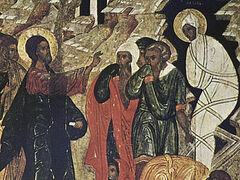
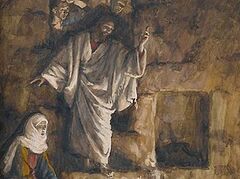
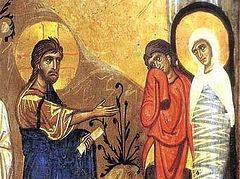
Every year Lent is like the pace of a metronome, measuring the passage of time given by the Lord to my soul in this world. And every Forgiveness Sunday I stand at the “forty steps”, intending and hoping to “ascend” them worthily and smoothly. But I stumble, fall off and fly down, then I reproach myself, despair, grasp at straws and somehow drag my little cross to the “peak of peaks”—Pascha.
 Shrine with the relics of St. Lazarus, the Four Days Dead. Larnaca, Cyprus
By Divine Providence, last year during the penitential season of Lent I had to leave my quiet village in the Tver region and fly to Cyprus to see my family. Alas, my weak will quickly succumbed to the temptations of hospitality. But the main treasure of Cyprus is not the coolness of the mountains, the marvelous Mediterranean cuisine, or even the azure sea, but the grace that covers this small island thanks to the relics resting on it. And also its people.
I was in Larnaca, ancient Kition. A small square, from which narrow streets radiate in different directions. Bright sun, numerous cozy taverns, and cooing pigeons. And in the center towers a magnificent Byzantine church built over the tomb of Righteous Lazarus, the friend of Christ. Once I excitedly crossed its threshold the world fell silent, and time stood still. I venerated his relics, and it was hard for my mind to contain this seemingly simple action.
A friend of Christ... A friend is such an understandable human measure. AND—God. The feeling of His physical presence stunned me for a while, and I couldn’t take my eyes off the image of the Most Holy Theotokos. Only these words whispered themselves in me: Lord, I believe; help Thou mine unbelief (Mk. 9:24).
The streets of Larnaca sparkled with new colors. A weight was removed from my heart, giving way to quiet and radiant joy. Can the sun become brighter and the sky bluer than blue?... God, how good it is to be in Your house!
I bought some holy oil and small icons of Righteous Lazarus for my friends and the parishioners of our monastery who are close to me; and, remembering the requirements of the air carriers, I only bought a hundred-gram plastic bottle into which I collected holy water from a spring in St. Lazarus’ tomb (crypt).
I arrived at the airport. I was going home, and with a light heart I gave my backpack for luggage inspection. Suddenly, I was called out and asked to open it. A pretty customs officer, addressing me sternly in Greek, took out my bottle of holy water and threw it quickly into a garbage can... To all my attempts to explain I received harsh formal refusals. To take a step forward, walk away and leave the precious water in the garbage can was impossible; and it would have been so unforgivable of me that, out of desperation, I suddenly burst into bitter and hopeless tears, covering my face with my hands. And, again, the whole world vanished and time stood still.
But someone touched my shoulder. A tall, handsome man in a uniform asked his colleague in Greek what was the matter, but I could only utter, “Lazarus, Lazarus...” He bent over the garbage can, took out the bottle and put it into my hands. And my tears could not stop—now not from loss, but from gain. For me St. Lazarus was raised from the dead once more... The tears of Sts. Martha and Mary washed my withered heart, and the miracle occurred again. After putting all my things back into the backpack, I went up to my savior and said a simple “Thank you” in Russian. And I suddenly heard a Russian response, albeit with a Greek accent: “May God save you!” We looked into each other’s sparkling eyes, understanding everything without words, smiled and briefly hugged. And, wiping away the last tears, I ran to board the plane, taking in my heart the meeting with St. Lazarus, the friend of Christ, the love of my family, the look of a smiling handsome man in uniform, and a small bottle in his hands that contained much more than I had collected.
Thank you.