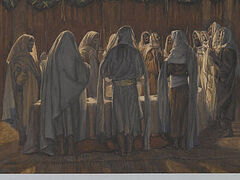
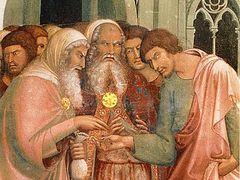
Now when Jesus was in Bethany, in the house of Simon the leper, there came unto him a woman having an alabaster box of very precious ointment, and poured it on his head, as he sat at meat. But when his disciples saw it, they had indignation, saying, To what purpose is this waste? For this ointment might have been sold for much, and given to the poor. When Jesus understood it, he said unto them, Why trouble ye the woman? for she hath wrought a good work upon me. For ye have the poor always with you; but me ye have not always. For in that she hath poured this ointment on my body, she did it for my burial. Verily I say unto you, Wheresoever this gospel shall be preached in the whole world, there shall also this, that this woman hath done, be told for a memorial of her. Then one of the twelve, called Judas Iscariot, went unto the chief priests, And said unto them, What will ye give me, and I will deliver him unto you? And they covenanted with him for thirty pieces of silver. And from that time he sought opportunity to betray him. (Mt. 26:6–16).

I beseech you to exert all your strength to eradicate the disease of avarice.
The Lord spent Wednesday night in Bethany. Here, in the house of Simon the leper, at the very time when the council of the chief priests, scribes, and elders had already resolved to take Jesus Christ by cunning and kill Him, a certain sinful woman poured precious ointment on the head of the Savior and thereby prepared Him for burial, as He Himself judged her deed. Here also, in contrast to the selfless act of the sinful woman, there arose in the ungrateful soul of Judas, one of the twelve disciples of the Savior, the criminal intention to betray his Teacher and Lord to the lawless council. Therefore in the divine service of Great Wednesday the Church glorifies the sinful woman and condemns and curses the love of money and the betrayal of Judas.
On the day of the betrayal of the Lord to suffering and death for our sins, when He forgave the sins of the sinful woman, after the Hours the Church concludes the services according to ancient custom with the reading of the prayer “O Master greatly merciful, Lord Jesus Christ our God…” Throughout Great Lent, this is read at the service of Compline, as the faithful bow their heads and knees. It intercedes before God for the granting to us of the remission of our transgressions. On Great Wednesday the Liturgy of the Presanctified Gifts is also celebrated for the last time, at which the Church proclaims the woman who anointed the Lord with ointment and the betrayal of Judas (Mt. 26:6–16). On Great Wednesday, the great prostrations made during the prayer of St. Ephraim the Syrian—“O Lord and Master of my life”—also cease. After Wednesday it is appointed to perform this prayer until Great Friday only by monks in their cells. Thus the prayer of Ephraim the Syrian begins on Cheese-fare Wednesday and ends on Passion Wednesday.
—Archpriest Gregory Debolsky, Days of Divine Service of the Orthodox Church
Hymns from the service of Great Wednesday
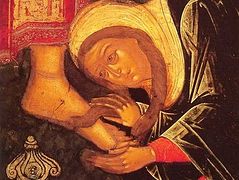
The woman had fallen into many sins, O Lord, yet when she perceived Thy divinity, she joined the ranks of the Myrrhbearing Women. In tears she brought Thee myrrh before Thy burial. She cried, “Woe is me! For I live in the night of licentiousness, shrouded in the dark and moonless love of sin. But accept the fountain of my tears, O Thou Who didst gather the waters of the sea into clouds. Bow down Thine ear to the sighing of my heart, O Thou Who didst bow the heavens in Thine ineffable condescension. Once Eve heard Thy footsteps in Paradise in the cool of the day, and in fear she ran and hid herself. But now I will tenderly embrace those pure feet, and wipe them with the hair of my head. Who can measure the multitude of my sins, or the depth of Thy judgments, O Savior of my soul? Despise not Thy servant in Thy immeasurable mercy.
—Sticheron at “Lord, I have cried”, the hymn of Nun Kassiani. Tone 8
Explanation of the Gospel of Matthew
At a time when all the other women came only to receive bodily healing, she (the sinful woman) came solely to render honor to Jesus and to receive healing of soul. She had no bodily infirmity, and therefore everyone should especially marvel at her. And she approaches Jesus not as to a mere man—otherwise she would not have wiped His feet with her hair—but as to One Who is above man. Therefore she also brought to the feet of Christ her head, the most precious part of the body…
They (the disciples) had heard Jesus say, “I desire mercy, and not sacrifice,” and had rebuked the Jews for leaving the weightier matters—judgment, mercy, and faith; He had spoken with them on the mountain about almsgiving—and from all this they drew conclusions and reasoned among themselves: If He does not permit burnt offerings and the ancient worship, then He will even less permit anointing with oil. But so the disciples thought; Jesus, however, seeing the thoughts of the woman, allowed her to draw near. And because her reverence was great and her zeal inexpressible, He, by His utter condescension, permitted her to pour ointment on His head. If He did not refuse to become man, to be carried in the womb, to be nourished with milk, then why be surprised if He did not reject this either? As His Father accepted incense and smoke, so He accepted the sinful woman, approving, as I said earlier, of her disposition…
The exploits of countless kings and generals are passed over in silence, though their monuments still stand. Unknown even by rumor or name are those who built cities, who erected walls, who won victories in wars, who raised trophies, who subjugated many nations, although they set up statues and issued laws—but all the world sings of that sinful who woman poured ointment in the house of a certain leper in the presence of twelve men. So much time has passed, yet the memory of this event has not been obliterated; Persians, Indians, Scythians, Thracians, Sarmatians, the tribe of the Moors, and the inhabitants of the British Isles tell of what the sinful woman did in Judea, secretly, in a house. Great is the Lord’s love for mankind! He receives the harlot, the harlot who kisses His feet, pours ointment on them, and wipes them with her hair, and He reproaches those who accuse her…
Judas was not moved by this and did not fear when he heard that the Gospel would be preached everywhere (and what was said contained inexpressible power); while women—even harlots—showed such honor to Jesus, he was committing a diabolical deed… Behold what a great evil avarice is! It was this that made Judas both a defiler of Holiness and a traitor. Hear, all you who suffer from the disease of Judas—hear and beware of this passion. If he who was with Christ, worked miracles, and received such teaching fell into such an abyss because he was not free of this disease, then how much more easily can you, who have not even heard the Scriptures and are constantly attached to the present, be caught by this passion if you do not apply constant care. Judas was daily with Him Who had nowhere to lay His head; daily he was taught by deeds and words not to have gold, silver, or two coats—and still he did not come to his senses. How then do you hope to escape this disease when you do not use powerful medicine and do not apply powerful effort? Terrible, truly terrible is this beast. Yet if you wish, you can easily conquer it. It is not a natural lust, as those who have been freed from it prove. Natural inclinations are common to all; but this lust arises from negligence alone. From negligence it is born, from negligence it grows, and when it seizes those attached to it, it forces them to live contrary to nature. For when they do not recognize their own kinsmen, friends, brothers, relatives—in a word, everyone—and along with them do not know themselves, is that not living contrary to nature? From this it is clear that both malice and the disease of avarice are contrary to nature. Having fallen into it, Judas became a traitor. How then did he become a traitor, you ask, when he was called by Christ? God, calling people to Himself, does not impose necessity or do violence to the will of those who do not wish to choose virtue; He exhorts, gives counsel—He does everything and tries in every way to urge them to become good. But if some resist this, He does not compel them. If you want to know why Judas became what he became, you will find that he perished from avarice. Why then, you ask, was he caught by this passion? Because he was careless. From carelessness come such changes, whereas from zeal come the opposite changes… I have said all this in order to show that if we are watchful, no one can harm us, and that harm comes to us not from poverty but from ourselves. Therefore I beseech you with all your strength to eradicate the disease of avarice, so that we may become rich here, and also enjoy eternal blessings, of which may we all be counted worthy by the grace and love for mankind of our Lord Jesus Christ, to Whom be glory unto the ages of ages. Amen.
From: Readings For Every Day of Great Lent, Ed. N. Shaposhnikova (Moscow: Danilov Monastery, 2025).