And there were also two other, malefactors, led with him to be put to death. And when they were come to the place, which is called Calvary, there they crucified him, and the malefactors, one on the right hand, and the other on the left. Then said Jesus, Father, forgive them; for they know not what they do. And they parted his raiment, and cast lots. And the people stood beholding. And the rulers also with them derided him, saying, He saved others; let him save himself, if he be Christ, the chosen of God. And the soldiers also mocked him, coming to him, and offering him vinegar, And saying, If thou be the king of the Jews, save thyself. And a superscription also was written over him in letters of Greek, and Latin, and Hebrew, This Is The King Of The Jews. And one of the malefactors which were hanged railed on him, saying, If thou be Christ, save thyself and us. But the other answering rebuked him, saying, Dost not thou fear God, seeing thou art in the same condemnation? And we indeed justly; for we receive the due reward of our deeds: but this man hath done nothing amiss. And he said unto Jesus, Lord, remember me when thou comest into thy kingdom. And Jesus said unto him, Verily I say unto thee, Today shalt thou be with me in paradise. And it was about the sixth hour, and there was a darkness over all the earth until the ninth hour. And the sun was darkened, and the veil of the temple was rent in the midst. And when Jesus had cried with a loud voice, he said, Father, into thy hands I commend my spirit: and having said thus, he gave up the ghost. Now when the centurion saw what was done, he glorified God, saying, Certainly this was a righteous man. And all the people that came together to that sight, beholding the things which were done, smote their breasts, and returned. And all his acquaintance, and the women that followed him from Galilee, stood afar off, beholding these things (Lk. 23:32–49).

On Great Friday were accomplished, and the Church commemorates, the holy, saving, and terrible sufferings and death of the Lord Jesus Christ, Who voluntarily endured all this for our sake. Celebrating on Great Friday the “Order of the Holy and Saving Passion of our Lord Jesus Christ,” the Orthodox Church marks on this great day in the divine services every moment of the sacred events of the salvation of the world: in the Matins service, the time the Savior was taken in the Garden of Gethsemane, and the high priests and elders condemned Him to sufferings and death (Matt. 27:1); in the service of the First Hour, the time the Savior was led to judgment before Pilate (Matt. 27:2); in the Third Hour, the time of the Lord’s judgment at the trial before Pilate; in the Sixth Hour, the time of Christ’s crucifixion and sufferings; in the Ninth Hour, the time of His death; and in Vespers, the taking down of the Body of Christ from the Cross.
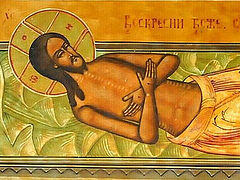
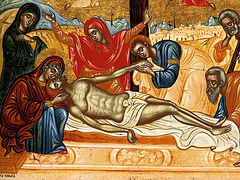
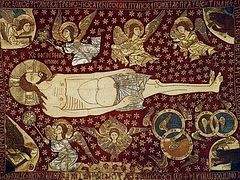
On Great Friday there is no Liturgy, because on this day the Lord Himself offered Himself as a sacrifice; but the Royal Hours are celebrated. Vespers is served at the third hour of the day, at the hour of the death of Jesus Christ on the Cross, in remembrance of the taking down of the Body of Christ from the Cross and His burial. At Vespers the clergy lift up the Shroud (that is, the image of Christ lying in the tomb) from the altar, as it were from Golgotha, and carry it out of the sanctuary to the middle of the temple. The Shroud is laid upon a specially prepared table representing the tomb. Then the clergy and all the faithful venerate the Shroud and kiss the wounds of the Lord depicted on it—His pierced side, hands, and feet. The Shroud remains in the center of the church for three (incomplete) days, thereby reminding us of the three-day sojourn of Jesus Christ in the tomb.
At the morning service on Great Friday the Church solemnly proclaims the glad tidings of the sufferings and death of the God-Man, divided into twelve Gospel readings called the Passion Gospels. The reading of the twelve Passion Gospels on Great Friday originated from apostolic tradition. St. John Chrysostom mentions the reading of the twelve Passion Gospels on Great Friday. He says: “The Jews attack Jesus Christ with fury and torment Him themselves; they bind Him, lead Him away, become guilty of the insults inflicted by the soldiers, nail Him to the Cross, reproach Him, and mock Him. Pilate here adds nothing of his own; they themselves do everything. And this is read to us when we are all gathered together, so that the pagans may not say to us: You show the people only the brilliant and glorious things, for example, signs and miracles, but you hide the shameful things. The grace of the Holy Spirit so arranged that all this is read on this great public feast—namely, on Great Thursday of Pascha (that is, on Friday of Passion Week), when men and women stand in great multitudes, when the whole universe assembles, then this is proclaimed with a loud voice; and with this public reading and preaching we believe that Christ is God.” “Now all of us,” said St. John of Damascus on Great Friday, “have gathered to hear about the Cross. We fill the church, press upon one another, sweat, and exhaust ourselves.”
The readings of the Passion Gospels are preceded and accompanied by the singing: “Glory to Thy long-suffering, O Lord”. Indeed, His long-suffering was extraordinary, His sufferings terrible. According to the words of the Church and St. John Chrysostom, during the terrible and saving sufferings of the Lord every member of His holy flesh “endured dishonor for our sake: the head from the crown of thorns and the reed; the face from blows and spittings; the cheeks from buffetings; the mouth from the offering of vinegar mixed with gall; the ears from the blasphemies of the ungodly; the shoulders from scourging; the right hand from the reed which they gave Him to hold instead of a sceptre; the hands and feet from the nails; the ribs from the spear; the whole body from being stripped, scourged, clothed in a purple robe, the mock worship, and crucifixion on the Cross.”
Each reading of the Gospel is announced with bell-ringing, and at each reading the faithful light their candles—this symbolically points to the triumph and glory that accompanied the Son of God even in the time of His extreme humiliation, amidst mockery and sufferings, and testifying to His supreme holiness and Divinity. The Lord, going to His voluntary sufferings and death, Himself foretold: Now is the Son of Man glorified, and God is glorified in Him. If God is glorified in Him, God will also glorify Him in Himself, and will glorify Him at once (Jn. 13:31–32), that is, “together with the Cross,” says John Chrysostom. The Lord’s sufferings for our sins were as heavy for Him as they were glorious. The enemies come to take Him to sufferings and death; they fall down before His divine omnipotence, and are healed from their wounds. They rage against the Savior, but His innocence and supreme holiness triumph over their blind malice. Those who either out of fear or greed denied the Lord, confess their sin against Him either with tears of repentance or with the death of despair. The Apostle Peter washes away his denial of Christ with bitter tears of sincere repentance. Judas the traitor, seeing that the Lord is condemned to death, falls into despair and returns the thirty pieces of silver to the chief priests, saying: I have sinned in that I have betrayed the innocent blood (Matt. 27:4). Instead of comforting the man who served them, the chief priests only increase his despair and show their weakness and indecision before the Truth, saying to Judas: What is that to us? see thou to that. “Are these not the words of men who themselves witness their own villainy and madness, covering themselves with the senseless mask of feigned ignorance?” The despairing Judas throws the silver pieces down in the temple and hangs himself. And because they are the price of blood, at the counsel of the chief priests the silver pieces are not put into the temple treasury. “Do you understand,” says St. John Chrysostom, “how their own conscience condemns them? They themselves see that they have bought murder, and therefore they do not put it in the corban.”
The God-Man is on the Cross. One of the criminals crucified with Him rebukes the other for his blasphemous words, and confesses Jesus Christ as Lord, confesses His innocence and Divinity. Finally, for the glory of the Crucified, terrible signs follow one after another, proclaiming the redemptive sufferings and death of the Holy of Holies and instructing the crucifiers (1 Cor. 2:8). In the Jerusalem temple the veil is rent in twain, showing that with the death of the universal Sacrifice on the Cross, the end of the old tabernacle has come, and the way into the Holy of Holies has been opened to all (Heb. 9:8).
—Archpriest Gregory Debolsky, Days of Divine Service of the Orthodox Church
Hymns from the services for Great Friday
Today He who hung the earth upon the waters is hung upon a tree, He who is the King of the Angels is arrayed in a crown of thorns. He who wraps the heaven in clouds is wrapped in the purple of mockery. He who freed Adam in the Jordan is struck on the face. He who is the Bridegroom of the Church is transfixed with nails. The Son of the Virgin is pierced by a lance. We worship Thy Sufferings, O Christ. We worship Thy Sufferings, O Christ. We worship Thy Sufferings, O Christ. Show us also Thy glorious Resurrection.
Antiphon 15, tone 6
From: Readings For Every Day of Great Lent, Ed. N. Shaposhnikova (Moscow: Danilov Monastery, 2025).