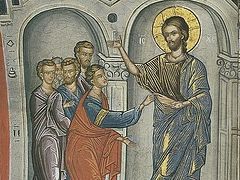
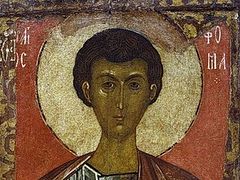
Dionysius. The Assurance of Thomas. C. 1500 On the first Sunday after Pascha the Orthodox Church celebrates Antipascha, which is also called St. Thomas Sunday. It does not mean “opposed to” or “in contrast to” Pascha, as the name might suggest, but rather its continuation and affirmation. The very word “Antipascha” (Greek: Ἀντιπάσχα) means “instead of Pascha”, or “in place of Pascha”—that is, the continuation of the celebration of the Resurrection of Christ. On this day, the Church remembers the Apostle Thomas, his doubts and confession of faith in the Risen Savior.
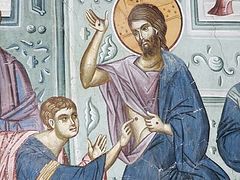
First and foremost, let’s turn to the Scriptures. The Gospel of John (20:24–29) tells us that when the Risen Christ appeared to the disciples, St. Thomas was not present. When Thomas heard from the other apostles that they had seen the Lord, he replied: Except I shall see in His hands the print of the nails, and put my finger into the print of the nails, and thrust my hand into His side, I will not believe (Jn. 20:25). After these words, Thomas was nicknamed “Doubting” (in Russian, literally: “Unbelieving”). But eight days later, Christ came to the disciples again and, addressing St. Thomas, said: Reach hither thy finger, and behold My hands; and reach hither thy hand, and thrust it into My side: and be not faithless, but believing (Jn. 20: 27). And then Thomas realized Who was standing in front of him, and exclaimed, My Lord and my God (Jn. 20:28).
Many people mistakenly believe that faith is the absence of doubt. In reality, faith is the ability to move forward despite doubts. The Apostle Thomas did not reject faith; he just required personal confirmation to strengthen it—he needed a personal meeting with Christ. His doubts did not make him weak; on the contrary, they helped him come to a deeper understanding. And Christ did not condemn St. Thomas for this—He gave him what he needed. Similarly, everybody should experience this very personal meeting with Christ in their lives. After all, the Lord does not avoid our questions: He waits for us, like Thomas, to reach out and touch Him, even if not physically, but with our hearts.
Christ said to St. Thomas, Because thou hast seen Me, thou hast believed: blessed are they that have not seen, and yet have believed (Jn. 20:29). These words are about all of us. We have not seen Christ in the flesh, but we believe according to the testimony of the apostles, according to the experience of the Church, and according to the call of our own souls. And this faith is a special gift to us.
The story of St. Thomas is not just a narrative about one of the apostles—it is a mirror of the human soul. This is a story about each one of us. Like St. Thomas, today many people are looking for evidence of God’s existence. Think about how many times we have said: “If there is a God, why is there so much suffering in the world?”, “If God loves me, why don’t I feel His help?”, “I will believe if I see a miracle...”
It is in the nature of the human mind to look for evidence and confirmation. We want to see, hear and touch in order to believe. It’s natural to doubt, to seek explanations, and not to take everything on trust without questions. In this sense, the Apostle Thomas is not an exception, but a reflection of our inner nature. When we are faced with important issues of life, spirituality, and meaning, we often have doubts. This may be owing to our personal experiences, frustrations, fears, or just our desire to understand more thoroughly. Doubts help us not to accept everything superficially, but to seek the truth.
However, faith is not blind acceptance, but a long, sometimes thorny path. Faith is a constant painstaking work on yourself. Sometimes doubts arise because of fear: the fear of being mistaken, deceived, or disappointed. We are afraid of opening up to something new and losing control. Not having seen Christ right away, the Apostle Thomas feared taking the other apostles’ testimony on faith, because faith requires trust and inner readiness. This fear is a natural defense mechanism, but it should not become an obstacle. Acknowledging your doubts and fears is the first step to overcoming them. Doubts on this matter are a test, a test of ourselves, which can lead to deeper faith if we are able to see, feel, and open the door to the Risen Christ in time. Antipascha reminds us that faith is not fear, but the joy of knowing God.

St. Thomas did not remain an “unbeliever”—his doubts led him to profound faith. Likewise, when faced with questions and difficulties, we can come to a point when we turn to Christ and say, like Thomas: My Lord and my God! (Jn. 20:28).
So, St. Thomas Sunday is our feast, too. This feast is specifically for those who search, doubt, and yet desire to believe.